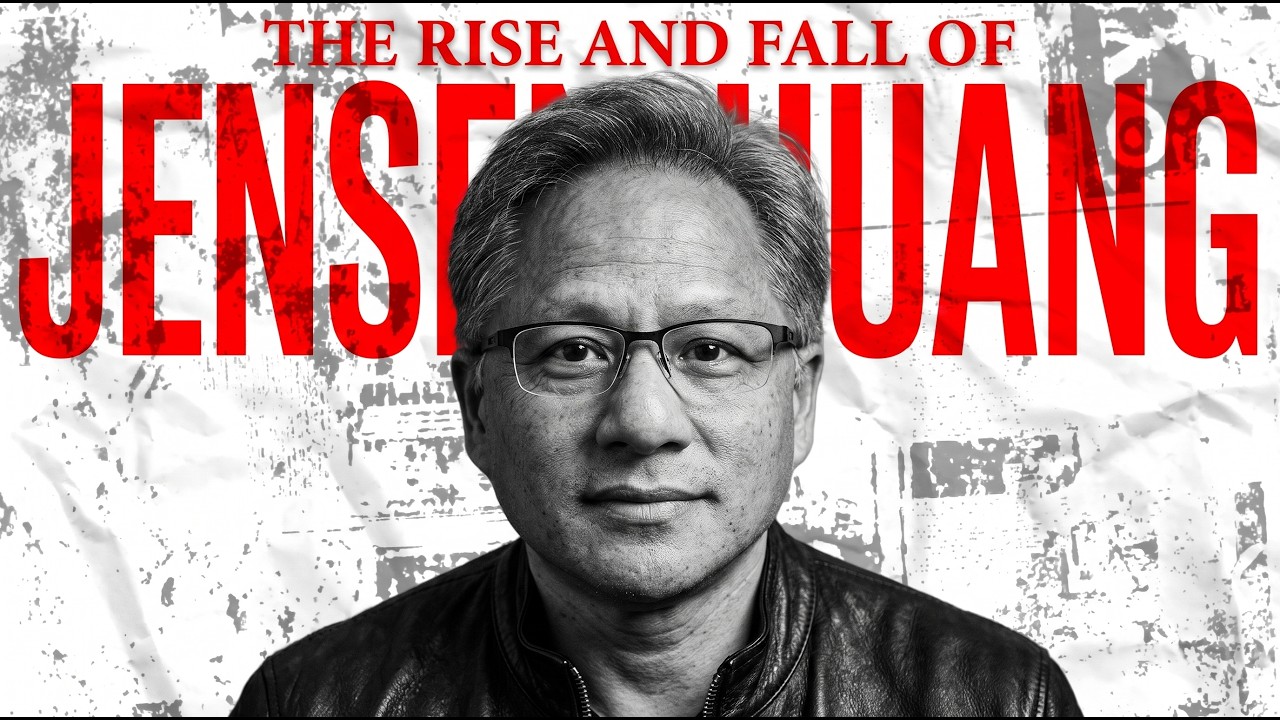
The Rise and Fall of Jensen Huang
Keywords
Summary
298 words
Critical Evaluation
Value of the Information & Strength of the Argument
The video’s informational value is real but sharply divided. The biographical and corporate-history segments carry genuine density: specific dates, funding amounts, product names, the technical reason the first chip failed, the price of the GeForce 8800 GTX, the identity of the three AlexNet authors, the mechanics of the software moat. The passage explaining why CUDA mattered more than the hardware — that every major deep-learning toolkit was written to run on Nvidia’s platform first, creating switching costs that compound — is the strongest analytical moment in the video and is essentially correct. The argumentative architecture is also deliberate: five ‘cracks’, each traced back to a single root cause, with the closing line that a fortress built against every external rival can still be left open from the inside. That is a coherent thesis, and the contrast between external threats (failed chip, collapsed console deal, six-year software bet, export controls) and the internal one is well constructed. The weakness lies in the substitution of narrative momentum for evidential weight. The entire second half rests on claims that are attributed to ‘reporting’ without a single article title, date, author or link, and rendered in vivid sensory prose — a humid warehouse of boxed chips, a hearing room being prepared, a CEO who ’looks broken and shattered’. That prose style manufactures the feeling of verified reporting while supplying none of its apparatus. Several quantitative assertions are also internally shaky: the claim that Huang’s 3.6% stake is worth ‘roughly $150bn’ implies a ~$4.2tn valuation at a moment the video elsewhere places at $5tn, and the $1.7tn of value destruction cited for early October to 10 November is asserted without reconciliation against the $5tn peak described earlier. The video does, to its credit, include an explicit precision paragraph near the end separating what is admitted (infidelity), what is reported but unproven (the intelligence assessment), what is denied (Beijing’s response) and what is unconfirmed (the second relationship). That paragraph is the most intellectually honest element in the script, but it arrives after roughly twenty-five minutes of unhedged narration and functions as a disclaimer rather than a corrective. The result is an argument that is structurally elegant and evidentially thin exactly where it matters most.
Scientific Rigor, Source Quality, Title Accuracy
The video cites no primary documents, no filings, no court records, no named interviewees. Its sources are invoked by institution — the New York Times, the Wall Street Journal, Bloomberg Intelligence, The Information, Forbes, a prediction market — which conveys the impression of a well-sourced investigation without allowing any claim to be checked. The historical section is the exception: the Denny’s booth plaque, the Computer History Museum’s preservation of the AlexNet code, the 2024 Nobel Prize in physics, the IEEE Medal of Honor and the National Medal of Science, the Philadelphia Semiconductor Index comparison — these are the kinds of specifics that can be independently confirmed and largely hold up. The speculative section is built on the opposite pattern: unnamed ‘officials’, a ‘secret government memo reportedly drafted’, a briefing that ‘reportedly’ happened, an estimate from an analyst identified only by surname, a probability quoted from a betting market at a precise moment (‘from about 30% to as high as 77% in 3 minutes’). Where numbers are given in the historical half they are checkable; where they are given in the speculative half they serve atmosphere rather than verification. On title-versus-content fit: the title announces a fall, and the video does narrate one, but it narrates a future one that has not occurred, so the title’s implicit claim of documented events is not met. No advertising break is present; there is a brief channel-promotion insert of roughly fifteen seconds, which does not affect the assessment.
627 words
Title / Content Match
The title matches the promise of a rise-and-fall arc, and the rise is genuinely covered; but the 'fall' is a speculative, future-dated scenario narrated as documented reporting, so the title overpromises what the video can actually establish.
Quality & Reliability
2/10
The historical half of the video (the Denny's origin story, the 1993 founding with Malachowski and Priem, the near-fatal NV1 bet and Sega buyout, the GeForce 256, the 2006 CUDA launch, AlexNet trained on two GTX 580s in 2012, the market-capitalisation milestones up to the October 2025 $5tn mark) is accurate and well documented. The second half, however, is a dramatised scenario set in November 2026 that is narrated in the grammar of established fact: a resignation, an admission of infidelity, a foreign-intelligence relationship, a second internal relationship, a board removing its CEO. These are attributed to vague 'reporting' from named outlets without dates, links or article titles, and the video only concedes, at the very end, that the espionage claims are 'publicly unproven'. The gap between the certainty of the delivery and the unverifiability of the content is the central reliability problem.
Key Moments
Markers derived by PSI from the transcript: the creator did not define chapters.
- Cold open: a November 2026 email in which Jensen Huang admits infidelity to his employees, framing the four-day collapse to come.
- The Kentucky childhood — the Onida Baptist Institute, described as a reformatory where the nine-year-old cleaned the bathrooms daily.
- Oregon, the Denny's jobs from dishwasher to waiter, the electrical engineering degree and the Stanford master's.
- 1993: the Denny's booth meeting with Malachowski and Priem, $40,000 of starting capital, and the near-fatal first chip saved by the Sega buyout.
- The GeForce 256 and the 'world's first GPU' claim — the template of betting the company and refusing to blink.
- CUDA in 2006, the GeForce 8800 GTX at $599, and AlexNet in 2012 on two GTX 580 cards as the hinge of the modern AI era.
- The valuation ladder from roughly $400bn to $5tn on 29 October 2025, revenue growth to $215.9bn, and 97% server-GPU share.
- Governance: about sixty direct reports, no COO, no board chair, directors in place since 1993 — the key-person dependency made explicit.
- The Megaspeed diversion investigation and the reported relationship with an executive linked by a leaked memo to Chinese state security.
- 12 November 2026: resignation as president and CEO after 33 years, CFO Colette Kress as interim CEO, Harvey Jones as first board chair.
Cited Sources
- The New York Times — reporting on the board's combined 161 years of service, the October 2026 relationship disclosure and the second relationship — Invoked repeatedly as the origin of the central allegations; no article title, date or link is provided, so none of the claims can be traced.
- The Wall Street Journal — reporting that the board was preparing to remove Huang and that he had privately doubted his successor — Used to establish the final turn of the narrative on 11 November 2026; cited without reference details.
- Bloomberg Intelligence — 97% share of the server graphics processor market — The most concrete market-structure figure in the video, attributed to a named research unit but without a report date.
- The Information — reporting on the Alice Huang family network and roughly $7.5bn in chip purchases — Presented as the evidentiary basis for the diversion allegations, alongside the video's own caveat that none of it is officially confirmed.
- Forbes — Huang's fortune above $200bn and ranking as seventh wealthiest person — Used to establish his personal stake and the scale of the reversal.
- Computer History Museum — preservation of the original AlexNet code — Cited as the archival endpoint of the 2012 deep-learning breakthrough.
- Nobel Prize in Physics 2024 — Geoffrey Hinton — Referenced in connection with the intellectual lineage of the AlexNet result.
Concurring Sources
- Nvidia — Wikipedia — Corroborates the founding in 1993 by Huang, Malachowski and Priem, the GeForce 256, the 2006 CUDA launch, and the market-capitalisation milestones toward the trillion-dollar scale.
- CUDA — Wikipedia — Supports the video's central technical argument: CUDA's release in 2006 and the resulting software lock-in across deep-learning frameworks.
- AlexNet — Wikipedia — Confirms that Krizhevsky, Sutskever and Hinton trained the network on two GTX 580 GPUs for the 2012 image-recognition competition.
- Denny's — Wikipedia — Background on the restaurant chain where Huang worked and where Nvidia was founded; the booth plaque is a documented piece of company lore.
- Nobel Prize in Physics 2024 — summary — Confirms the 2024 physics Nobel awarded to Hinton and Hopfield, as referenced in the video.
Dissenting Sources
Radar Profile
The profile is lopsided: information density and domain specificity are high, reflecting a tightly scripted narrative full of dates, figures and product names, while information quality and overall reliability collapse because the decisive half of the story rests on unverifiable, future-dated claims delivered with documentary certainty. Technical level sits in the middle, adequate to explain CUDA's moat and market concentration but not to interrogate the governance and export-control questions it raises.