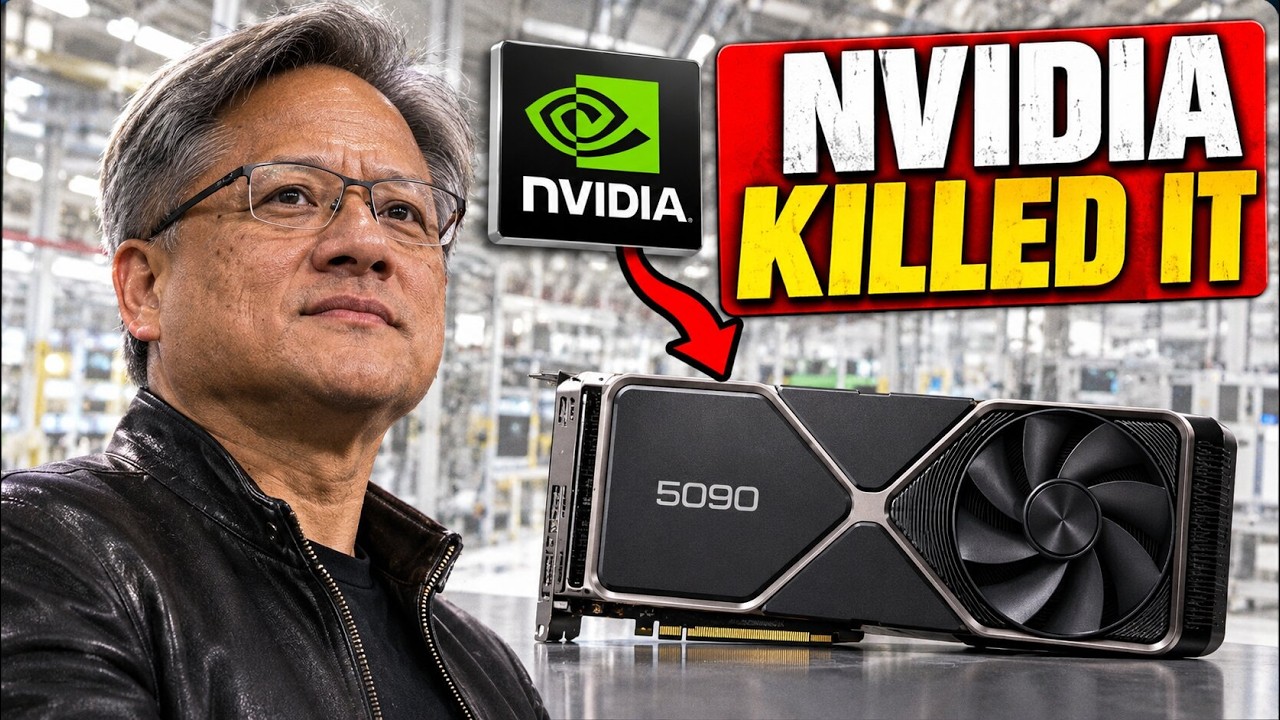
Why Nvidia Killed the 5090
Keywords
Summary
194 words
Critical Evaluation
Value of the Information & Strength of the Argument
The video’s value lies in its comprehensive synthesis of multiple threads: the technical specs of the card, the timeline of scarcity, the memory market dynamics, and Nvidia’s strategic pivot towards AI. It convincingly argues that the 5090’s scarcity is not a typical supply issue but a deliberate reallocation of resources to more profitable segments. The argumentation is solid, using concrete data like price increase percentages, revenue splits, and memory cost trends. It also presents counterarguments from Nvidia itself, lending credibility. The explanation of the per-gigabyte revenue comparison between the 5090 and RTX Pro 6000 is particularly effective in illustrating the business logic. The video avoids sensationalism and provides a nuanced analysis, though some claims are based on unconfirmed leaks.
Scientific Rigor, Source Quality, Title Accuracy
The video cites a wide range of sources, including reputable tech outlets (TechRadar, Tom’s Hardware, PC Games Hardware), market research firms (TrendForce), and official Nvidia statements. It clearly distinguishes between confirmed reports and rumors. The title is appropriate and directs the viewer to the core question. The content is well-researched and the sources are properly contextualized, though the lack of direct links to primary sources is a minor limitation. The adéquation between title and content is strong, as the video directly addresses whether Nvidia killed the card and provides a reasoned answer.
226 words
Title / Content Match
The title asks a provocative question and the video delivers a nuanced answer: Nvidia didn't officially kill the card but effectively starved it due to AI demand and memory scarcity. Perfect alignment.
Quality & Reliability
7/10
The video provides a well-documented analysis citing multiple industry sources (TrendForce, PC Games Hardware, TechRadar, etc.) and presents a balanced view, though some claims rely on unverified leaks. The argumentation is coherent and supported by specific numbers.
Key Moments
Markers derived by PSI from the transcript: the creator did not define chapters.
- Opening scene in a Micro Center showing missing RTX 5090 and high resale prices.
- Launch of RTX 5090 in January 2025 with specs and price.
- Timeline of scarcity and price increases throughout 2025-2026.
- Explanation of memory shortage and shift of production to AI servers.
- Comparison with RTX Pro 6000 and Nvidia's decision to allocate resources to professional cards.
- Counterarguments, Nvidia's denial, and final analysis of the card's fate.
Cited Sources
- TechRadar report — Mentioned that reviewers noticed no direct sales of RTX 5090 at major retailers.
- Reddit user comment — Quoted a user saying 'launch day vibes a full year after launch day.'
- The Information report — Reported that Nvidia would cut GeForce production by 30-40% and delay RTX 60 series.
- PC Games Hardware — Confirmed via multiple independent sources that RTX 5090 production would stop.
- WCCFTech — Industry sources on Nvidia holding off memory cost increases.
- Notebookcheck — Criticized Fischer's comments for not explaining allocation changes.
- Tom's Hardware — Estimated that only 8% of RTX Pro 6000 price increase reflected manufacturing costs.
- TrendForce — Market tracker providing memory price forecasts and supply shift data.
- Micron announcement — Shutdown of Crucial consumer brand due to AI demand.
- Gigabyte CEO Eddie Lynn — Explained Nvidia's per-gigabyte revenue calculation and product focus strategy.
Concurring Sources
- TrendForce memory forecasts — Aligns with the video's claims of memory shortage and price increases.
- PC Games Hardware sourcing report — Corroborates the production cut of RTX 5090 chips.
- Micron's exit from consumer memory — Supports the thesis that memory manufacturers prioritize data center customers.
Dissenting Sources
- Nvidia official statements — Nvidia denies discontinuing the RTX 5090, claiming supply constraints but no end of life.
- Community defenders — Some argue this is a typical shortage resolved when supply returns, citing past cryptoboom cycles.
Contribution & Novelties
This video provides a unique synthesis of the RTX 5090 scarcity, connecting the memory shortage, Nvidia’s business pivot, and the grey market for AI accelerators. It clearly explains the economic logic behind the card’s disappearance, offering a compelling narrative that goes beyond simple supply-demand dynamics.
Pour aller plus loin :
- High Bandwidth Memory — Relevant to the memory technology discussed as a key scarcity factor.
- Nvidia — Company background and transformation from gaming to AI infrastructure.
- Graphics processing unit — General context on GPUs and their evolving use in AI.
- AI accelerator — Explains the hardware specialization that drives demand for 5090-like cards.
103 words
Radar Profile
The radar profile shows high scores in information quantity and quality, moderate technical depth, and a slightly lower but still reasonable reliability score. This suggests a content-rich video with solid sourcing, though the reliance on some unconfirmed leaks keeps the reliability in check.