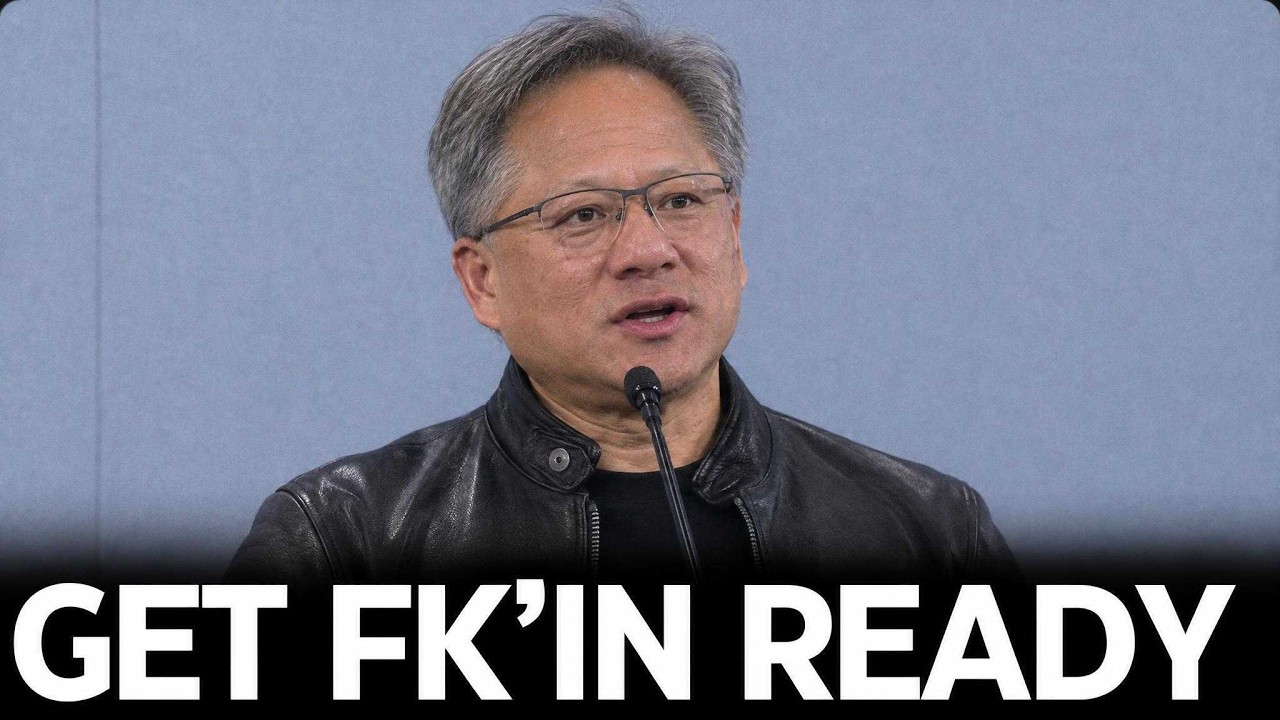
Nvidia's CEO Just Left The Audience Speechless!
Keywords
Summary
369 words
Critical Evaluation
Value of the Information & Strength of the Argument
The informational payload is unusually dense for a YouTube essay of this format: quarterly and annual revenue, segment growth rates, valuation peaks, the collapse of a national market share, the size and structure of a lease guarantee, the dates of each disclosure and the sequence of market reactions. That density gives the viewer real anchors — figures that could in principle be checked against filings. The difficulty is that the density is deployed rhetorically rather than analytically. Numbers arrive in clusters timed to a dramatic beat, without uncertainty ranges, without indicating whether they are company guidance, analyst estimates or the narrator’s reconstruction, and without resolving fiscal-year conventions. The argumentative spine is a three-act morality structure: the salesman of calm, the concealed exposure, then the human flaw. Each act rests on juxtaposition rather than inference — the Berlin protester saying ’later’ is placed beside the November email so that the word resonates, which is a literary device, not evidence. Where the video genuinely argues, it argues competently: the treatment of circular financing is the strongest passage, laying out Nvidia’s contractual rebuttal (a guarantee triggered only on default, not a purchase), the sceptics’ structural objection, the IMF’s provisional judgement, and the explicit concession that ‘both things can be true at once’. The radiologist anecdote is used as a causal claim about AI and employment; it is directionally defensible but presented as settled when it remains contested. The central episode is handled with more epistemic care than the surrounding melodrama — no accusation of espionage, an admitted personal betrayal, an investigation into whether he was a target — and that distinction is stated repeatedly. The weakness is the causal framing: the video implies a direct line from a personal admission to a trillion-dollar valuation loss, yet the price moves it reports (roughly -4.3%, -5.5%, +3%) sit within ordinary volatility, and the video itself supplies the counter-evidence — order backlog, supply constraints, product roadmap — without resolving the tension. The most rigorous reasoning concerns key-person risk and succession, where the case is structural; the least rigorous are the passages of interior monologue attributed to employees, which are invention presented as description.
Scientific Rigor, Source Quality, Title Accuracy
Rigor rests entirely on oral attribution. The video names its outlets — The New York Times, Reuters, Bloomberg, CNBC, the IMF, Morgan Stanley, KPMG, Culper Research, the Milken Institute, Stanford’s business school, the Lex Fridman and Memos to the President podcasts — which allows a motivated viewer to trace claims, but it supplies no on-screen citations, no article titles, no publication dates beyond the events themselves, and no references in the description, which contains only a promotional paragraph. Nothing is quoted verbatim from a document. Several claims are asserted as established fact in places where the video’s own phrasing elsewhere signals allegation or open investigation: the intelligence-agency conclusion, the Commerce Department probe with ’no finding announced’, and the board’s statement that it had no reason to believe secrets were compromised. To its credit, the video repeatedly marks the boundary between allegation and proven fact and explicitly declines to accuse Huang of espionage. The financial figures are consistent with Nvidia’s publicly reported trajectory, but they cannot be audited from within the video, and the more forward-looking product claims are reported without distinguishing announcement from deployment. The main source-quality defects are the absence of primary documents, reliance on a single dramatised narrative voice, and the inclusion of scenes — crowd reactions, employee emotions, the wording of an internal email — that no source named in the video could support at that level of detail. On title/content fit: the title points to a single moment, the Berlin protesters and Huang’s composure, while most of the runtime is a business, geopolitical and governance narrative. The connection is real but the title’s hyperbole overstates that moment’s centrality, and ‘speechless’ is a metaphor the video itself reinterprets rather than a reported reaction.
658 words
Title / Content Match
The title points to one moment — the Berlin protesters and Huang's composure — while most of the runtime is a business, geopolitical and governance narrative; the link is real but the hyperbole overstates that moment's centrality.
Quality & Reliability
3/10
The narrative names its outlets (The New York Times, Reuters, Bloomberg, CNBC, IMF, Morgan Stanley, KPMG, Culper Research) and its figures are broadly consistent with Nvidia's publicly reported trajectory, but no primary document, article title, publication date or link is supplied, the description contains no references, and several passages (crowd reactions, employee emotions, the content of an internal email) are dramatised reconstruction delivered in the same register as reported fact. The video does explicitly separate allegation from proven fact on the central episode, which prevents a lower score.
Key Moments
Markers derived by PSI from the transcript: the creator did not define chapters.
- Opening scene: 3,000 people in Berlin's Tempodrom, protesters rise with a banner, Huang stays calm and promises to speak with them later.
- GTC San Jose, March 16: the $1 trillion demand projection through 2027, doubled in twelve months, and the declaration that Moore's law has run out of steam.
- The financial record: $215.9 billion annual revenue, $96.2 billion quarterly, data-centre growth of 117%, and a peak valuation of $5.7 trillion.
- The employment argument — 'you'll lose it to someone who uses it' — illustrated by the radiologist anecdote and set against the accusation of commercial self-interest.
- Berlin content: Europe's roughly 5% share of global AI compute, the containerised AI factory design, and the RTX Spark laptop comparison with the 2016 machine given to OpenAI.
- The technical layer: the 'five-layer cake' model of AI, agent architecture and sandbox security, the T-Mobile/Nokia call, and the adaptive radiotherapy partnership.
- The environmental critique behind the protest: land, power and water demands of data centres, local ballot measures, and Nvidia's claimed efficiency gains.
- The China problem: market share falling from over 90% to zero, H200 licences that produced no shipments, and Huawei poised to take the market.
- The Ohio lease and the circular-financing debate: the $15 billion guarantee, Nvidia's contractual defence, sceptical analysts, Michael Burry and the IMF note.
- 8 November: the board's independent investigation, Huang's email to employees, the two-day share decline, Morgan Stanley's reclassification and the key-person-risk question.
Cited Sources
- The New York Times — report on a businesswoman close to Jensen Huang and an alleged foreign intelligence effort — Cited for the 29 October disclosure, the Mega Speed relationship and the $4.8 billion of chip purchases over two years.
- Reuters — report that no H200 shipments had occurred by mid-May — Used to support the claim that US export licences failed to produce sales because Beijing did not approve the purchases.
- Bloomberg — commentary by Dina Bass on dotcom-era parallels — Invoked for the historical comparison that early leaders in a technology wave are often not the eventual winners.
- CNBC — interview with Paul Argenti, Dartmouth's Tuck School of Business — Source for the framing that the episode moved from a personal scandal to a corporate governance issue.
- Culper Research — report titled 'The China Problem' — Short-seller research published in May examining ties between Jensen Huang and Alice Huang; presented as an earlier warning sign.
- KPMG survey on worker attitudes to AI — Cited for the finding that roughly four in ten workers fear AI could take their job.
- International Monetary Fund — note on rising circular financing — Referenced for the assessment that interlocking AI financing arrangements pose a risk judged minor for now.
- Morgan Stanley — analyst commentary and removal of Nvidia from top picks — Used for the sceptical view on opaque debt and for the post-disclosure reclassification.
- Memos to the President podcast — interview of 30 April — Source for Huang's statement that Nvidia's China share had fallen to zero and that export policy had largely backfired.
- Lex Fridman podcast and Milken Institute conference 2025 — Huang's statements on AI and employment — Basis for the recurring 'tasks, not jobs' argument and the radiologist case.
- Nvidia investor communications — quarterly guidance and fiscal-year results — Origin of the revenue, segment growth, guidance and valuation figures quoted throughout.
Concurring Sources
- Nvidia investor relations — quarterly results and guidance — The revenue, segment and guidance figures quoted in the video follow the pattern of Nvidia's published reporting, allowing independent verification of the financial backbone.
- SEC EDGAR — corporate filings — Primary source where the annual and quarterly figures, risk factors and related-party disclosures could be checked directly rather than through narration.
- Jensen Huang — biographical and corporate record — Corroborates the founding date, the co-founding story and the length of his tenure, which the video uses to establish its central thesis about a company built around one voice.
Dissenting Sources
- Anthropic — public statements by Dario Amodei on AI and employment
- International Monetary Fund — financial stability commentary on AI-related financing
- KPMG — survey of worker attitudes toward AI
- Commentary from investors including Michael Burry on interlocking AI deals
Contribution & Novelties
The video’s contribution is synthesis and chronology rather than disclosure. It sequences a scattered set of events — the GTC demand projection, the European tour’s compute-shortage argument, the containerised data-centre product, the collapse of the Chinese market, the Ohio lease guarantee, the October reporting and the November board investigation — into one causal narrative with a beginning, a turn and a closing image. Its most useful analytical move is to hold the optimistic public message (AI reallocates tasks rather than destroying jobs) against the speaker’s direct commercial interest in that message, and to do so without pretending the tension can be resolved. Its second useful move is reframing a personal episode as a governance question through the key-person-risk lens, noting the absence of a public succession plan and the absence of majority voting control — the point at which gossip becomes a balance-sheet item. The weakest move is treating a still-developing episode, reported initially by a single outlet, as the necessary climax of a three-decade story arc, which converts chronology into destiny.
Pour aller plus loin :
- Jensen Huang — biographical baseline for the founder-led-company and key-person-risk argument that closes the video.
- Nvidia — corporate history, segment structure and the data-centre pivot underpinning the revenue figures.
- Moore’s law — context for the claim that classical scaling has ended and that the economics of computing have changed shape.
- OpenAI — the counterparty in both the 2016 supercomputer anecdote and the Ohio lease guarantee.
- Huawei — the competitor positioned to absorb the Chinese market share Nvidia is said to have lost.
- Key-person risk and founder-led governance — the concept carrying the video’s final argument; best pursued through corporate-governance literature rather than a single web page.
- Vendor and circular financing in financial-stability research (IMF, BIS) — the accounting pattern at the centre of the sceptics’ case.
303 words
Radar Profile
The profile is that of a high-volume, mid-complexity narrative explainer: information quantity and topical technical content score high because the script is packed with figures, product names and institutional actors, while information quality and overall reliability lag well behind, dragged down by the absence of primary documents and by dramatised reconstruction delivered in the same register as reported fact. The visible gap between the two pairs of axes is the signature of confident storytelling resting on thin documentation — the argument is fluent enough to feel evidenced, which is precisely where the risk lies.