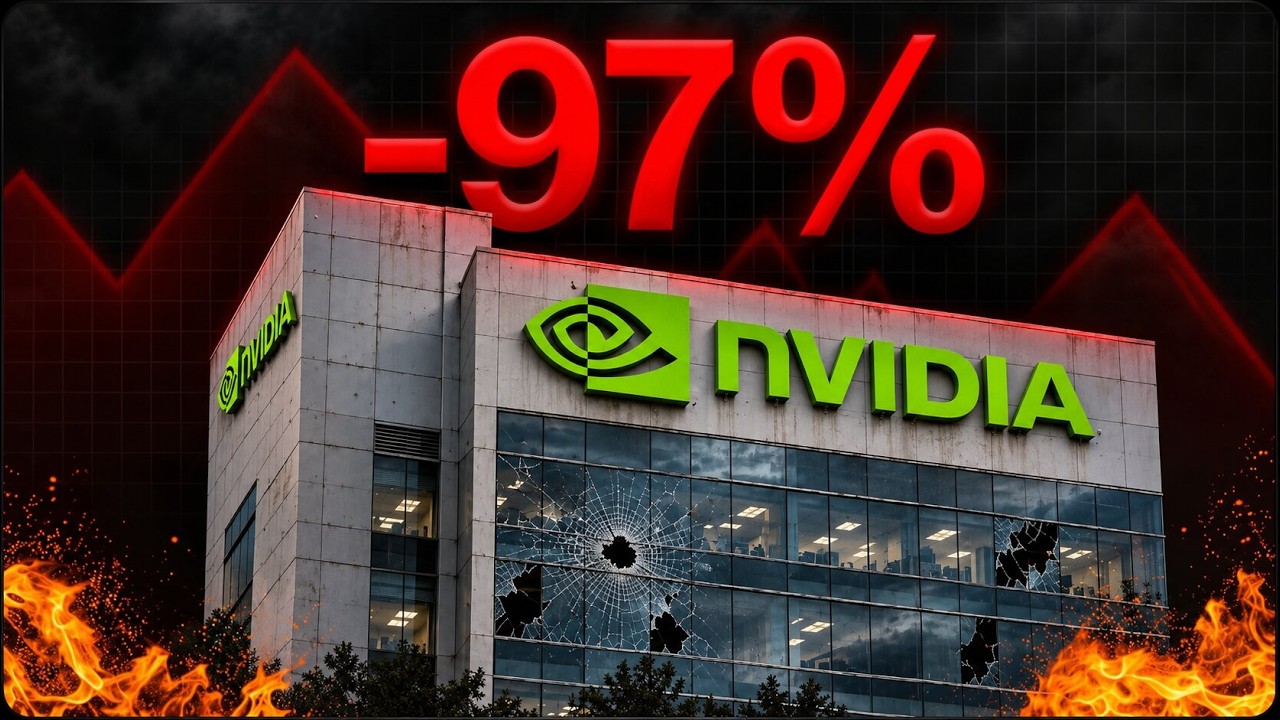
The Nvidia Disaster Nobody Saw Coming
Keywords
Summary
206 words
Critical Evaluation
Value of the Information & Strength of the Argument
The video’s informational value lies in its synthesis: it connects CEO succession risk, customer concentration, custom silicon, export controls and vendor financing into a single causal story about Nvidia. It uses concrete figures and a clear contrast between record operating performance and a collapsing share price to frame the central puzzle. The argument is strongest when it separates the scandal from underlying vulnerabilities and when it uses historical analogies to show that interim leadership can stabilize but rarely supplies strategic direction. It is weaker where it treats an anonymously sourced allegation as a pivot point and where it infers market causation from a sequence of events. The narrative repeatedly moves from ‘reported’ to ‘happened’ without an intervening evidence chain, and rhetorical questions often substitute for proof. Scenarios are presented vividly, but counterfactuals and alternative explanations are underdeveloped. Overall, the argument is coherent and engaging but not rigorously established; it is a persuasive story built around a plausible risk model, not a demonstrated account of events.
Scientific Rigor, Source Quality, Title Accuracy
Rigor is limited. The video names several outlets and analysts—The New York Times, Bloomberg, The Wall Street Journal, The Economist, Bernstein, Yole Group, NPR, Fortune, the IMF and the BIS—but provides no links, article titles, dates or direct quotations beyond paraphrase. Several key claims are attributed to unnamed people briefed on intelligence, and the central resignation is future-dated relative to the video’s publication context, making independent verification impossible from the material supplied. The video does acknowledge that the intelligence claims are unproven and that Nvidia disputed the customer-diversion story, which is a point in its favor, but it still builds a 29-minute narrative on those claims. Title/content fit is strong in rhetorical terms: the video is indeed about an allegedly unforeseen Nvidia crisis. The title is nevertheless sensational and asserts a ‘disaster’ as fact, while the content is a speculative reconstruction.
321 words
Title / Content Match
The title matches the video's central claim of an unforeseen Nvidia crisis, but it frames a speculative scenario as a confirmed disaster. The fit is strong rhetorically yet misleading factually.
Quality & Reliability
2/10
The video is a polished but future-dated speculative narrative. It mixes verifiable background facts about Nvidia with unverifiable claims attributed to anonymous intelligence sources and presents them as established events. No primary documents, links, article titles, dates or methodological transparency are provided.
Key Moments
Markers derived by PSI from the transcript: the creator did not define chapters.
- Opening claim: Jensen Huang resigns as Nvidia CEO on 12 November 2026, effective immediately, and the stock opens sharply lower.
- Market reaction: roughly $180 billion of value lost in one session, about $600 billion shed since the board investigation, and shares roughly 32% below the October 6 peak.
- Nvidia's one-man structure: Huang as founder, strategist and brand, with no board chair for 33 years and no clear successor.
- Origins and CUDA: the Denny's founding, near-bankruptcy, and the GPU parallelism bet that later enabled deep learning.
- Mega Speed allegations: a Singapore-based Nvidia customer is linked by anonymous intelligence reports to Chinese intelligence, and Nvidia disputes the diversion claims.
- Board investigation, interim CEO Colette Kress, and the succession dilemma between an insider, a technical leader and an outsider.
- Competitive and geopolitical pressures: Google TPUs, Amazon Trainium, Broadcom/OpenAI custom chips, China export controls and Huawei.
- Circular financing concerns: Nvidia's investments in customers, a $500 billion credit pool, and IMF/BIS warnings about AI financing risk.
- The November 17 earnings call as the first real test, plus recovery steps: investigation, permanent succession, governance and execution.
- Conclusion: the real 'disaster' is Nvidia's dependence on one person, which exposed known risks—custom chips, China and circular money—all at once.
Cited Sources
- The New York Times — Reports on Mega Speed trade records, anonymous intelligence claims about a Chinese intelligence asset, a second relationship, and the alleged recruitment goal.
- Bloomberg — Described Mega Speed as the largest buyer of Nvidia chips in Southeast Asia and reported that the board weighed a temporary CEO before a wider search.
- The Wall Street Journal — Reported that Nvidia was preparing to fire Huang after a second relationship was disclosed.
- The Economist — Argued that Google pierced Nvidia's aura of invulnerability after Gemini 3 was trained on Google's own tensor processing units.
- Bernstein — Estimated that Nvidia chips make up more than two-thirds of the cost of a typical AI server rack.
- Yole Group — Analysts reported that OpenAI's first custom chip with Broadcom matched or beat Nvidia's Blackwell on inference efficiency.
- NPR — Put a $750 billion figure on the AI spending wave and noted critics calling it a bubble.
- Fortune — Compared AI vendor financing with Cisco and Nortel financing before the dot-com crash, when such financing exceeded 10% of annual revenue.
- International Monetary Fund — Flagged rising financing risk across the AI investment world in April.
- Bank for International Settlements — Flagged rising financing risk across the AI investment world in September.
Dissenting Sources
- Nvidia denial of Mega Speed chip-diversion allegations — The video notes that Nvidia said the allegations that Mega Speed diverted its chips had been thoroughly investigated and debunked, which cuts against the narrative's framing of the customer as a confirmed risk.
Contribution & Novelties
The video’s original contribution is not new primary reporting but a narrative integration of several known Nvidia debates: founder-key-person risk, the CUDA moat, hyperscaler custom chips, China export controls, and circular financing in AI infrastructure. Its distinctive angle is to make succession the master variable that connects those risks. That framing is useful as a scenario-analysis prompt, but the video does not supply the evidence needed to confirm the scenario.
Pour aller plus loin:
- Jensen Huang — Background on the founder whose role is central to the succession argument.
- Nvidia — Company history, products and market position.
- CUDA — The software ecosystem described as Nvidia’s main defensive moat.
- Tensor Processing Unit — Google’s custom accelerator, relevant to the rival-chip discussion.
- Brian Krzanich — Intel CEO resignation, used as a succession analogy.
- Tim Cook — Apple succession case cited as the successful counterexample.
142 words
Radar Profile
The profile is lopsided: very high information density and a moderately technical discussion of chips, market structure and geopolitics, but low reliability because the central events are unverifiable and future-dated. It reads as a persuasive narrative rather than an evidence-based investigation.