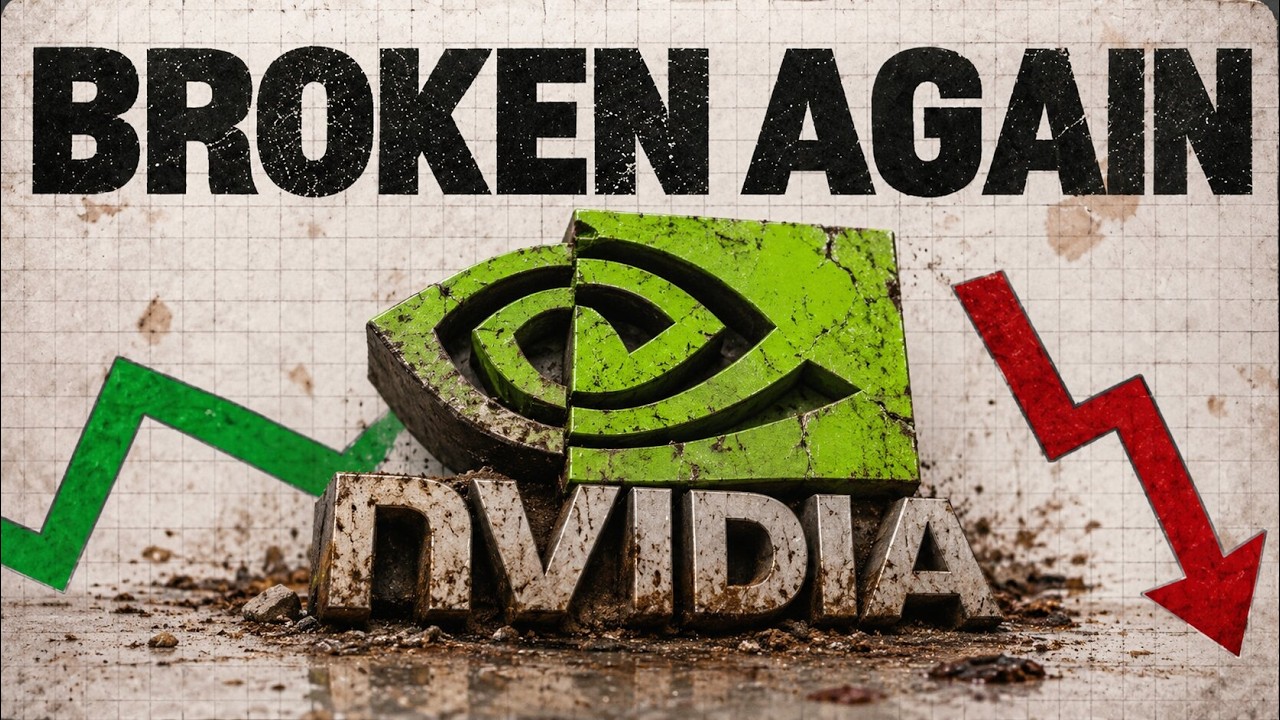
Nvidia Is (Finally) Getting What They Deserve
Title history
- Nvidia Is (Finally) Getting What They Deserve — observed on 20261121-1829 UTC (YouTube)
Keywords
Summary
180 words
Critical Evaluation
Value of the Information & Strength of the Argument
The video delivers high value by synthesizing a complex web of events—financial performance, board dynamics, export control controversies, and personal scandals—into a coherent narrative. It uses specific numbers (e.g., revenue, market value, compensation) to ground its analysis, and it carefully distinguishes between proven facts and allegations, repeatedly noting that no charges have been filed. The argumentation is strong in its causal chain: Nvidia’s dependency on Huang’s personal credibility becomes a liability when that credibility collapses, exposing the fragility of the company beyond its financials. The video also acknowledges counterarguments (e.g., Culper’s short-seller status, Korean fact-check nuances, legality of certain transfers), demonstrating a balanced approach. However, the explanation of the Singapore revenue reclassification could have been even more technical, and the emotional framing (‘getting what they deserve’) slightly colors the objectivity, though it is clearly presented as an editorial stance.
Scientific Rigor, Source Quality, Title Accuracy
The video demonstrates rigorous sourcing by referencing well-established news outlets: TechCrunch, Reuters, The Wall Street Journal, Fortune, The New York Times, The Information, the Financial Times, and Forbes, as well as a report from Culper Research and an analysis by the Atlantic Council. It uses these sources to support specific claims, attributing information appropriately. The video, however, also incorporates unverified allegations and pressures the viewer by presenting them as part of a pattern, though it explicitly labels them as unproven. The title, ‘Nvidia Is (Finally) Getting What They Deserve,’ is somewhat sensational but accurately reflects the video’s critical stance and its focus on consequences for governance failures and opaque dealings. The title does not mislead the content; the content adheres to the promise of an investigative analysis. There are no systematic biases detected beyond a narrative that links various crises to one root cause, but this is largely substantiated by the evidence presented.
307 words
Title / Content Match
The title accurately reflects the video's thesis that Nvidia is facing consequences for its governance and China exposure, though the framing is somewhat editorial.
Quality & Reliability
8/10
The video integrates multiple reputable sources (WSJ, NYT, FT, etc.) and provides balanced treatment of unverified claims, with clear caveats about the lacking proof and the short-seller status of Culper Research.
Key Moments
Markers derived by PSI from the transcript: the creator did not define chapters.
- Introduction: Jensen Huang's resignation and market impact.
- Founding of Nvidia at a Denny's in 1993 and Huang's continuous leadership.
- Nvidia's record revenue ($96.2B) and market valuation near $6 trillion.
- Singapore revenue surge and questions about where the chips actually go.
- Culper Research's short-seller report alleging China diversion via Mega Speed.
- New York Times report on Alice Hang's alleged intelligence ties and Huang's relationship.
- Huang's resignation, board investigation, and appointment of interim CEO Colette Kress.
- Petition to reinstate Huang and his reported comeback discussions.
- Treasury Secretary Bessant's criticism and calls for a dramatic shakeup.
- Upcoming earnings expected to be strong despite stock drop; conclusion about lost credibility.
Cited Sources
- TechCrunch — Quoted on Huang never setting up a succession plan and on Kress's background.
- Reuters — Reports on Huang's non-replaceability, the second intimate relationship, and congressional testimony expectations.
- The Wall Street Journal — Calculations of independent directors' compensation and equity, and reporting on the board's treatment of the Huang family.
- The New York Times — Reports on Madison Huang's behavior, the Alice Hang intelligence allegations, and the extramarital relationship with a vice president.
- Fortune — Cited on the board's compensation and stock decline.
- The Information — Reporting on Mega Speed and Speed Matrix moving $7.5B in Nvidia chips to China.
- Financial Times — Reporting on Huang's discussions about a comeback and the pressure campaign.
- Culper Research — Short-seller report alleging illegal chip diversion and highlighting Mega Speed.
- Forbes — Reported on Huang's testimony agreement and his net worth estimate.
- Atlantic Council's GeoEconomics Center — Pointed out that some transactions might be perfectly legal under current rules.
Concurring Sources
- The Wall Street Journal — Corroborates the board's compensation and the royal family treatment, as well as the Singapore revenue change.
- The New York Times — Provides the core allegations about Alice Hang and the relationship with a direct report.
- Financial Times — Confirms the comeback talks and the war room effort, aligning with the narrative's corporate pressure.
Dissenting Sources
- SPS News (Korean fact-check) — Could not confirm sufficient evidence for extreme claims that diverted exports to China made up 20-40% of Nvidia's total revenue.
- Atlantic Council's GeoEconomics Center — Noted that some of the suspicious-looking transactions might be perfectly legal under current US export control rules.
Contribution & Novelties
The video provides a cohesive synthesis of scattered news reports into a single narrative, connecting corporate governance failures with national security concerns and market reactions. It emphasizes the systemic issue of founder-centered leadership and the dangers of unverified claims in high-stakes tech. The original contribution lies in linking the succession void, permissive board, and suspicious revenue reporting to the sudden collapse of trust. While the underlying events are already reported elsewhere, this video structures them into a clear cause-and-effect chain, offering a comprehensive overview for viewers who may not have followed the evolution.
Pour aller plus loin :
- Export control — Relevant to the discussion of US restrictions on advanced chips to China and the alleged diversion.
- Short selling — Understand Culper Research’s incentives and the role of short-sellers in exposing corporate issues.
- Corporate governance — The video highlights board independence issues; this entry explains frameworks and pitfalls.
148 words
Radar Profile
The radar profile shows high values in information quantity and quality, with moderate technical depth and high overall reliability. The video is rich in data and citations, but its technical explanations remain accessible, and its reliability is underpinned by careful attribution and caveats.