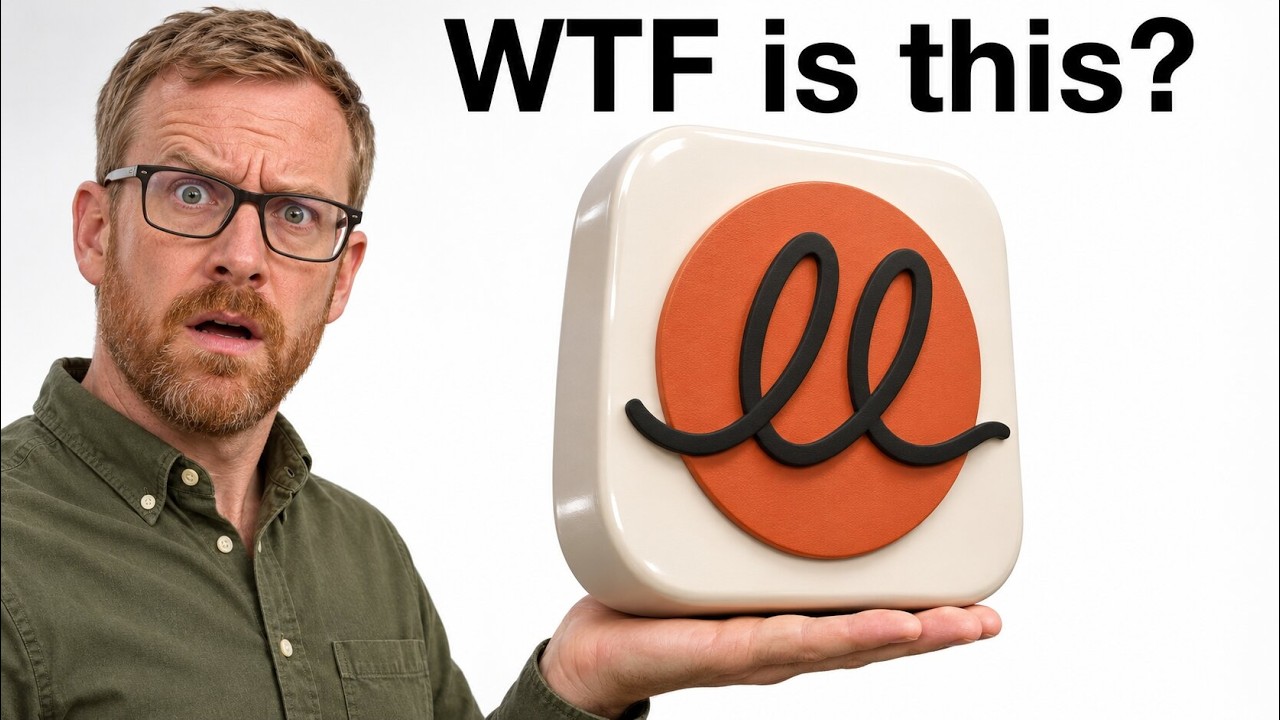
Anthropic Released Their Weirdest Product Yet
Title history
- Anthropic Released Their Weirdest Product Yet — observed on 20261118-1753 UTC (YouTube)
Keywords
Summary
160 words
Critical Evaluation
Value of the Information & Strength of the Argument
The video provides a thorough and balanced evaluation of Claude Meetings. It succinctly explains the product’s mechanics and dwells on the strategic choices Anthropic made, such as visible participation and automatic exit, which directly address the consent issues raised by the Otter lawsuit. The argumentation is coherent, supported by concrete examples, expert quotes, and market data. The video critically assesses both potential benefits (reducing meeting overhead) and limitations (the difficulty of making machines understand social cues). It also evaluates analyst opinions, presenting a spectrum from bearish to bullish. The overall reasoning is solid and evidences a good understanding of the technology and its socio-legal environment.
Scientific Rigor, Source Quality, Title Accuracy
The video demonstrates strong rigor by citing specific sources: a Microsoft survey on workplace interruptions, the Otter.ai litigation, a ‘Runtime Wire’ investigative piece, and comments from analysts at Stifel and KeyBanc. It also references the EU AI Act and UC Today’s recommendations. These sources are timely and relevant, though some are not easily verifiable from the video alone. The title is apt and not exaggerated; the video genuinely argues that Claude Meetings is ‘weird’ due to its social scripting. The content matches the title throughout without significant digressions. The analysis of public comments is not applicable since none were provided.
220 words
Title / Content Match
The title accurately captures the video's main theme: Claude Meetings is portrayed as an unconventional and socially sensitive AI product. The content consistently elaborates on this 'weirdness'.
Quality & Reliability
7/10
The video is well-structured and references credible sources such as Microsoft studies, the Otter.ai lawsuit, and analyst reports. It balances factual reporting with informed commentary, though some claims (e.g., specific performance metrics) lack independent verification.
Key Moments
Markers derived by PSI from the transcript: the creator did not define chapters.
- Introduction: Claude Meetings is introduced as a unique product launched by Anthropic.
- Detailed description of Claude Meetings features: real-time planning, whiteboard mapping, and integration with business apps.
- Discussion of the 'weird' design choices: introductions, chat notices, and automatic exit when outsiders join.
- Otter.ai lawsuit and its impact on the meeting bot industry, leading to stricter consent requirements.
- Analysis of Project Parka and how it reveals Anthropic's direction toward autonomous action items.
- Market and analyst reactions: Microsoft stock drop, cautious optimism from Stifel, and warnings about overlapping tools.
- Financial context: Anthropic's IPO plans, revenue growth, and valuation prospects.
- Future implications: meetings as triggers for automated work, and the challenge of distinguishing decisions from daydreams.
- Conclusion: the product's social rules are its most distinctive feature; the future depends on trust and legal compliance.
Cited Sources
- Microsoft study on workplace interruptions — Mentioned as evidence of meeting overload and fragmented work
- Otter.ai lawsuit (Justin Brewer v. Otter) — Discussing consent and privacy issues with meeting bots
- Project Vendropic / Andon Labs experiment — Early prototype of Claude as a coworker with social boundary issues
- Runtime Wire's discovery of Project Parka — Investigation of unreleased Claude features
- Stifel analyst Brad Reebach commentary — Analyst view on impact on Microsoft 365
- KeyBanc analyst Jackson Ader commentary — Analyst view on competition with Monday.com, Asana, Zoom
- UC Today recommendations on meeting AI — Guidelines for implementing meeting assistant in enterprises
- EU Artificial Intelligence Act — Legal obligations for AI in workplace settings
Concurring Sources
- Microsoft survey on meeting overload — Supports the video's claim about the burden of meetings.
- Otter.ai lawsuit allegations — Provides legal precedent that supports the need for consent in AI meeting participants.
- Runtime Wire's Project Parka investigation — Confirms the direction of autonomous action items after meetings.
Dissenting Sources
- Stifel analyst Brad Reebach opinion — He argues Claude Meetings is unlikely to dent Microsoft 365 growth, contrary to market fears.
Contribution & Novelties
The video offers a distinctive perspective by connecting Claude Meetings’ design choices to previous Anthropic experiments and the broader legal landscape. It highlights how the product’s social behavior (announcing itself, leaving when outsiders join) is a strategic response to the Otter lawsuit and consent concerns. The analysis also situates the launch within Anthropic’s IPO timing, providing a well-rounded view. The central novelty is framing the product as the first AI coworker that must understand ‘whose room it is in’.
Pour aller plus loin :
- Otter.ai lawsuit background — Provides context on the company and legal challenges.
- EU Artificial Intelligence Act — Official overview of the EU’s AI regulation.
- Microsoft Work Trend Index — Source of the meeting interruption statistics mentioned in the video.
- Project Vendropic — Anthropic’s own blog post about the experiment (if accessible).
- [AI coworker concept] — No URL provided; a theoretical discussion on AI in the workplace.
150 words
Radar Profile
The radar profile shows high scores in information quantity and reliability, with moderate technical depth. This indicates a well-researched and accessible analysis that prioritizes broad context and expert commentary over deep technical details. The lower technical score reflects the absence of implementation intricacies, making the video suitable for a general audience interested in AI business implications.