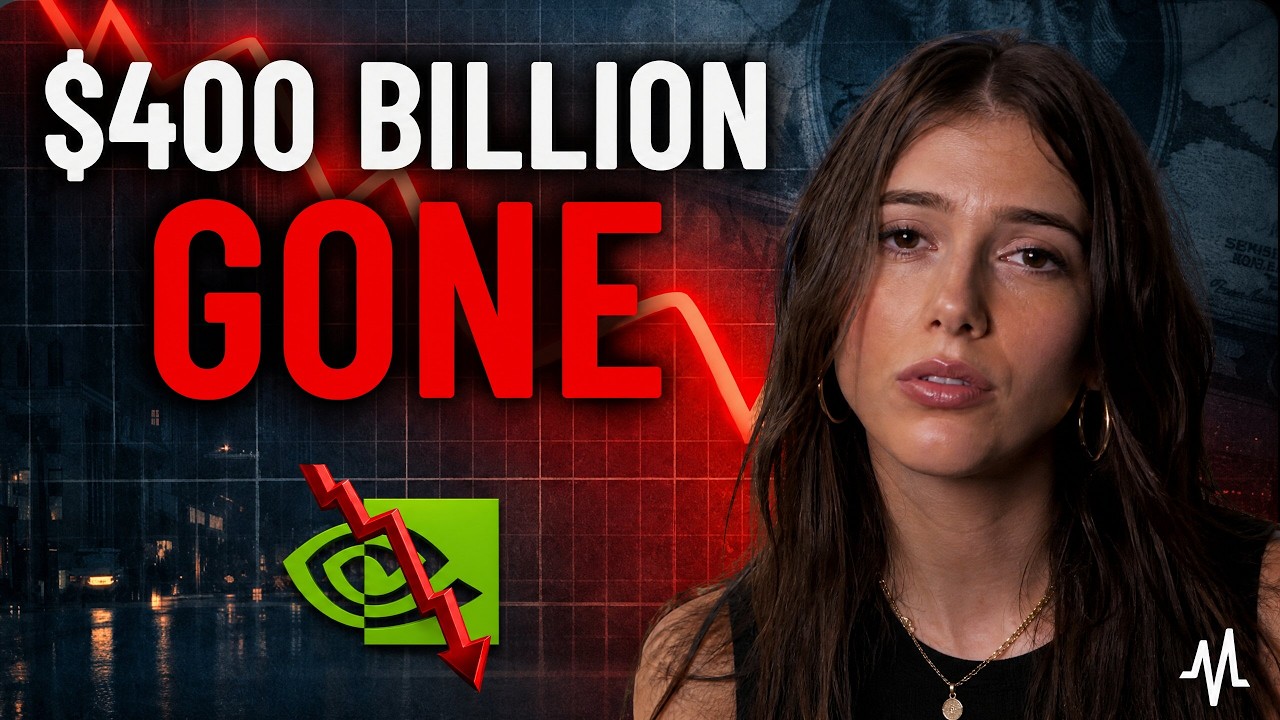
Nvidia Tanks... Most Aren’t Ready For What This Means
Keywords
Summary
164 words
Critical Evaluation
Value of the Information & Strength of the Argument
The video provides substantial value by synthesizing a complex financial and geopolitical story into an accessible narrative. It effectively uses concrete data—market percentages, revenue figures, credit default spreads, and comparative historical examples—to support its thesis. The argumentation is solid, building a case that Nvidia’s concentration risk is a systemic threat not just to the company but to global retirement savers. It acknowledges counterpoints from more optimistic analysts, thereby presenting a balanced view. However, the animation and delivery are didactic, and some causal claims (e.g., the direct impact of Huang’s departure on the entire AI economy) are asserted rather than rigorously proven. The strength lies in connecting seemingly disparate events into a coherent warning about over-reliance on a single visionary leader.
Scientific Rigor, Source Quality, Title Accuracy
The video demonstrates commendable rigor by referencing well-known news outlets (New York Times, Wall Street Journal, ABC News, Bloomberg) and official institutions (IMF, BIS) for its factual claims. It also cites named analysts and experts, adding credibility. The title is well-aligned with the content—it promises an explanation of Nvidia’s drop and its broader meaning, which the video delivers. The sourcing is transparent, though no direct links or footnotes are provided in the video itself, limiting verifiability. The narrative does not shy away from uncertainty, presenting multiple expert forecasts and acknowledging limits of comparison. Overall, the video adheres to journalistic standards more typical of established media, despite its independent production.
244 words
Title / Content Match
The title accurately captures the core event—Nvidia's dramatic stock drop—and hints at the broader systemic implications, matching the video's focus on the AI economy's fragility.
Quality & Reliability
7/10
The video presents a detailed, well-structured analysis citing numerous reputable sources (NYT, WSJ, ABC News, Bloomberg, IMF, BIS) and expert opinions. However, the channel is not a primary news outlet, some names appear misspelled (likely transcription artifacts), and certain claims lack direct verification. The narrative is plausible and aligns with broader market reports.
Key Moments
Markers derived by PSI from the transcript: the creator did not define chapters.
- Intro: $2 trillion lost from Nvidia in six weeks, setting the stage.
- Timeline of Jensen Huang's resignation, including affair reports and board decisions.
- Analysis of Nvidia as a 'bank'—$540B in deals, circular financing, and credit default swaps.
- China connection: export controls, Alice Hong's suspected espionage, and the remote access loophole.
- Cisco comparison and the distinction between a great business and a great stock.
- Upcoming earnings report as the key test, with interim CEO Colette Crest under pressure.
Cited Sources
- New York Times report on Jensen Huang's second relationship — Reported the second relationship with VP Kimberly Powell, leading to resignation.
- Wall Street Journal on board's preparation to oust Huang — Reported that the board had been planning to push him out and had dismissed succession planning.
- ABC News interviews with analysts Taobi and Agarwal — Provided contrasting views on concentration risk and recovery potential.
- Bloomberg interview with Jensen Huang in October — Huang described Nvidia working with every AI company; context for his role.
- International Monetary Fund (IMF) and Bank for International Settlements (BIS) — Both flagged rising financing risk across AI investment chain in April and September.
Concurring Sources
- IMF Global Financial Stability Report (April 2025) — Cited in video as flagging rising financing risks in AI investment chain.
Dissenting Sources
- Analyst Agarwal on ABC News — Argued losses were modest and shares could recover, softening the impact on index funds.
- Ed Yardeni of Yardeni Research — Described it as an 'AI bubble losing air' rather than bursting, suggesting a more gradual adjustment.
Contribution & Novelties
The video offers a compelling synthesis of an unfolding news story, framing it as a stress test of the AI economy rather than a mere corporate scandal. Its original contribution is the systematic connection between Jensen Huang’s personal fall, Nvidia’s financial engineering, and the passive exposure of ordinary savers through index funds. It also introduces listeners to the concept of ‘circular financing’ and its fragility, while drawing a sharp contrast with the Cisco bubble.
Pour aller plus loin :
- Nvidia (Wikipedia) — Background on the company and its market position.
- Cisco Systems (Wikipedia) — Historical comparison of post-2000 bubble behavior.
- Concentration Risk (Investopedia) — Definition and examples of risk concentration in portfolios.
- Index Fund (Wikipedia) — Explanation of how index funds work and their impact on retail investors.
128 words
Radar Profile
The radar profile shows high information quantity but moderate reliability and technical depth, indicating a content-rich yet somewhat speculative analysis. The balance between quantity and quality suggests a video that is dense with data but may overreach in causal conclusions, aligning with a news-review style rather than rigorous academic work.