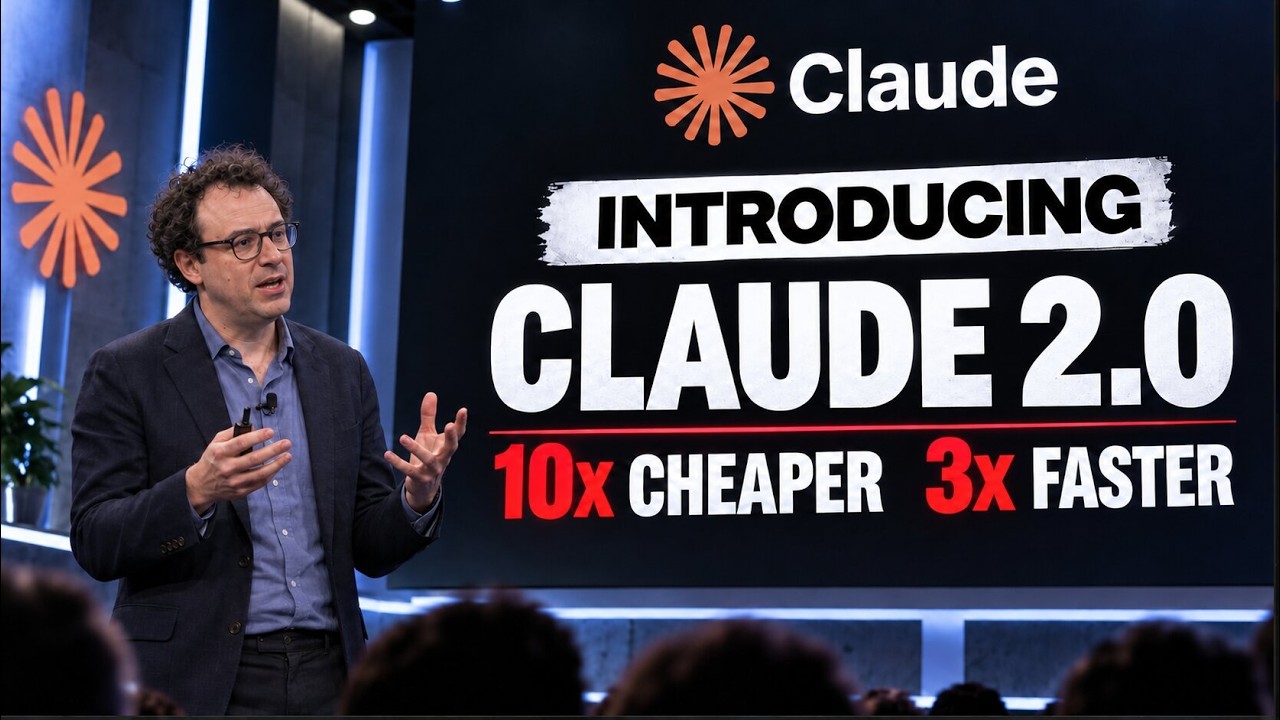
Anthropic's New Claude 2.0 Is WAY Better Than It Should Be (10x Cheaper, 3x Faster)
Title history
- Anthropic's New Claude 2.0 Is WAY Better Than It Should Be (10x Cheaper, 3x Faster) — observed on 20261121-0226 UTC (YouTube)
Keywords
Summary
180 words
Critical Evaluation
Value of the Information & Strength of the Argument
The video provides substantial value by aggregating a wide range of data—pricing, benchmarks, customer testimonials, independent tests, and financial filings—into a coherent critique of Claude Opus 5.5. It argues strongly that the model is better than its price suggests, but also that headline numbers hide asterisks. The argumentation is solid: it uses concrete examples, counters official marketing with independent measurements, and addresses potential biases. However, it occasionally relies on anecdotal evidence (e.g., individual developer reports) and the selection of testimonials is skewed by the vendor’s marketing, though the video acknowledges this. The overall reasoning is persuasive, acknowledging uncertainties while drawing clear conclusions about the model’s value and the strategic underpinnings of Anthropic’s pricing.
Scientific Rigor, Source Quality, Title Accuracy
The video demonstrates scientific rigor by citing official Anthropic documents, benchmark datasets, independent evaluations (Artificial Analysis, Computing for Geeks), and regulatory filings. It critically examines the methodology behind scores (e.g., partial credit, default effort settings) and includes both supporting and contradicting evidence. However, the title is inaccurate—claiming a 10x price drop and 3x speedup, while the actual numbers are moderate—and it misidentifies the model as ‘Claude 2.0’ instead of the correctly named Claude Opus 5.5. This undermines the video’s credibility slightly, but the content itself is careful and well-sourced.
217 words
Title / Content Match
The title exaggerates claims (10x cheaper, 3x faster) and incorrectly names the model as Claude 2.0 instead of Opus 5.5, which is misleading.
Quality & Reliability
7/10
The video blends official Anthropic data with independent tests and user reports, but relies heavily on anecdotal evidence and has a clear analytical perspective. It acknowledges uncertainties and provides a nuanced discussion of caveats.
Key Moments
Markers derived by PSI from the transcript: the creator did not define chapters.
- Introduction to the launch story with Quantium's 38-prompt task reduced to 11 prompts.
- Detailed pricing breakdown: $4 input, $20 output, 60% cheaper cache reads.
- Benchmark results: Terminal Bench 4.0, GDP Val, Humanities; comparisons with GPT-4 Astra and Fable 5.1.
- Customer testimonials from Cleo, Stripe, Deloitte, and others demonstrating real-world performance gains.
- Independent test by Computing for Geeks: three infrastructure tasks, total cost $0.09, and a refusal from Fable 5.1.
- Migration issues: always-on thinking, preserved reflection, and default effort changes with their implications.
- Refusal controversies and developer complaints; Addy Osmani's response on X.
- SEC filing details: revenue growth, $600M in price cuts, operating loss, and strategic pricing rationale.
Cited Sources
- Anthropic launch materials for Claude Opus 5.5 — Official announcement of model, pricing, benchmarks, and customer stories.
- Terminal Bench 4.0 — Benchmark used to evaluate agentic coding performance.
- GDP Val — Benchmark for professional work tasks.
- Artificial Analysis — Independent analysis index giving Opus 5.5 a score of 58.
- Computing for Geeks — Independent test with three infrastructure tasks.
- Tom's Hardware — Article quoting developer Jared Walton on refusals.
- The Batch (Deeplearning.ai) — Reported latency issues with Claude Haiku 5.5.
- SEC filing by Anthropic (November 2, 2026) — Financial data on revenue, price reductions, and operating losses.
- Dario Amodei's essay 'We Need to Moderate the Frontier' — Essay calling for pacing AI development.
Concurring Sources
- Artificial Analysis — Independently measured Opus 5.5's intelligence index and speed, aligning with the video's positive assessment.
- Computing for Geeks — Independent test confirmed cost and speed improvements in real infrastructure tasks.
- Developer testimonials (Stripe, Cleo, Deloitte) — Reported productivity gains and reliability improvements consistent with the video's claims.
Dissenting Sources
- Anthropic's official marketing claims — The video notes that headline benchmarks may overstate gains due to effort-level differences and partial credit, contrasting with Anthropic's promotional narrative.
Contribution & Novelties
This video adds value by synthesizing multiple sources to reveal the gap between marketing and reality for Claude Opus 5.5. It highlights the significance of lower costs enabling new use cases, while exposing the hidden trade-offs such as always-on reasoning and reduced user control. The analysis of Anthropic’s pricing strategy in the context of its IPO is particularly insightful.
Pour aller plus loin :
- Claude (language model) - Wikipedia — Background on Anthropic’s model series.
- AI alignment - Wikipedia — The safety concerns underpinning Anthropic’s safety measures.
- SWE-bench — A common benchmark for coding agent performance, contextualizing Terminal Bench 4.0.
- Pacing AI development — Discusses the debate around slowing AI progress, relevant to Amodei’s essay.
115 words
Radar Profile
The radar shows a strong concentration in quantity of information and technical level, reflecting the video's dense data presentation. Quality and reliability are moderately high, balanced by critical analysis and acknowledged caveats. The profile suggests a thorough technical review with some reliance on anecdotal evidence.