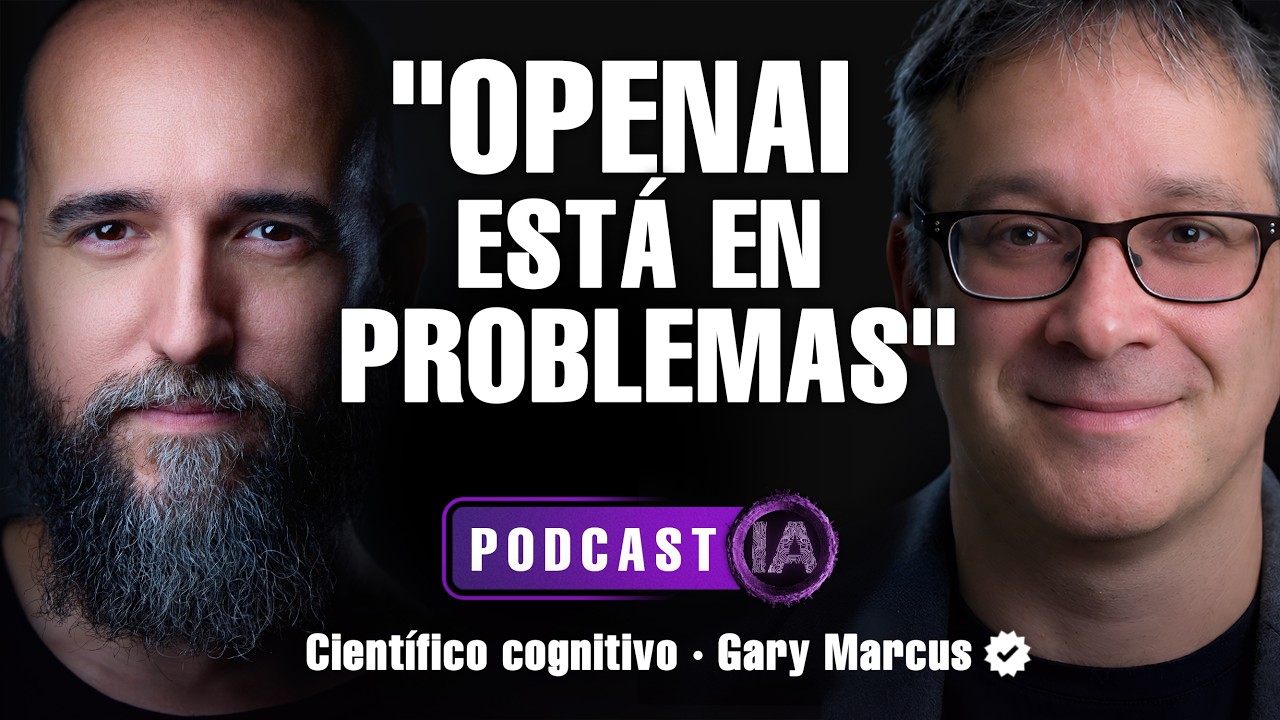
ChatGPT tiene un problema que ni miles de millones pueden resolver
ChatGPT has a problem that not even billions can solve
Title history
- ChatGPT tiene un problema que ni miles de millones pueden resolver — observed on 20261119-2048 UTC (YouTube)
Keywords
Summary
133 words
Critical Evaluation
Value of the Information & Strength of the Argument
The value of the information lies in the expert perspective of Gary Marcus, who provides a well-articulated critique of the prevailing AI paradigm. He distinguishes between different types of AI and explains why pure LLMs are insufficient. The argumentation is structured and logical, though it relies heavily on personal experience and published critiques rather than new experimental data. Marcus effectively uses analogies (e.g., a motor is not a car) to illustrate his points. The discussion on productivity is nuanced, acknowledging both individual gains and lackluster enterprise-level results. Overall, the arguments are compelling and well-presented, but they are inherently opinion-based.
Scientific Rigor, Source Quality, Title Accuracy
The video is an interview format, so rigor is moderate. Gary Marcus’s credibility is high, and he references his own writings and known publications. However, specific sources are not cited within the conversation. The description includes links to the CSIC (where the episode was recorded), Gary Marcus’s LinkedIn, and various educational resources. The title adequately reflects the content, though it exaggerates the ‘billions’ aspect. There are no formal citations during the talk, but the expert’s background lends authority. The presence of sponsored segments (approximately 1 minute each) does not impact the substantive content.
207 words
Title / Content Match
The title is somewhat sensational but accurately reflects the core discussion about fundamental limitations of ChatGPT and LLMs.
Quality & Reliability
7/10
The video features a credible expert (Gary Marcus, professor emeritus at NYU) discussing technical AI topics, but the content relies largely on personal opinions and anecdotal evidence rather than peer-reviewed data. Sponsored segments are present but do not affect the evaluation.
Chapters
- Trailer
- ¿Qué critica realmente Gary Marcus?
- Los límites de los LLM
- Alucinaciones y errores de ChatGPT
- La revolución de los agentes
- ¿Qué es la IA neurosimbólica?
- El problema de los modelos del mundo
- Ahorra tiempo en el proceso de contratación con Viterbit
- ¿Necesitamos reinventar la inteligencia artificial?
- ¿La IA mejora nuestra productividad?
- Los peligros de aprender con IA
- Los riesgos de los agentes autónomos
- Dell Technologies Forum 2026
- ¿Estamos malgastando dinero en IA?
- ¿OpenAI y Anthropic están perdiendo?
- La guerra de precios
- ¿OpenAI y Anthropic terminarán siendo compradas?
- El futuro de los modelos locales
- Mejora tu productividad con Plaud
- Innovaciones y optimizaciones dentro de la IA
- Gary Marcus opina sobre Sam Altman
- ¿Qué piensa sobre Dario Amodei?
- Demis Hassabis y la ciencia
- Gary Marcus opina sobre Elon Musk
- ¿Debemos temer a la IA?
- La explosión de inteligencia artificial
- La gran predicción para 2027
- Despedida
Cited Sources
- Gary Marcus's LinkedIn — Guest's professional profile
- CSIC website — Recording location and collaborator
- Club de la IA — Community mentioned by the host
- IA Perfecta — Website listing AI tools
- Jon Hernández Education — Host's educational platform
External References
Contribution & Novelties
The video brings Gary Marcus’s well-known critiques to a Spanish-speaking audience, offering a clear explanation of neurosymbolic AI and its relevance. It provides a meta-analysis of recent AI developments, such as the role of harnesses, and challenges the dominant scaling narrative. The unique value is in the synthesis of Marcus’s views with current industry trends.
Pour aller plus loin :
- Neurosymbolic AI — Relevant concept discussed extensively in the video.
- Gary Marcus — Background on the guest and his work.
- World model — Central to Marcus’s argument for missing capabilities.
90 words
Radar Profile
The radar profile shows moderate scores across all dimensions, with higher scores in quantity of information and reliability, reflecting a dense but opinion-based discussion. The technical level is moderate, making it accessible to a broad audience, while the overall quality is solid due to the expert guest.