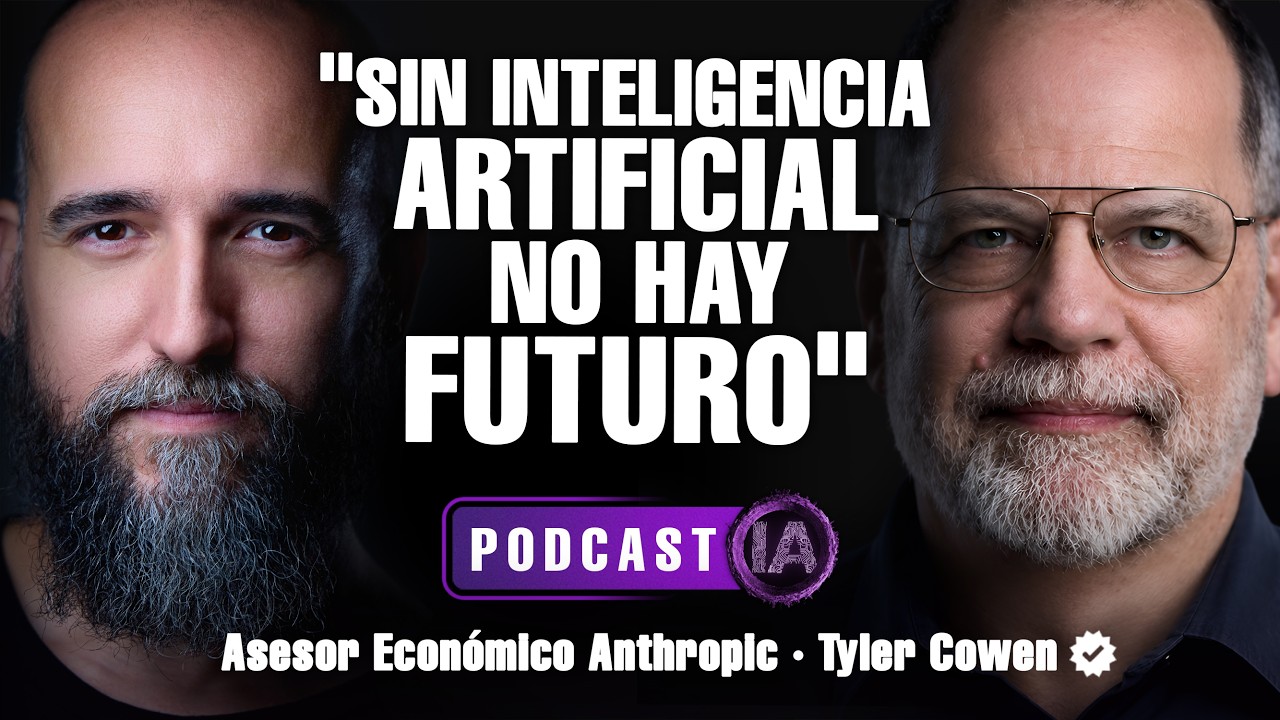
No hay plan B: la IA es nuestra única salida - Tyler Cowen
There Is No Plan B: AI Is Our Only Way Out - Tyler Cowen
Keywords
Summary
255 words
Critical Evaluation
Value of the Information & Strength of the Argument
The informational value is high for a talk-format piece: the interview accumulates a large number of distinct arguments rather than restating a single thesis, moving from near-term risk to growth accounting, from industrial policy to education, and from valuation questions to medical regulation. Cowen reasons by analogy and by counterfactual, which makes his case easy to follow: the scientific revolution of the 1620s–1630s is used as a structural parallel in which the costs of upheaval arrive within a generation while the benefits (penicillin, in his illustration) arrive three centuries later, with the explicit counterfactual that compressing that timeline would have saved many more lives. The strongest argumentative move is his reframing of the binding constraint: frontier capability is advancing faster than the institutions that must absorb it, and he supports this with concrete examples — the university system, public healthcare, and the backlog of litigation filed with GPT or Claude while administrations still process claims manually. The weak point is quantification. The ‘half a percentage point’ of extra growth is justified only by a loose historical analogy to late-1990s US IT diffusion, without figures, dates or sources; the 40–50% of GDP attributed to ‘static’ sectors is offered as a rough order of magnitude; the two-trillion-dollar valuation of Anthropic is discussed as an expectation rather than a computed value, and Cowen himself labels it speculative. Predictions about AGI diffusion, longevity escape velocity and the fate of European politics are stated with confidence but without falsifiable criteria or time horizons that could be tested. The reasoning is also occasionally circular, for instance when near-term optimism about employment is grounded in the scale of future data-integration projects that are themselves a bet on the same technology. Overall the argumentation is honest about uncertainty in places (he explicitly downgrades his own life-extension prospects, and concedes that neither OpenAI nor Anthropic has secured revenue), but it rests on the authority and breadth of the speaker rather than on evidence presented in the episode.
Scientific Rigor, Source Quality, Title Accuracy
No source is presented on screen or read out during the conversation, and the episode contains no charts, datasets or references that a viewer could follow up. Third-party positions are paraphrased from memory rather than cited: Daron Acemoglu’s 2022 work on the near-zero macroeconomic impact of AI and his subsequent revision, Demis Hassabis’s claim that AI could cure diseases within a decade, Sam Altman’s statement about the financial department, Elon Musk’s advice to stop saving. All are reported second-hand, without titles, dates or links, which makes them impossible to check without independent search; the description provides no bibliography, only the guest’s personal website and the host’s own commercial offers. The host does supply some framing figures (Europe at roughly 5% of global compute against 75% for the United States) but without attribution. Advertising is present in the form of several promoted segments embedded in the episode, including two mid-roll blocks of roughly 1.5 to 2 minutes each; their presence has no bearing on the informational assessment. On title-to-content fit, the ’no plan B’ claim is effectively argued in the growth and pensions section, but the title overstates the centrality of that thread within an interview that is mostly about diffusion bottlenecks, Europe and education.
547 words
Title / Content Match
The title's 'no plan B' framing is genuinely defended in the episode, where AI-driven growth is presented as the only escape from the fiscal and pension squeeze. It is nonetheless a dramatised condensation of a much broader 74-minute conversation covering Europe, geopolitics, education and regulation.
Quality & Reliability
6/10
Long, dense interview with a recognised economist (George Mason University, co-author of Marginal Revolution, author of The Great Stagnation), whose arguments are internally coherent and largely consistent with mainstream economics of technology diffusion. Credibility is however limited by the format: no data, no citations on air, several quantitative claims given as rough orders of magnitude (0.5 pp extra growth, a 40–50% of GDP 'static sector'), a number of unfalsifiable predictions (valuations, AGI timelines, longevity), and paraphrases of third parties (Acemoglu, Hassabis, Altman, Musk) that are not sourced. The presence of three advertising segments does not affect this assessment.
Chapters
- Tráiler
- Los riesgos inmediatos de la IA
- Frenar la IA y la apuesta por Anthropic
- El coste de acelerar la IA
- La soberanía europea en IA
- IA, crecimiento y pensiones
- InfoJobs y Viterbit: selección con IA
- Longevidad y avances médicos
- La AGI y su adopción real
- El futuro del empleo
- Rossellimac: IA segura en empresas
- Ventajas profesionales y oportunidades para España
- EE. UU. vs. China: IA y robótica
- Anthropic y la automejora de la IA
- Los límites de la AGI y el valor humano
- La educación en la era de la IA
- Regulación y adaptación de Europa
Cited Sources
- Tyler Cowen — personal website and research pages — Official link given in the description for the guest, professor of economics at George Mason University and co-author of the Marginal Revolution blog.
- The Great Stagnation (Tyler Cowen) — Book referenced in the description as the guest's best-known work on the slowdown of measurable economic progress.
- Marginal Revolution (blog co-authored by Tyler Cowen) — Mentioned in the description; the economics blog through which much of Cowen's public writing circulates.
- Daron Acemoglu — 2022 work on the limited macroeconomic impact of AI — Referenced in the conversation as the paper arguing AI had near-zero measurable effect on the economy, and its later revision in light of agentic systems.
Concurring Sources
- Productivity paradox literature (Solow, late-1990s US IT diffusion) — Supports the argument that a general-purpose technology can take a decade or more to show up in aggregate productivity statistics.
- Baumol's cost disease / stagnant services sector — Echoes the claim that large, slow-adapting service sectors (health, education, public administration) constrain aggregate growth.
Dissenting Sources
- Acemoglu, 'The Simple Macroeconomics of AI' (2024) — Estimates much smaller total factor productivity gains from AI over ten years than the more than 0.5 pp annual boost Cowen treats as plausible, which directly challenges the growth arithmetic underlying the 'no plan B' thesis.
- Longevity escape velocity advocates (cited in the episode) — The interviewees referenced by the host argue that a few extra years of life would be enough to reach radical life extension; Cowen counters that regulatory approval cycles alone make the ten-year horizon implausible, leaving the disagreement unresolved in the episode.
External References
Contribution & Novelties
The episode’s original contribution is not new research but a synthesis: it ties the AI debate to a concrete fiscal argument — that roughly half a percentage point of additional annual growth is the difference between a Greek-style fiscal crisis and a manageable pension transition, which is what gives the ’no plan B’ framing its force. Cowen also offers three reusable analytical moves: the 17th-century scientific-revolution analogy, used to argue that costs front-load while benefits lag; the claim that the binding constraint is institutional rather than technical, quantified as a 40–50% of GDP ‘static sector’; and an insider’s perspective from Anthropic’s economic advisory council, which lets him distinguish between what frontier labs believe and what diffusion actually permits. His scepticism toward longevity escape velocity and toward AGI-in-Kenya-by-2030 narratives provides a useful counterweight to the more promotional discourse the host usually covers.
Pour aller plus loin :
- Tyler Cowen — Biography and bibliography of the guest, useful for situating his stagnation thesis and his libertarian-institutionalist framework.
- Scientific Revolution — Historical background for the analogy that structures the first half of the interview.
- Productivity paradox — The ‘you can see the computer age everywhere but in the productivity statistics’ debate, directly relevant to Cowen’s late-1990s growth comparison.
- Daron Acemoglu — Context for the labour-market and task-based literature implicitly invoked when the host raises Acemoglu’s change of view.
- Artificial general intelligence — Definitions and timeline debates, useful to separate capability claims from deployment claims as Cowen does.
- Baumol’s cost disease and the ‘stagnant sector’ argument, cited by name only — underpins the claim that slow-adapting public services cap aggregate growth.
267 words
Radar Profile
The profile is that of a high-density, low-technical conversation: information quantity is high because the interview ranges across macroeconomics, geopolitics, education and medicine, while technical depth stays modest since no model architecture, benchmark or dataset is discussed. Reliability sits in the middle — a credible expert speaking without citations, so the profile is broad rather than deep or verifiable.