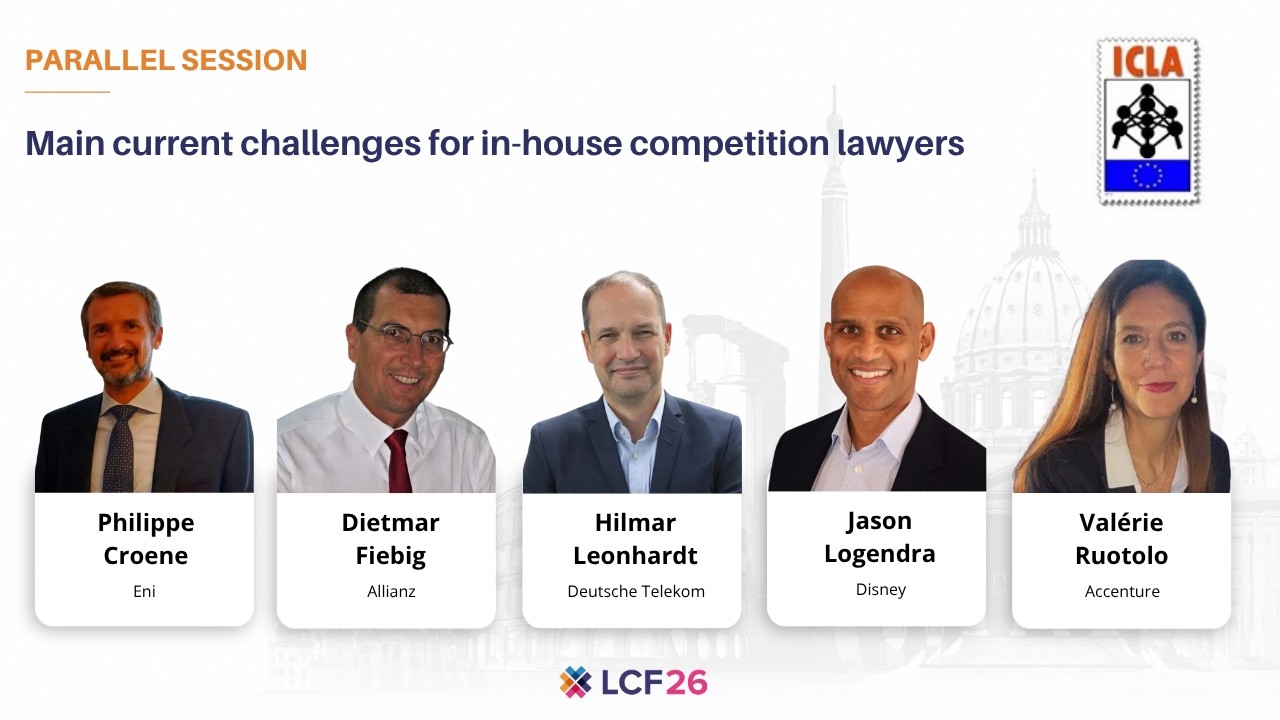
LCF26 | Main current challenges for in-house competition lawyers
Keywords
Summary
114 words
Critical Evaluation
Value of the Information & Strength of the Argument
The discussion provides valuable practical insights from senior legal practitioners on how recent regulatory developments affect real-world compliance. Arguments are well-structured, grounded in direct experience with merger control reviews and compliance programs. Speakers effectively illustrate the tension between business goals and legal constraints, such as the difficulty of proving efficiencies under the draft guidelines and the challenges of AI-generated documents in litigation. The exchange benefits from diverse industry perspectives, although some points remain exploratory without concrete data or case outcomes.
Scientific Rigor, Source Quality, Title Accuracy
The speakers reference specific regulatory texts (draft merger guidelines, 2004 Horizontal Merger Guidelines, 2024 EC labor market guidelines) and enforcement actions (Italian Competition Authority investigation, US luxury handbag merger case), lending credibility to their analysis. However, no external links or written sources are provided, and some references are vague (e.g., ‘a dawn raid in some country’). The title is fully aligned with the content, accurately summarizing the panel’s focus on current challenges for in-house competition lawyers.
171 words
Title / Content Match
The title accurately reflects the content: a panel discussion on current challenges for in-house competition lawyers, covering merger guidelines, labor markets, and AI.
Quality & Reliability
8/10
Panel of four experienced in-house competition lawyers from major multinationals, sharing practical expertise on merger control, labor market compliance, and AI. Views are informed and reflect real-world experience, though no empirical data or citations are provided beyond references to official guidelines and cases.
Key Moments
Markers derived by PSI from the transcript: the creator did not define chapters.
- Introduction by moderator, framing the panel structure and topics.
- Discussion on draft EU merger guidelines: Nils Zero comments on political influence and impact on national champions.
- Hilmer Leonard from Deutsche Telekom elaborates on scale, efficiency test, and standard of proof concerns.
- The panel addresses the treatment of internal documents and their evidentiary weight in merger reviews.
- Transition to labor market enforcement: Valerie Rotolo discusses Accenture's approach to no-solicitation and compliance training.
- Jason Logendra shares an anecdote about a trampoline park discussion, highlighting the reach of labor market cartel laws.
- Discussion on AI in business and legal practice: benefits and risks, including prompt discoverability and legal privilege.
- Wrap-up of AI discussion, with emphasis on the need for responsible AI use and compliance safeguards.
Cited Sources
- Draft EU Merger Guidelines — Mentioned as the primary subject of the merger control discussion; speakers critique its provisions.
- 2004 Horizontal Merger Guidelines — Referenced by Jason Logendra to contrast the treatment of internal documents.
- Draghi Report — Mentioned by Hilmer Leonard as the basis for the reform ambition behind the merger guidelines.
- European Commission guidelines on labor markets (2024) — Mentioned by Valerie Rotolo as background preparation for labor market compliance.
- Italian Competition Authority labour market investigation — Cited as an example of recent enforcement activity in labor markets.
Concurring Sources
- European Commission draft merger guidelines — The draft guidelines are the central topic; speakers' criticisms align with public commentary from legal professionals.
- 2004 Horizontal Merger Guidelines — Referenced as the existing benchmark against which the new draft is compared.
- US Federal Trade Commission enforcement on no-poach agreements — Mentioned indirectly through the luxury handbags merger case, illustrating similar enforcement trends.
Contribution & Novelties
The panel offers a rare in-depth look at how multinational corporations are adapting compliance programs to emerging antitrust risks in labor markets and AI. It provides concrete examples of internal training initiatives, challenges with AI-generated documents, and suggestions for improving merger guidelines. The discussion bridges legal theory with practical operational concerns, making it valuable for practitioners.
Pour aller plus loin :
- Competition law — Overview of competition law principles and enforcement.
- Merger control — Explanation of merger review processes and theories of harm.
- No-poach agreement — Specific antitrust issue related to hiring and wage-fixing, directly relevant to the labor market discussion.
101 words
Radar Profile
The radar profile shows high scores in information quality and technical level, reflecting the panel's expertise and depth. Quantity of information is moderate due to time limits, and reliability is high for a discussion format though not empirical. Overall, the radar indicates a well-balanced, expert-driven panel.