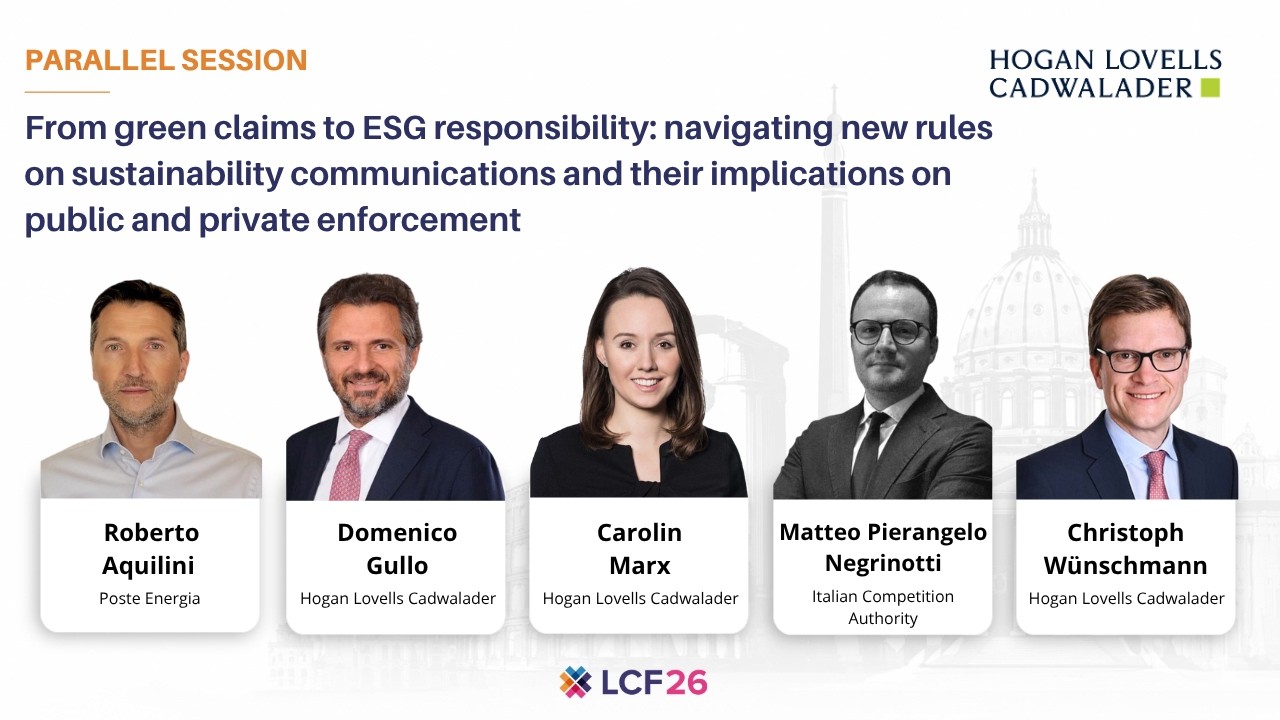
LCF26 | From green claims to ESG responsibility
Keywords
Summary
202 words
Critical Evaluation
Value of the Information & Strength of the Argument
The panel provides valuable insights into the evolving legal landscape for green claims and ESG, combining regulator perspectives with business experience. The argumentation is generally strong, with concrete examples from case law (e.g., AGCM’s Aquasan Benedetto, Armani, car emissions) and references to new legislation. However, some points remain high-level, and the discussion occasionally lacks critical depth on potential conflicts between sustainability goals and competition rules. The moderator’s questions guide the debate effectively, but the lack of a counterpoint or opposing view limits the critical examination of the positions presented.
Scientific Rigor, Source Quality, Title Accuracy
The panelists refer to key legal instruments (Directive 2024/825, proposal for Green Claims Directive) and real enforcement cases, but no written sources are provided in the video description. The factual statements appear reliable given the professional background of the speakers. The title accurately captures the content, transitioning from specific green claims to broader ESG obligations. The discussion is well-structured and factually grounded, though the absence of citations in the video limits verifiability for viewers. No comments were available for analysis.
184 words
Title / Content Match
The title accurately reflects the content, which transitions from discussion of green claims to broader ESG responsibilities.
Quality & Reliability
8/10
Expert panel discussion featuring regulators and legal practitioners with in-depth knowledge of EU and national frameworks. The arguments are well-structured and grounded in concrete case law, but the format does not allow for systematic citation of sources, and the claims are not accompanied by written references.
Key Moments
Markers derived by PSI from the transcript: the creator did not define chapters.
- Introduction of panelists and overview of the Empowering Consumers Directive
- Matteo discusses enforcement changes, blacklisted practices, and burden of proof
- Roberto presents Poste Italiane's ESG strategy and concrete green initiatives
- Kristoff compares enforcement across EU and mentions antitrust cases on emissions and recycling
- Discussion turns to private litigation and upcoming trends in ESG-related claims
Cited Sources
- Directive (EU) 2024/825 on empowering consumers for the green transition — Central legal instrument discussed, entering into force on 27 September 2026.
- AGCM decision in Aquasan Benedetto case (2009) — First Italian competition authority case on green claims, cited by Matteo.
- European Commission car emissions cartel case (fine €875 million) — Mentioned by Kristoff as an example of sustainability-related antitrust enforcement.
Contribution & Novelties
The discussion offers a rare cross-jurisdictional view of green claim enforcement, combining public and private perspectives. It highlights how the new directive simplifies authorities’ work and stresses the importance of ‘walking the talk’ in corporate ESG strategies. The practical example from Poste Italiane demonstrates how companies can embed sustainability in their business model to avoid greenwashing risks.
Pour aller plus loin :
- Directive (EU) 2024/825 — The relevant EU directive on empowering consumers for the green transition.
- Green Claims Directive proposal — European Commission’s proposal to further regulate environmental claims.
- CMA consumer protection cases — UK Competition and Markets Authority’s enforcement actions related to green claims and consumer law.
109 words
Radar Profile
The profile shows high technical level and strong information quality, with moderate scores in quantity and reliability. The discussion is highly specialized, targeting legal professionals, and relies on expert opinions rather than systematic citations, which slightly reduces the reliability score.