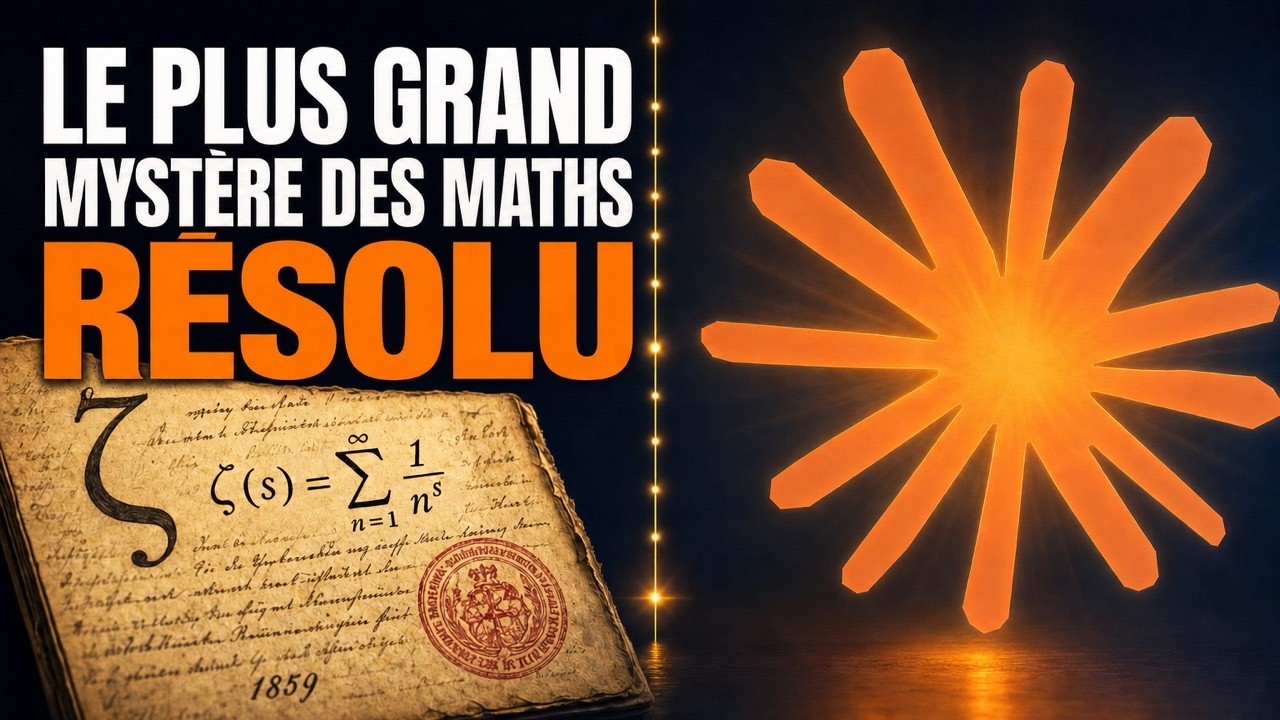
L'hypothèse de Riemann est démontrée : l'histoire vraie d'une énigme de 167 ans
The Riemann Hypothesis Is Proven: The True Story of a 167-Year-Old Enigma
Keywords
Summary
296 words
Critical Evaluation
Value of the Information & Strength of the Argument
The informational value is high for a 14-minute format: the video avoids the usual hand-waving by giving concrete numbers, dates and mechanisms. It explains the Euler product, the interpretation of zeros as frequencies added to Gauss’s smooth staircase, and the Riemann–Siegel formula, in terms a non-specialist can follow without distortion. It also supplies the quantitative history of partial results, which most treatments omit, and it correctly separates three distinct epistemic states: numerically verified for a finite range, proved for a positive proportion, and formally certified in a proof assistant. The argumentation is essentially chronological and cumulative, which suits the subject and gives the conclusion weight. Its weakest point is a recurring slippage in register: the narration moves from ’the verifiers declare the proof correct’ to ’the hypothesis has been proven’ and back to caution, without ever asking whether a machine-checked derivation of an unread 17-million-line object should count as a proof in the sociological sense the Clay rules imply. The question is raised at the end (‘would you accept a proof no one has read?’) but not analysed. The human-interest vignettes — Hardy’s postcard, the Princeton tea, Hilbert’s alleged answer about the emperor Barbarossa — are properly flagged as anecdotes or reported second-hand by the narrator, which is good practice. The competing 940-page handwritten manuscript is mentioned fairly, with its unverified status stated. Overall the reasoning is sound and well-paced, but the video performs more narrative synthesis than critical examination of its central claim.
Scientific Rigor, Source Quality, Title Accuracy
Rigour and sourcing are well above the norm for the genre. The description lists primary and secondary references that correspond precisely to the claims made: Riemann’s 1859 memoir in the Wilkins transcription, Gauss’s letter to Encke of 24 December 1849 as translated in the AMS Bulletin, Euler’s E72, Siegel’s 1932 paper in English translation, Pólya’s recollections, the Hejhal–Odlyzko piece on Turing’s zeta computations, the IAS article on primes and random matrices, Platt–Trudgian (2021), and the Clay Institute’s rules. For the contemporary segment it points to Alpöge’s four-page note, the Lean/Mathlib verification announcement, Sutherland’s and Rubinstein’s independent verification pages, Tao’s blog post, Vakil’s announcement of Masullo’s manuscript, and the Anthropic research note. The video is careful to attribute anecdotes to their sources and to label Hilbert’s response as a ‘dirty story’ reported by Pólya. It also encloses the claim within explicit limits: no human review of the reasoning, two further independent checks still running on 23 November, and a prize timeline that cannot start before 2028. The main reservation concerns proportionality: one blog announcement from the Lean community and a four-page author’s note carry an enormous conclusion, and the video reports their authority without interrogating how the statement was matched to the Riemann hypothesis inside the formalisation. The one point where the sourcing is thin is the August 2026 ’two thirds’ episode, reported without naming the external referees beyond Conrey. On the title: it announces a proven hypothesis and a ’true story’; the story is indeed documented wager by wager, but the headline’s certainty runs ahead of the video’s own qualifications and concentrates the epistemic weight on the single most contested element.
530 words
Title / Content Match
The title matches the content — a history of the Riemann hypothesis culminating in the announced 2026 Lean proof — but it asserts the result as settled fact while the video itself notes that no human has reviewed the argument and that the Clay prize cannot be awarded before 2028. Slight overstatement of certainty in the headline.
Quality & Reliability
7/10
The video is dense with real, identifiable references (Riemann's 1859 memoir, Gauss's 1849 letter to Encke, Siegel's 1932 work on the Nachlass, Turing's 1950 calculation, the Platt–Trudgian verification, the Clay Institute rules) and consistently distinguishes what has been machine-checked from what has been humanly reviewed. However, the central claim — a 2026 Lean proof of 17 million lines produced with an AI — rests on documents that no human has read as a paper, and the narration sometimes slides from 'certified by verifiers' to 'the hypothesis is proven' before returning to nuance. The framing is honest about the remaining uncertainty (Clay prize not before 2028, two independent checks still running on 23 November), which keeps the reliability above average, but the absence of any critical interrogation of the claim itself limits the score.
Chapters
Cited Sources
- Riemann, Ueber die Anzahl der Primzahlen unter einer gegebenen Grösse (1859), transcription D. R. Wilkins — The ten-page memoir containing the sentence 'very probable' that became the hypothesis.
- Gauss's letter to Encke (24 December 1849), translation in Tschinkel, Bulletin AMS (2006) — The only source for Gauss's youthful counting of primes and his logarithmic estimate.
- Euler, Variae observationes circa series infinitas (E72), Euler Archive — The Euler product expressing the zeta function as a product over primes.
- MacTutor, biography of Riemann — Biographical context: Göttingen, the Berlin Academy membership, illness and death in 1866.
- C. L. Siegel, Über Riemanns Nachlaß zur analytischen Zahlentheorie (1932), English translation — Siegel's study of Riemann's drafts, revealing his hand computation of the first zero and the Riemann–Siegel formula.
- G. Pólya, Some Mathematicians I Have Known (1969) — Source of the Hilbert anecdote and the Hardy postcard story.
- Hejhal & Odlyzko, Alan Turing and the Riemann zeta function — Turing's 1950 computation of the first 1104 zeros on the critical line.
- Institute for Advanced Study, From Prime Numbers to Nuclear Physics and Beyond (2013) — The Montgomery–Dyson encounter and the link between zero spacings and random matrix theory.
- Platt & Trudgian, The Riemann hypothesis is true up to 3·10^12 (2021) — Rigorous verification of over 12 trillion zeros, all on the critical line.
- Clay Mathematics Institute, Millennium Problems and prize rules — Rules requiring publication, a two-year waiting period and community acceptance before any award.
- Heidelberg Laureate Forum, Atiyah and the Riemann Hypothesis (2018) — The 2018 Heidelberg presentation of a short proof that convinced no one.
- Pratt, Robles, Zaharescu, Zeindler, More than five-twelfths of the zeros of ζ are on the critical line (2020) — The 41.7% record in the 'percentage race' before the 2026 advance.
- Anthropic, research note on the zeros of zeta (August 2026) — The claimed jump beyond two thirds of the zeros proven to lie on the critical line.
- L. Alpöge, Remark (20 November 2026) — The four-page note announcing the Lean formalisation produced with Claude.
- Lean FRO and Mathlib Initiative, Lean verification of the Riemann Hypothesis (21 November 2026) — The maintainers' statement that the statement is the Riemann hypothesis and the proof correct.
- A. Sutherland (MIT), verification files — First independent local run of the formalised proof.
- M. Rubinstein, independent verification — One of the independent verification efforts reported by the video.
- T. Tao, blog post of 20 November 2026 — Reaction quoted in the closing section: the strategy appears to mobilise much of modern mathematics and will take time to digest.
- R. Vakil, announcement of A. Masullo's manuscript (20 November 2026) — The competing 940-page handwritten proof, unverified and already reported to contain problems.
Concurring Sources
- Platt & Trudgian, The Riemann hypothesis is true up to 3·10^12 (2021) — Confirms the video's statement that rigorous numerical verification covers thousands of billions of zeros, all on the critical line.
- Hejhal & Odlyzko, Alan Turing and the Riemann zeta function — Confirms the 1950 Manchester computation and Turing's stated hope of finding a zero off the line.
- Clay Mathematics Institute, prize rules — Confirms the procedural timeline that precludes any award before 2028 at the earliest.
Dissenting Sources
- R. Vakil, announcement of A. Masullo's manuscript (20 November 2026) — A competing claim published the same day complicates the video's framing: a 940-page handwritten proof, humanly readable but unverified and already reported to contain problems, illustrates that formal certification and mathematical acceptance do not coincide — the very tension the video raises at the end without resolving.
External References
Contribution & Novelties
The video’s contribution is less the mathematical content — the zeta function and its zeros are standard fare — than the assembly of a continuous 167-year narrative in which each partial result is placed on a single scale of certainty: numerical verification, partial density results, formal certification. It also articulates clearly, if briefly, the distinction that the 2026 episode forces on the discipline: a machine-checked derivation of 17.37 million lines across 17,517 files, comparable in size to the whole of Mathlib, is verifiable but not readable, and the ordinary social mechanisms of mathematical acceptance — refereeing, exposition, simplification — have not yet operated. The comparison with the 940-page handwritten manuscript published the same day, unverified but humanly legible, sharpens the question. The video is also careful to state the Clay Institute’s procedural constraints, which most coverage of such announcements omits. Its limitation is that it reports the announcement more than it examines it: the crucial step, showing that the formal statement proved in Lean is indeed the Riemann hypothesis, is asserted on the authority of the maintainers’ blog post rather than explained.
Pour aller plus loin :
- Riemann hypothesis — Overview of the statement, its history and the state of partial results.
- Riemann zeta function — Definition, Euler product, analytic continuation and the critical line.
- Lean (proof assistant) — The interactive theorem prover and its mathematical library Mathlib, in which the 2026 proof is written.
- Clay Mathematics Institute — Millennium Problems rules — The procedural conditions (publication, two-year wait, community acceptance) governing any award.
- Proof assistant / formal verification of mathematics — The general question of what a machine-checked proof certifies, and the sociology of acceptance it implies.
- Riemann–Siegel formula — The computational method found in Riemann’s drafts by Siegel and still used for large-scale zero computations.
297 words
Radar Profile
The profile is that of a well-documented popular-science narrative: information quantity and reliability are high, technical level is deliberately moderated to remain accessible, and quality sits slightly below quantity because the contemporary segment is reported rather than critically examined. The imbalance reflects the format — a 14-minute chronological story — rather than any weakness in the historical material.