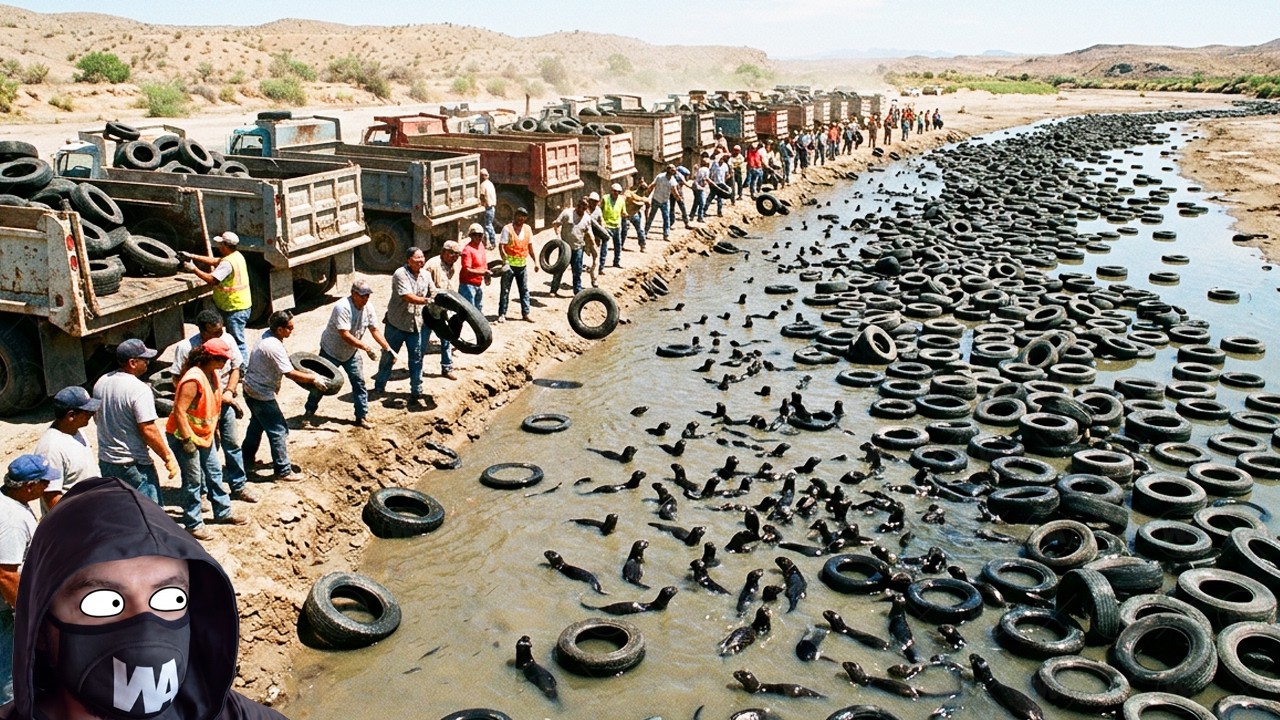
They Buried Thousands of Tires in the Dead River, but No One Expected Such Consequences
Title history
- They Buried Thousands of Tires in the Dead River, but No One Expected Such Consequences — observed on 20261031-2313 UTC (YouTube)
Keywords
Summary
237 words
Critical Evaluation
Value of the Information & Strength of the Argument
The video provides valuable insights into an unconventional engineering solution for erosion control. It effectively argues that the tire dam worked by slowing water flow and trapping sediment, demonstrating a practical recycling method. The argumentation is solid, with specific data on costs (the dam cost $5,000 vs. $35,000 for concrete), quantitative results (5 acres of reclaimed land), and a clear explanation of the hydrological principles. The narrative logically progresses from the problem definition to the solution and its limitations, offering a balanced perspective. However, the video lacks direct citations to peer-reviewed studies, and its persuasive style occasionally oversimplifies the complexities of large-scale implementation.
Scientific Rigor, Source Quality, Title Accuracy
The video relies on anecdotal evidence and mentions researchers and locations without providing bibliographic references. While it names institutions like the Sandy Hook Marine Laboratory and the University of Arizona, no direct links or publications are cited in the description. The title is somewhat sensationalist but the content accurately reflects the surprising positive outcomes. The absence of explicit sources reduces the scientific rigor, but the factual details (dates, numbers, names) suggest a basis in real events. The presentation is engaging but should be cross-verified with independent sources for full reliability.
208 words
Title / Content Match
The title is somewhat clickbait with 'No One Expected Such Consequences', but the content does show unexpected positive results, so it fits.
Quality & Reliability
7/10
The video presents a real engineering case study with specific data, dates, and named individuals, but lacks direct citations or links to primary sources. The narrative is coherent and plausible, though independent verification is limited.
Key Moments
Markers derived by PSI from the transcript: the creator did not define chapters.
- Introduction of the tire waste problem and annual tire disposal rates.
- History of Broly Wash erosion, starting from the 1905 floods and progressing to severe gullying.
- Joshua Minyard and Stuart Honig propose using tires to build a permeable dam.
- Construction details: tying tires, filling with gravel, anchoring, and burying the base.
- Results after 3 years: 5 acres of new land, vegetation regrowth, and wildlife return.
- Limitations: labor intensity, scalability issues, and the ongoing Broly Wash watershed plan.
Cited Sources
- Sandy Hook Marine Laboratory - Tire reef research — Researchers at this lab studied using tires as artificial reefs in the late 1960s.
- Stuart Honig, University of Arizona — Engineering professor who proposed and oversaw the tire dam project.
- Joshua Minyard, engineer — Young engineer who designed the tire dam structure.
Contribution & Novelties
The original contribution of this video is to present a lesser-known case study of using waste tires as a low-cost erosion control structure. It highlights the success of a small-scale experiment in reclaiming land and restoring ecological function, while also critically examining the barriers to scaling such an approach. The video brings together topics of waste management, civil engineering, and ecological restoration in a tangible example.
Pour aller plus loin :
- Artificial reef — Relevant because tires were first tested as artificial reefs, and this page covers the concept and its environmental impacts.
- Gully erosion — The problem at Broly Wash was severe gully erosion; this page explains the process and control methods.
- Tire recycling — Provides context on the tire waste problem and various recycling applications, including civil engineering uses.
131 words
Radar Profile
The radar profile shows a balanced entry with strong points in information quantity and moderate scores in technical depth and reliability. The relatively lower reliability suggests a need for external verification, while the high information quantity reflects the detailed narrative.