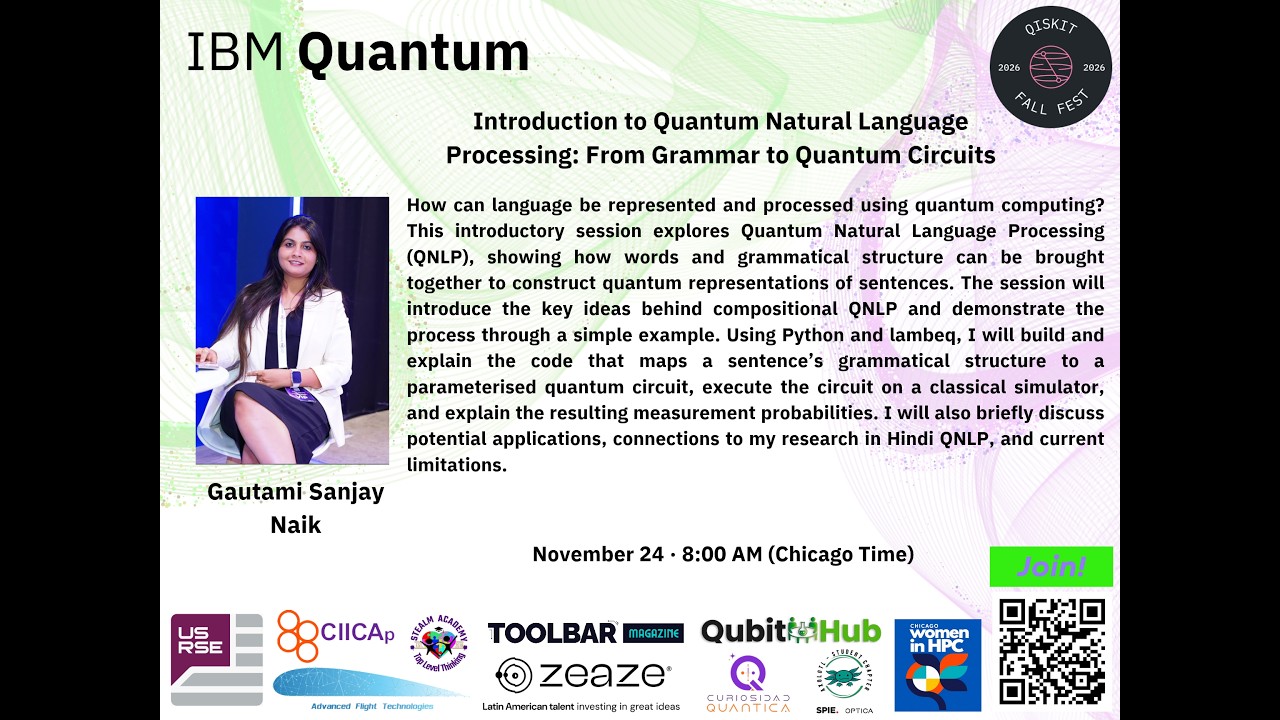
Introduction to Quantum Natural Language Processing: From Grammar to Quantum Circuits
Keywords
Summary
262 words
Critical Evaluation
Value of the Information & Strength of the Argument
The informational value lies mainly in the didactic articulation of a pipeline that is otherwise scattered across papers: the speaker makes explicit how a grammatical type assignment becomes a diagram, how the diagram becomes a circuit with a definite qubit count (one for each noun, three for the transitive verb, in her worked example), and how measurement outcomes are interpreted. For a viewer new to the field, this is a useful map, and the two-sentence contrast between ‘Alice loves Bob’ and ‘Bob loves Alice’ is an effective, concrete illustration of why compositionality matters. The most substantive original content is the Hindi section: the observation that a subject-object-verb language with karaka case marking tolerates reordering without semantic change, the consequent need for linguist-derived pregroup types, the absence of an open annotated corpus, and the low-resource result (about 210 sentences for sentiment classification) constitute the genuinely informative part of the talk. The argumentation, however, is largely by assertion and analogy rather than by demonstration. The claim that quantum NLP ’needs’ grammar instead of billions of sentences is stated as motivation without a controlled comparison; the assertion that quantum hardware ‘understood’ an English then a Hindi sentence conflates the execution of a circuit with semantic comprehension; and the efficiency claim about 210 sentences is presented without baselines, train/test protocol or error bars, so it cannot be weighed. Several formulations are pedagogically loose in ways that could mislead — equating words with qubits, describing grammatical composition as a ’linear equation’ being satisfied, or treating well-typedness as the criterion for a sentence being ‘right’. The Q&A adds real value, notably the clarification that r and l denote the right and left noun slots of the verb, and the honest admission that large sentences inflate qubit counts and motivate compressed pipelines such as DisCoPipe. The opening minutes are consumed by event housekeeping and community-channel announcements, which should be noted but do not affect the assessment.
Scientific Rigor, Source Quality, Title Accuracy
Scientific rigour is that of a live outreach lecture rather than a review: no equations beyond the pregroup notation, no complexity analysis, no discussion of noise, barren plateaus or trainability of parameterised circuits, and no quantification of any advantage over classical models. The historical framing compresses two decades of NLP into four bullet points and simplifies word embeddings into a single number per word, which is a distortion of what vectors are. The DisCoCat framework, the lambeq toolkit, the DisCoPipe pipeline and the 2020 execution of an English sentence on IBM quantum hardware are correctly attributed by name, and the speaker honestly flags that Hindi pregroup grammars barely exist and that she had to construct a dataset — a rare and valuable admission of the field’s limits. But the talk stops at naming: no bibliography is displayed in a durable form, the video description contains no links at all, and the viewer is left to search for the referenced work. The title/content fit is good: the promise of going from grammar to a quantum circuit is honoured literally, with a working code walkthrough, and the advertised discussion of applications, limitations and Hindi research is present, albeit briefly. The overall impression is of a sincere, well-structured pedagogical introduction whose credibility rests on the speaker’s institutional position rather than on verifiable citations.
554 words
Title / Content Match
The title matches the content: the session moves from grammar (pregroup types, DisCoCat) to an actual quantum circuit built with lambeq, plus a brief extension to Hindi. The advertised scope is delivered, though the depth remains introductory.
Quality & Reliability
5/10
The speaker is an identified doctoral researcher working on QNLP, and the conceptual chain she presents (pregroup grammar → string diagram → parameterised circuit → measurement) is faithful to the DisCoCat/lambeq literature. However, the talk is delivered live with heavy spoken-language approximation: several statements are imprecise or pedagogically simplified (words described as 'qubits', grammar described as 'linear equations', the historical timeline compressed into a few dates), no bibliography or URLs are given in the description, and the automatic transcript is noisy (toolkit names garbled). It is a credible entry-level orientation, not a citable technical reference.
Key Moments
Markers derived by PSI from the transcript: the creator did not define chapters.
- Host introduces the speaker and her work on QNLP, Hindi grammar-aware models and molecular representations.
- Compressed history of NLP: hand-written rules, statistical models, word embeddings, transformers, then QNLP milestones in 2020-2021.
- The motivating example: classical models see 'Alice loves Bob' and 'Bob loves Alice' as the same bag of words, losing who does what to whom.
- Introduction of pregroup grammar: nouns typed n, transitive verb typed n·r · s · n·l, and how the types contract to a valid sentence.
- String diagrams: each word as a quantum state, cups read as entanglement, and the resulting qubit count (1 + 3 + 1) for the example sentence.
- Overview of the full QNLP pipeline: sentence → grammar/string diagram → quantum circuit → training for a downstream task such as sentiment analysis.
- Hands-on session: installing lambeq, assigning grammatical types, drawing the diagrams for both sentences and converting them into circuits.
- Extension to Hindi: subject-object-verb order, karaka markers, absence of pregroup types and of an open dataset, and the custom parser built to fill the gap.
- Claimed low-resource result: sentiment classification on Hindi achieved with roughly 210 sentences, against thousands typically required classically.
- Q&A: what n·r and n·l mean, why grammar is central, why large sentences need compression pipelines such as DisCoPipe, and links to molecular representations.
Cited Sources
- lambeq — open-source QNLP toolkit — Presented as the toolkit that converts a sentence and its grammatical types into a string diagram and then into a quantum circuit; used in the live demo alongside pip installation.
- DisCoCat (DisCoCat categorical compositional distributional model) — Named as the theoretical framework underlying the string-diagram representation the speaker displays.
- DisCoPipe pipeline — Mentioned in the Q&A as the approach used to keep very large sentences from producing prohibitively complex circuits; the speaker refers viewers to the corresponding paper.
Concurring Sources
- lambeq — quantum NLP toolkit (documentation and repository) — Confirms the pipeline described in the talk: text → grammatical types → string diagram → quantum circuit, with simulator and hardware backends.
- DisCoCat framework overview — Corroborates that sentence meaning is obtained by composing word meanings according to grammatical structure, then reading the resulting diagram.
- Pregroup grammar — Corroborates the type notation used in the live demo, including left and right adjoints for the subject and object slots of a transitive verb.
Contribution & Novelties
The session’s distinctive contribution is not a new result but an end-to-end, runnable walkthrough: it connects the abstract compositional machinery of pregroup grammar and DisCoCat to a concrete Python workflow in lambeq that assigns types, draws string diagrams and emits circuits, and it does so in front of the viewer. The genuinely novel material for an outside audience is the Hindi case study — a subject-object-verb language whose karaka markers weaken the semantic role of word order, forcing the construction of new pregroup types with linguists, a bespoke parser and a hand-labelled dataset, with a reported low-resource sentiment classification obtained from about 210 sentences. That claim, if substantiated in a paper, would be the most interesting thread to follow, and the speaker also raises the practical limit that larger sentences increase qubit counts and motivate compressed pipelines. The talk is explicitly framed as an introduction, so the originality lies in the pedagogical bridge and in the under-documented Hindi resource effort rather than in theoretical advance.
Pour aller plus loin :
- lambeq — quantum NLP toolkit — The library demonstrated live; its documentation lets a reader reproduce the type-assignment, diagram and circuit steps shown in the talk.
- DisCoCat on Wikipedia — Entry point to the categorical compositional framework that gives the string diagrams their semantics.
- Pregroup grammar — Background on the type calculus (n, n·r, n·l) used to encode syntactic roles in the demo.
- Quantum natural language processing (overview) — Context on the field’s claims and open questions, useful for weighing the speaker’s assertions about advantage over classical models.
- Karaka case marking in Hindi and the notion of free word order in Indo-Aryan languages — Worth reading alongside the talk’s central linguistic argument, since it underpins the claimed difficulty of porting English pregroup types to Hindi.
295 words
Radar Profile
The profile is that of a pedagogy-first talk: information quantity and technical level sit in the middle, sustained by a real code walkthrough rather than by depth of analysis. Reliability and information quality are held back by the absence of any citable reference in the description and by over-simplified formulations, while the honest discussion of Hindi's missing resources is the strongest signal in the profile.