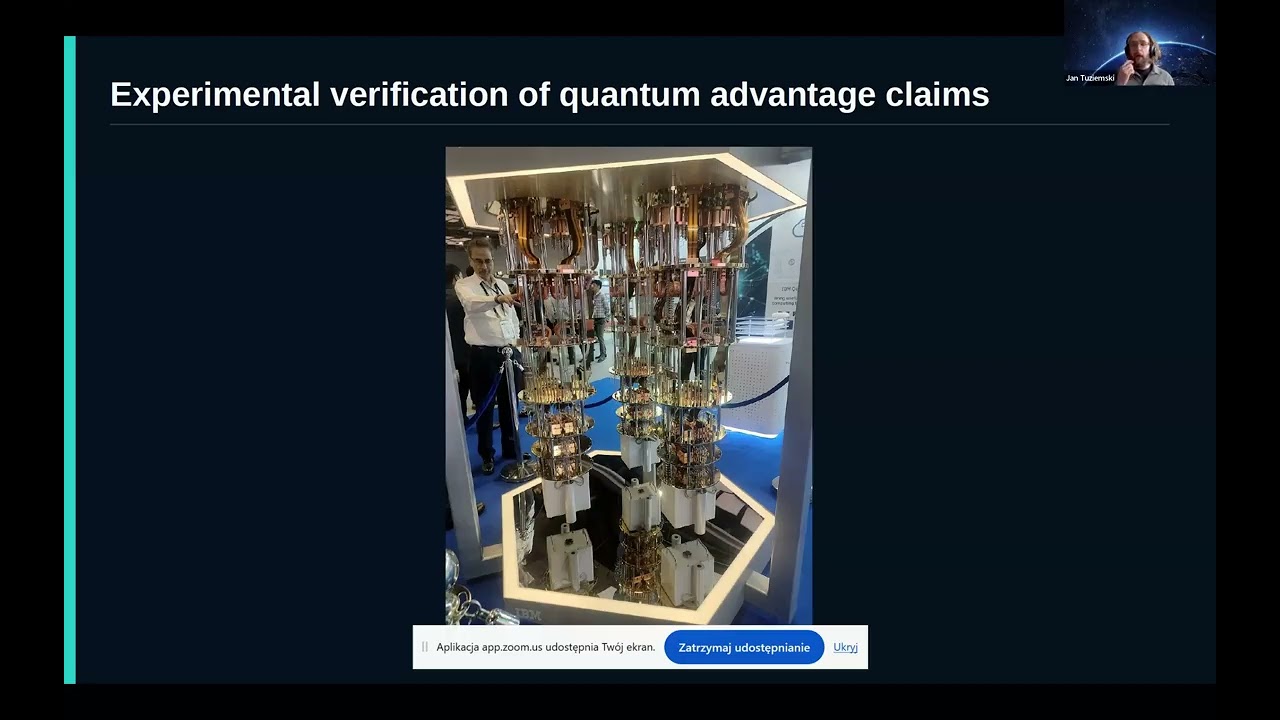
WQCG meetup - Episode LXXXI, 17.09.2026 (Jan Tuziemski, "Limits of quantum run-time advantage")
Keywords
Summary
109 words
Critical Evaluation
Value of the Information & Strength of the Argument
The talk provides a valuable contribution by critically examining the definition of quantum runtime. It convincingly argues that neglecting readout and reset times can lead to misleading conclusions about quantum advantage. The speaker reproduces previous results and shows how including all physical processes changes the scaling behavior. The argumentation is solid, supported by experimental data and references to existing literature. The talk also highlights the importance of measuring actual runtime rather than estimating it, using tools like Qiskit. This is a significant perspective for the quantum computing community.
Scientific Rigor, Source Quality, Title Accuracy
The talk is based on a peer-reviewed publication in Physical Review Applied, indicating high scientific rigor. The speaker refers to several known quantum algorithms (Shor, Simon) and experimental results (Google’s random circuit sampling). He also mentions the use of Qiskit for time measurement. The title accurately matches the content, as the talk indeed focuses on the limits of quantum run-time advantage. The speaker does not cite specific URLs but refers to published work and tools. The presentation is well-structured and technically detailed.
185 words
Title / Content Match
The title accurately reflects the content: the talk examines the limits of quantum runtime advantage, focusing on how definitions of runtime affect claims of quantum speedup.
Quality & Reliability
8/10
The talk is based on a peer-reviewed publication in Physical Review Applied and presents careful analysis of runtime definitions, reproducing prior results and demonstrating how including all physical processes changes scaling conclusions. The speaker provides technical details and references to established algorithms and tools.
Key Moments
Markers derived by PSI from the transcript: the creator did not define chapters.
- Introduction and welcome, announcements, and sponsor acknowledgments.
- Overview of different types of quantum advantage: complexity theory, Shor's algorithm, random circuit sampling, memory separation, heuristic algorithms, and energy.
- Discussion on the definition of quantum runtime for annealing devices, including programming, anneal, readout, and delay times.
- Experimental results showing that including all physical processes flattens scaling, undermining claims of quantum runtime advantage.
- Conclusion and emphasis on measuring actual runtime, with references to Qiskit and hybrid algorithms.
Cited Sources
- Limits of quantum run-time advantage — The paper underlying this talk, published in Physical Review Applied.
- Qiskit — Mentioned as a tool to measure actual runtime of quantum computations.
Contribution & Novelties
The talk contributes a critical analysis of how the definition of quantum runtime influences claims of quantum advantage, particularly in optimization problems. It emphasizes the need to include all physical processes (readout, reset, etc.) and advocates for measuring runtime directly rather than estimating it. The presentation reproduces previous claims and shows their fragility under more rigorous runtime definitions.
Pour aller plus loin :
- Quantum computing — Overview of quantum computing principles and algorithms.
- Quantum annealing — Description of the annealing process and its role in optimization.
- Time to solution — Definition and relevance of time-to-solution in benchmarking quantum annealers.
- Quantum supremacy — Context on demonstrations of quantum advantage.
108 words
Radar Profile
The radar shows high scores in information quality and technical level, with slightly lower but still good scores in quantity and reliability. This indicates a technically dense and well-sourced presentation, though not exhaustive in coverage of all aspects of quantum advantage.