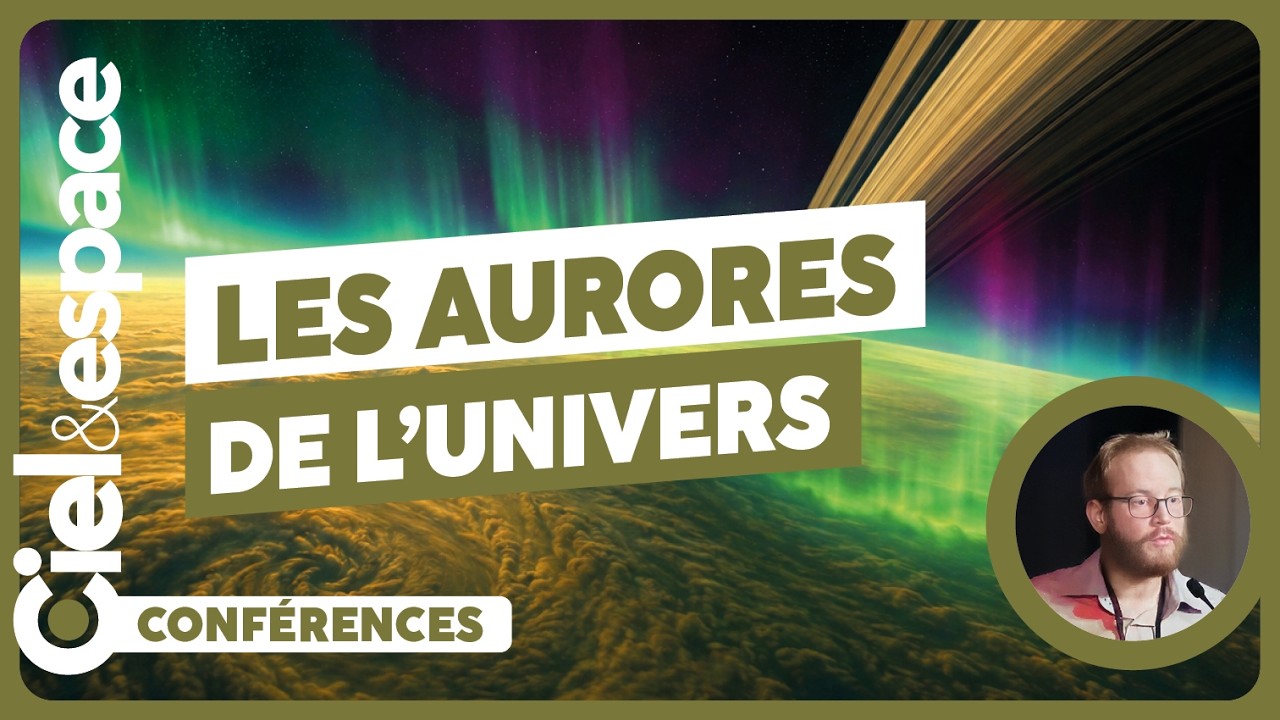
Les aurores polaires sont partout dans l'Univers ! Par Gaël Cessateur.
Auroras are everywhere in the Universe! By Gaël Cessateur.
Keywords
Summary
169 words
Critical Evaluation
Value of the Information & Strength of the Argument
The lecture offers substantial educational value by synthesizing a wide range of phenomena—from solar activity to atmospheric chemistry—into a coherent explanation of auroras. The argumentation is solid, building logically from fundamental physics (Lorentz force, Coulomb force) to complex magnetospheric processes like reconnexion and substorms. The speaker carefully distinguishes established facts from hypotheses, and corrects popular misconceptions with clear reasoning. The use of real-time footage and timelapses enhances the presentation, making abstract concepts tangible. The pace and depth are appropriate for a public interested in astronomy but not necessarily experts in plasma physics.
Scientific Rigor, Source Quality, Title Accuracy
The scientific rigor is high: the speaker references reliable names like NASA and presents data from actual events (e.g., the May 10, 2024 aurora). The description, however, only contains an abonnement link, not direct scientific references. The title accurately reflects the broad scope of the lecture, covering auroras across the solar system. Overall, the content aligns with current knowledge and is presented in a structured, didactic manner.
174 words
Title / Content Match
The title is slightly sensationalized but accurately reflects the content: the lecture indeed covers auroras not only on Earth but also on other planets, emphasizing their ubiquity in the Universe.
Quality & Reliability
8/10
The lecture is scientifically accurate, well-structured, and based on established physics and observations. The speaker clearly distinguishes facts from misconceptions, and the content aligns with current scientific understanding. Minor simplifications are appropriate for a general audience.
Key Moments
Markers derived by PSI from the transcript: the creator did not define chapters.
- Introduction to the lecture and the May 10, 2024 aurora event
- Definition of an aurora and common misconceptions (noise, weather)
- Basic physics: forces on charged particles in electric and magnetic fields
- Solar wind, solar activity, cycle, and coronal mass ejections
- Magnetosphere structure, currents, and magnetic reconnexion
- Electron precipitation, atmospheric interactions, and auroral colors
- Auroras on other planets and conclusion
Cited Sources
- Ciel & Espace subscription — Mentioned in the video description as an offer for the magazine.
Contribution & Novelties
The video provides a thorough, up-to-date overview of auroral science, integrating solar, magnetospheric, and atmospheric processes, and extending the discussion to other planets. It clarifies common misconceptions and explains the underlying physics clearly, making advanced topics accessible. For further reading, see the following resources:
- Aurora (Wikipedia) — Comprehensive overview of auroras, definitions, and mechanisms.
- Magnetosphere — Detailed explanation of the Earth’s magnetic environment and its interactions with the solar wind.
- Space weather — Overview of solar-driven phenomena affecting planetary environments.
80 words
Radar Profile
The radar profile shows high scores in information quantity, quality, and reliability, with a slightly lower but still solid technical level. This indicates a lecture that is both informative and trustworthy, but requires some background understanding to fully appreciate the advanced sections.