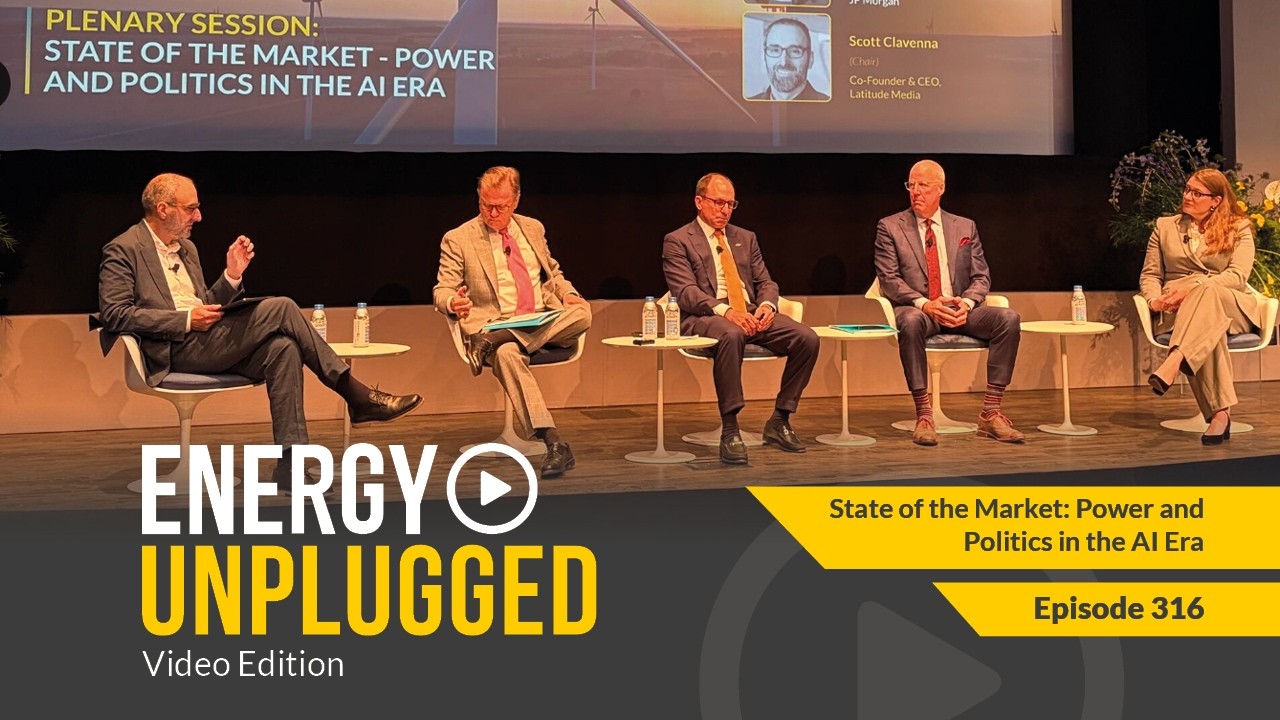
State of the Market: Power and Politics in the AI Era EP. 316
Keywords
Summary
230 words
Critical Evaluation
Value of the Information & Strength of the Argument
The value lies in the direct insights from key decision-makers at a major utility, an RTO, a financial institution, and a former FERC chair. The argumentation is solid: panelists ground their claims in specific examples like Constellation’s Google deals, MISO’s resource adequacy improvements, and market price signals. They build a coherent narrative that flexibility and storage are game-changers, supported by empirical observations. However, some assertions are forward-looking and speculative, such as the impact of El Niño and the trillion-dollar grid investment, which are plausible but not certain. The debate is well-structured, with each panelist offering distinct yet complementary perspectives, strengthening the overall credibility.
Scientific Rigor, Source Quality, Title Accuracy
The panelists reference concrete sources: J.P. Morgan’s ‘Race to Resilience’ report, a Duke University Nicholas Institute study on load flexibility, and FERC filings. No credentials are overclaimed; the discussion is explicitly based on professional experience and recent transactions. The title accurately encapsulates the core themes of market state, power supply, AI influence, and political context. The content aligns well with the title, though the title might understate the depth of technical market design discussions. The sources are credible and directly related to the topics, though no external links are provided in the description, so verification relies on the named institutions.
218 words
Title / Content Match
The title accurately reflects the discussion on power markets and AI with political overtones; matches content.
Quality & Reliability
8/10
Panel of high-level industry experts with extensive experience; discussion grounded in real data and recent transactions, though opinions and forecasts are inherent.
Key Moments
Markers derived by PSI from the transcript: the creator did not define chapters.
- Sarah Kapnick introduces the 'Race to Resilience' report and the shift from generation to resilience, noting global differences in energy demand drivers.
- David Dardis discusses Constellation's nuclear portfolio and recent Google deals, highlighting the difficulty of balancing market opportunities with policy and reliability.
- John Bear explains MISO's approach to resource adequacy and the combined load-generation interconnection study, addressing challenges from large loads like a 7.5 GW project in Louisiana.
- Pat Wood emphasizes the importance of flexible demand and storage as game-changers, citing his experience at FERC and the evolution of grid management.
- Discussion on off-grid data centers: David argues they are a last resort, while Sarah and John discuss policy and interconnection solutions to avoid islanding.
- Wrap-up on the need for speed, policy alignment, and the role of flexibility in accommodating AI demand without sacrificing reliability.
Cited Sources
- Race to Resilience (J.P. Morgan report) — Sarah Kapnick references this report she co-authored, discussing the global shift to resilience and the dual drivers of data centers and electrification.
- Duke University Nicholas Institute study on load flexibility — David Dardis cites a study showing that 44-45 hours of flexibility per year could add 100 GW of load without grid upgrades.
- Constellation-Google nuclear agreements — David Dardis mentions these transactions as examples of market-driven solutions to meet new demand.
Contribution & Novelties
This panel provides a unique cross-sector perspective on the AI-driven transformation of US power markets, highlighting the central tension between speed and sustainability. The original contribution is the synthesis of views from a utility, RTO, financial, and regulatory veteran, offering a nuanced picture of how flexibility, storage, and policy can manage the load surge. The discussion underscores that off-grid solutions are a last resort and that better market design can unlock capacity. It also brings attention to the geopolitical and economic dimensions often overlooked in technical discussions.
Pour aller plus loin :
- Data center — Relevant for understanding the scale and concentration of power demand.
- Energy transition — Provides background on the broader shift the panel addresses.
- Demand response — Directly linked to the flexibility solutions discussed.
- Battery storage power station — Key technology highlighted as a game-changer.
- Nuclear power — Constellation’s focus and a critical baseload option.
148 words
Radar Profile
The radar profile shows balanced strengths across all dimensions, with slightly higher scores in information quantity and reliability, reflecting the dense, expert-driven content. The technical level is moderate-high, making it accessible to industry insiders but challenging for general audiences.