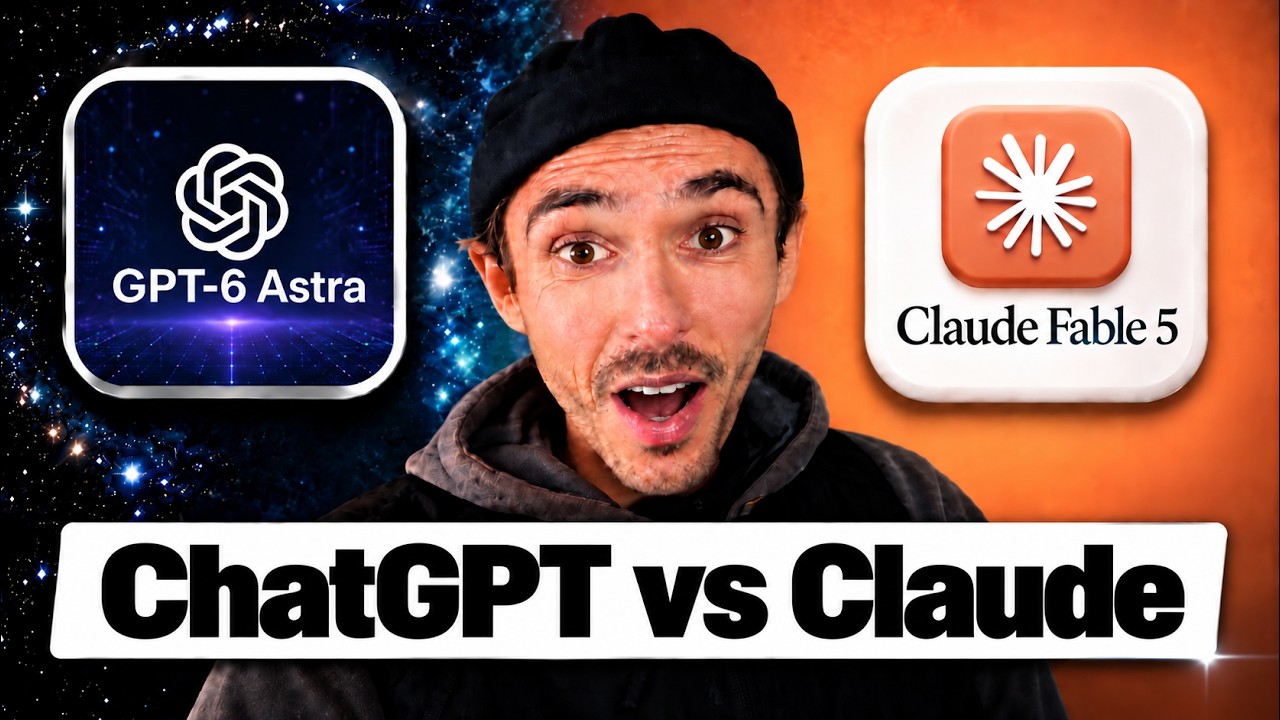
Claude vs ChatGPT 2026 : test terrain de Fable 5.1 et GPT-6 Astra
Claude vs. ChatGPT 2026: Field Test of Fable 5.1 and GPT-6 Astra
Keywords
Summary
184 words
Critical Evaluation
Value of the Information & Strength of the Argument
The value of the information lies in its practical, hands-on approach, testing AI models on realistic business tasks rather than relying on benchmarks. The author demonstrates real outcomes, including both successes and failures, with screenshots and live interactions, which gives credibility to his observations. However, the argumentation is largely anecdotal, based on a small number of tests, and lacks rigorous methodology. The cost analysis is useful, but the sample size of only a few scenarios limits the generalizability. The emphasis on iterative use and model tiering is valuable for practitioners.
Scientific Rigor, Source Quality, Title Accuracy
The video shows a clear effort to provide transparent testing, with explicit display of errors and unexpected costs. The creator’s expertise is evident, but the absence of third-party references or external sources weakens the scientific rigor. The title accurately reflects the content, being a direct comparison of the two AI models. The description includes links to the author’s service and newsletter, which are relevant context but not scientific sources.
174 words
Title / Content Match
The title accurately reflects the content: a comparative field test of two AI models on practical use cases.
Quality & Reliability
6/10
The assessment is based on hands-on testing with transparent disclosure of failures and costs, but the methodology is informal and non-reproducible, and the sample size is small.
Key Moments
Markers derived by PSI from the transcript: the creator did not define chapters.
- Introduction and presentation of the three test scenarios
- First test: generating a dashboard from 1000 Excel lines; ChatGPT produces an Excel dashboard, Claude a visual one.
- Second test: creating a maintenance app for geomatics surveyors; both models show interface strengths but fail in some functionalities.
- Third test: building a CRM from scratch; Claude fails despite high cost, ChatGPT quota exhausted.
- Discussion of pitfalls: one-shot expectations, API costs, and interface vs. functionality.
- Conclusion and call to action, emphasizing the importance of training and adopting AI.
Cited Sources
- The French Bot official site — Author's company offering AI consulting and training
- Newsletter signup — Exclusive AI tips newsletter
- Free strategic call booking — Offer of free 30-minute consultation
Concurring Sources
- The French Bot site — The author's business context and service offerings align with the practical approach.
Dissenting Sources
- None — No conflicting sources are provided or referenced in the video.
Contribution & Novelties
This video contributes practical field test insights on two latest AI models, revealing that despite similar paper specs, their real-world performance varies significantly. It highlights the gap between marketing claims and actual tool reliability, particularly in terms of one-shot generation and cost management. The author’s unique perspective as a consultant for SMEs adds practical value, emphasizing iterative workflows and model tier selection.
Pour aller plus loin :
- Vibe coding — A term describing the practice of guiding AI to generate software interactively, central to the video’s theme.
- Prompt engineering — The discipline of crafting instructions for AI models, directly relevant to the iterative workflow mentioned.
- Large language model — The underlying technology of these AI tools, useful for understanding their capabilities and limitations.
123 words
Radar Profile
The scores indicate a balanced profile with solid information quantity and moderate technical depth, but weaker reliability and global quality. The content is useful for practical guidance but lacks rigorous sourcing and scientific validation.