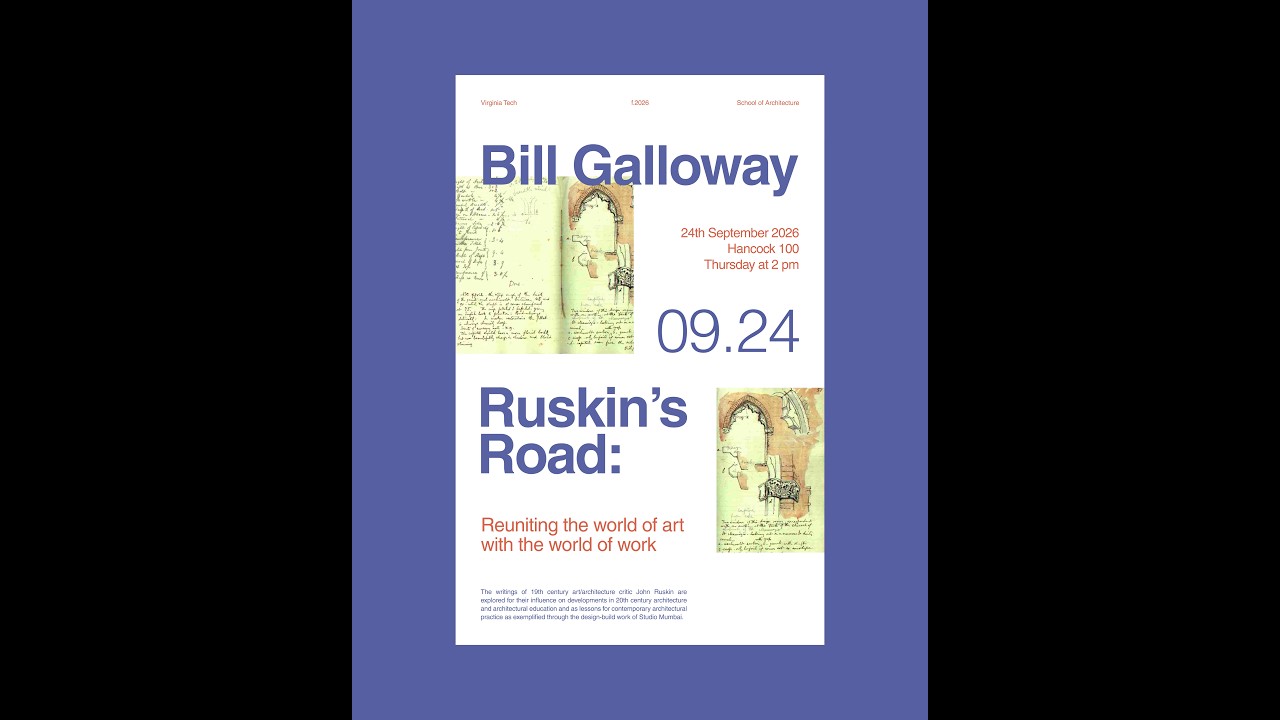
Fall 2026 Lecture Series | Bill Galloway: "Ruskin's Road"
Keywords
Summary
172 words
Critical Evaluation
Value of the Information & Strength of the Argument
The lecture is highly valuable for its historical depth and contemporary relevance. Galloway argues persuasively that Ruskin’s ideas, though rooted in the 19th century, offer timeless lessons on the relationship between labor, craft, and art. He supports this by quoting Ruskin extensively, connecting these ideas through historical movements (Arts and Crafts, Bauhaus) and culminating in the example of Studio Mumbai, which demonstrates the practical applicability of Ruskin’s philosophy. The argumentation is logical, moving from Ruskin’s personal practice to his theoretical critiques, then to his own design-build projects, and finally to a modern case study. The reasoning is solid, though it relies heavily on selective quotations and favorable interpretations. The lecture excels in showing the continuity of thought from Ruskin to contemporary practice, without oversimplifying the complex historical context.
Scientific Rigor, Source Quality, Title Accuracy
The lecture demonstrates high rigor in its use of primary sources, extensively quoting Ruskin’s texts (e.g., ‘The Stones of Venice’, ‘The Two Paths’, ‘Unto This Last’) and citing secondary influences like Huizinga’s ‘Homo Ludens’ and Adam Smith’s ‘Wealth of Nations’. The presenter identifies specific historical events (e.g., the O’Shea brothers at the Oxford Museum, the Hinksey Road project) and references key figures (Morris, Gropius, Gandhi). The title ‘Ruskin’s Road’ aptly captures both the literal Hinksey Road project and the metaphorical path from Ruskin’s ideas to modern architecture. The lecture’s rigor is evident in its clear sourcing and the coherence of its narrative. However, it relies on a single perspective and does not engage with critiques of Ruskin’s ideas, but overall, the sources are well marshaled and the content matches the title precisely.
275 words
Title / Content Match
The title accurately reflects the content, focusing on Ruskin's influence on architecture and design, from his own projects to contemporary practice.
Quality & Reliability
8/10
The lecture is scholarly, well-structured, and based on primary sources and historical research. It provides a thorough analysis of Ruskin's ideas and their influence, with verifiable references.
Key Moments
Markers derived by PSI from the transcript: the creator did not define chapters.
- Introduction to John Ruskin and his background as a critic and draftsman.
- Discussion of Ruskin's drawing practice and his philosophy of seeing and representing architecture.
- Reading from 'The Nature of Gothic' and critique of division of labor in the industrial age.
- Oxford Museum project, the O'Shea brothers' carving, and Ruskin's involvement.
- Hinksey Road project where Oxford undergraduates built a road, with Ruskin's guidance.
- Influence on Bauhaus and Walter Gropius, who credited Ruskin for integrating art and work.
- Introduction to Studio Mumbai as a contemporary example of Ruskin's principles in practice.
Cited Sources
- The Stones of Venice — Ruskin's book, particularly the chapter 'The Nature of Gothic', widely quoted by the lecturer.
- Homo Ludens — Huizinga's book on play, referenced to explain the methectic nature of drawing.
- Unto This Last — Ruskin's work that influenced Gandhi, mentioned for its line 'there is no wealth but life'.
- The Two Paths — Ruskin's lecture book on art and labor, cited in the lecture.
- The Wealth of Nations — Adam Smith's work, whose concept of division of labor Ruskin critiques.
- Studio Mumbai — Contemporary architecture practice presented as inheritor of Ruskin's ethos.
Contribution & Novelties
The lecture’s original contribution lies in synthesizing Ruskin’s ideas and demonstrating their direct connection to contemporary architectural practice, specifically through the lens of Studio Mumbai. It bridges history and current practice, showing how Ruskin’s concepts of holistic labor and design-build are not only historical interest but viable models today. The lecture also highlights lesser-known projects like the Hinksey Road, offering a nuanced view of Ruskin’s practical involvement.
Pour aller plus loin :
- John Ruskin — Comprehensive biography and overview of Ruskin’s writings and influence.
- Arts and Crafts movement — The movement directly inspired by Ruskin’s ideas, with key figures like William Morris.
- Studio Mumbai — Official site of the practice, offering details on their projects and approach.
- Design-build — A project delivery method that aligns with Ruskin’s emphasis on the unity of design and craft.
135 words
Radar Profile
The radar profile shows a balanced survey with high scores in quantity and quality of information, and moderate technical level. The lecture is not overly technical, but it provides substantial content and reliable references. The low technical level is appropriate for a general academic audience, while the high reliability and quality make it a solid resource.