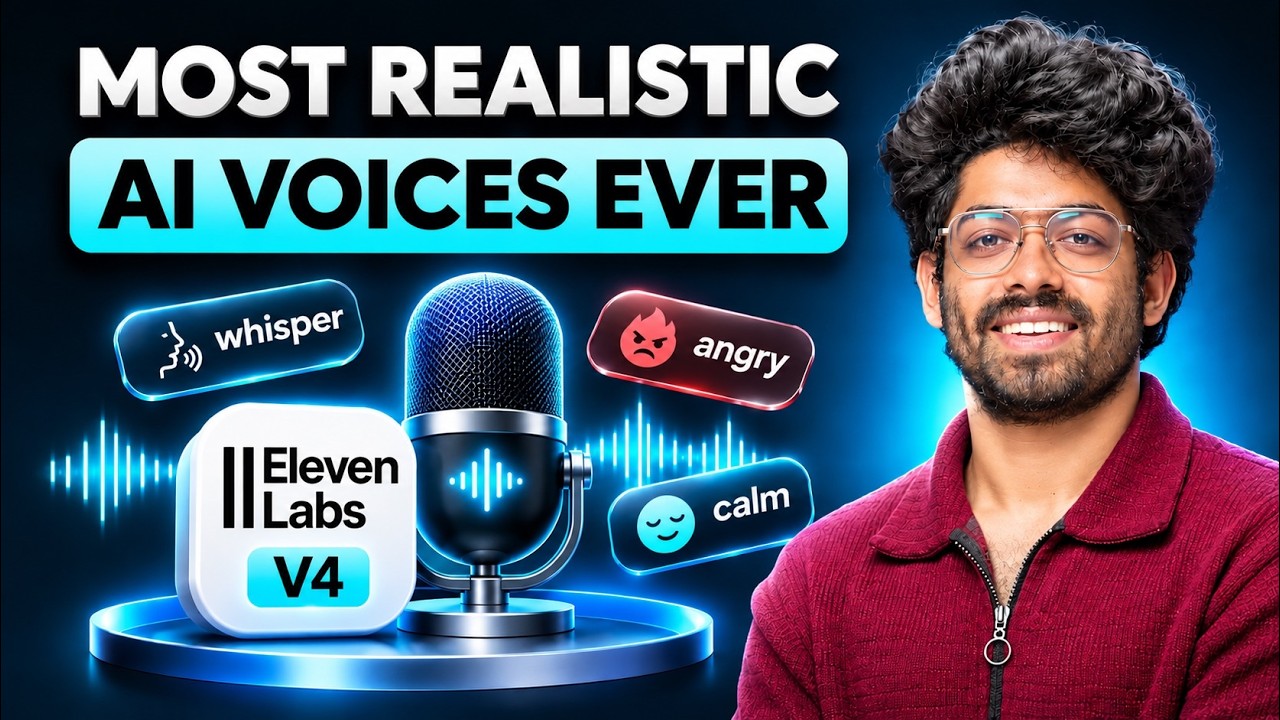
How to Make AI Voices Sound Insanely Realistic [Direct Eleven V4]
Title history
- How to Make AI Voices Sound Insanely Realistic [Direct Eleven V4] — observed on 20261118-1349 UTC (YouTube)
Keywords
Summary
136 words
Critical Evaluation
Value of the Information & Strength of the Argument
The main value of the video lies in its explicit demonstration of a specific technique (audio tags) to enhance AI voice realism. The argumentation is grounded in direct examples: the viewer hears the same sentence delivered with different emotions based on tags, and the contrast between tagged and untagged versions is stark. This practical evidence supports the claim that tags are effective. The video also shows how to scale this process using ChatGPT for auto-tagging, adding convenience. However, the argumentation remains at the level of demonstration rather than rigorous testing or comparison with other methods. It does not address limitations or potential issues, such as variability or artifacts.
Scientific Rigor, Source Quality, Title Accuracy
The video does not cite any external scientific sources; its authority rests on the creator’s own demonstration and the ElevenLabs platform. The title matches the content accurately. The presence of a sponsored segment (ElevenLabs) is disclosed at the end, but it may influence the objectivity. The instructions and techniques seem plausible, and the examples are reproducible. No user comments were provided for analysis.
186 words
Title / Content Match
The title accurately reflects the content, as the video focuses on directing AI voices to achieve realistic outputs using Eleven V4. The promised 'insanely realistic' results are demonstrated with examples.
Quality & Reliability
7/10
The video offers a clear, step-by-step tutorial on using ElevenLabs Eleven V4 audio tags to control AI voice expression. The demonstrations are convincing and the technical details appear accurate. However, the content is sponsored by ElevenLabs, and no independent sources or critical analysis are provided, reducing the overall reliability from an unbiased perspective.
Key Moments
Markers derived by PSI from the transcript: the creator did not define chapters.
- Introduction and demonstration of the same sentence with different emotions
- Overview of ElevenLabs interface and voice selection
- Generating a flat voiceover using an older model without tags
- Adding audio tags to control emotional delivery in Eleven V4
- Demonstrating sound effects and layered emotional tags
- Using ChatGPT to automatically add audio tags to a script
- Introduction to ElevenLabs Studio for full video production
- Final demonstration of a complete video assembled in Studio with voiceover, visuals, and captions
Cited Sources
- ElevenLabs (affiliate link) — The main platform discussed in the video; the creator uses it to demonstrate voice generation.
- aiholiq Newsletter — Creator's newsletter, mentioned as a way to stay updated with AI content.
- Astro K Joseph Website — Personal website of the creator, providing additional resources and contact.
- Scrimba (affiliate link) — Online learning platform for coding, promoted in the description.
- LinkedIn Profile — Professional profile of the creator for networking and further content.
Contribution & Novelties
The video’s original contribution is its focused demonstration of the audio tag feature in Eleven V4, showing how to achieve nuanced emotional expression and non-verbal sounds in AI voiceovers. It also provides a practical workflow integrating ChatGPT for tag generation, making the technique accessible to non-experts. This is a useful addition to the existing body of tutorials on AI voice synthesis.
Pour aller plus loin :
- Prosody (linguistics) — Explains the linguistic concept underlying audio tag control.
- Speech synthesis — Provides context on TTS systems and their evolution.
- Affective computing — Discusses systems that recognize and express emotion, relevant to emotional AI voices.
103 words
Radar Profile
The radar profile shows a moderate quantity of information (6), good quality (7), and a lower technical depth (5), reflecting a tutorial aimed at practical application rather than deep theory. The reliability score (6) is moderate, likely due to the absence of independent verification and the sponsored nature of the content.