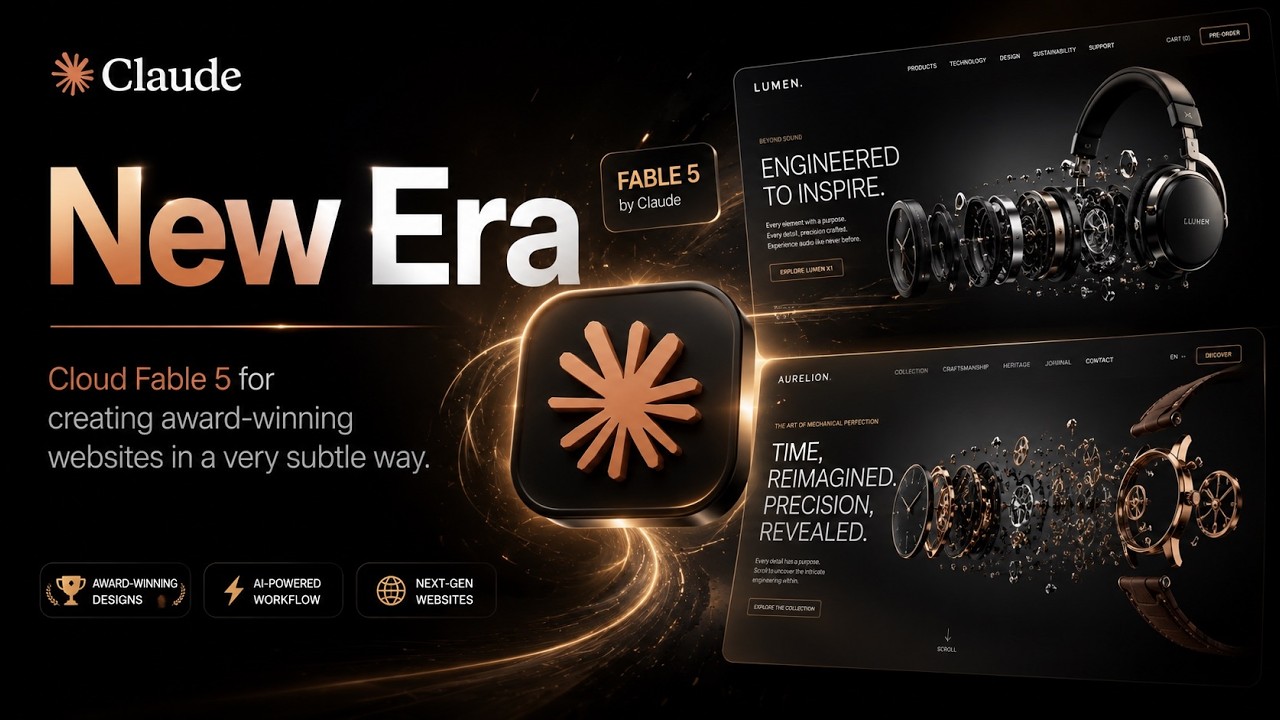
Claude + 3D Animations: Build $10,000 Al Websites in 15 mins
Keywords
Summary
174 words
Critical Evaluation
Value of the Information & Strength of the Argument
The video’s primary value lies in its clear, step-by-step demonstration of combining freely available AI tools (ChatGPT, Google Flow, Fublix, Claude Code) to produce a visually impressive website quickly. The argumentation is straightforward and practical: by providing detailed prompts and high-quality starting images, users can leverage AI to automate complex web animations. The creator supports his claims with live demos and shares all prompts, enhancing reproducibility. However, the argumentation lacks critical discussion of limitations, such as potential inconsistencies in generated content, dependence on specific tool versions, or the need for manual refinement. The integration of TestSprite is well-argued but appears promotional, as the tool is explicitly sponsored. Overall, the video offers actionable insights for AI-assisted web design, but its assertions about speed and quality should be taken with caution.
Scientific Rigor, Source Quality, Title Accuracy
The video cites all essential tools and resources in the description, including links to Google Flow, Fublix, Claude Code, TestSprite, and a document containing the exact prompts used. This transparency aids reproducibility. However, the title contains unquantified claims (’$10,000’, ‘15 mins’) that may mislead viewers, though the content largely aligns with the title’s promise of quick AI-powered website creation. The presentation is consistent with a tutorial, and the creator openly demonstrates the workflow without overstating technical depth. The inclusion of a sponsor (TestSprite) is transparent and does not undermine the core tutorial, but it does influence the recommendation. Overall, the sources are legitimate and the title-content alignment is acceptable, albeit slightly exaggerated.
256 words
Title / Content Match
The title accurately reflects the content's focus on using Claude and animations to build websites, though the '$10,000' is a marketing hyperbole and '15 mins' is optimistic (actual generation took ~10 minutes).
Quality & Reliability
6/10
The video provides practical, reproducible steps with visible results, but relies on subjective claims of 'award-winning' quality and lacks deep technical analysis. The workflow is plausible, but the reliability is moderate due to dependence on proprietary tools and the absence of independent verification.
Key Moments
Markers derived by PSI from the transcript: the creator did not define chapters.
Cited Sources
- Google Flow — Used for generating the animation from start and end frames.
- Fublix Video Frame Extractor — Tool for extracting individual frames from the animated video.
- Claude Code — Used to generate the complete website from the provided prompts and frames.
- TestSprite — AI-powered testing agent for front-end and back-end testing; the sponsor of the video.
- TestSprite CLI — Command-line interface for TestSprite used within Claude Code to run tests.
- Prompts used in the video — Document containing all the prompts shown in the video for image generation, animation, and website creation.
External References
Contribution & Novelties
The video presents a practical, end-to-end workflow that combines several free AI tools to create an animated website without manual coding. The key novelty is the integration of image-to-video generation with frame extraction and AI-based code generation, enabling non-specialists to produce visually rich web experiences. While each tool is known, the specific combination and the detailed prompts provide a reproducible method that can be adapted to various products. The inclusion of automated testing adds a quality assurance step, increasing the credibility of the process. However, the video does not introduce new algorithms or deep technical innovations; its contribution is primarily pedagogical.
Pour aller plus loin :
- Prompt engineering — Understanding how to craft effective prompts is central to this workflow.
- Artificial intelligence art — Background on AI-generated images and their use in design.
- Single-page application — The resulting website is effectively an SPA with interactive animations.
- Test automation — relevant to the automated testing step using TestSprite.
157 words
Radar Profile
The radar profile shows a balanced distribution with moderate scores across information quantity, quality, technical level, and reliability, indicating a practical tutorial with clear demonstrations but limited depth and some promotional bias.