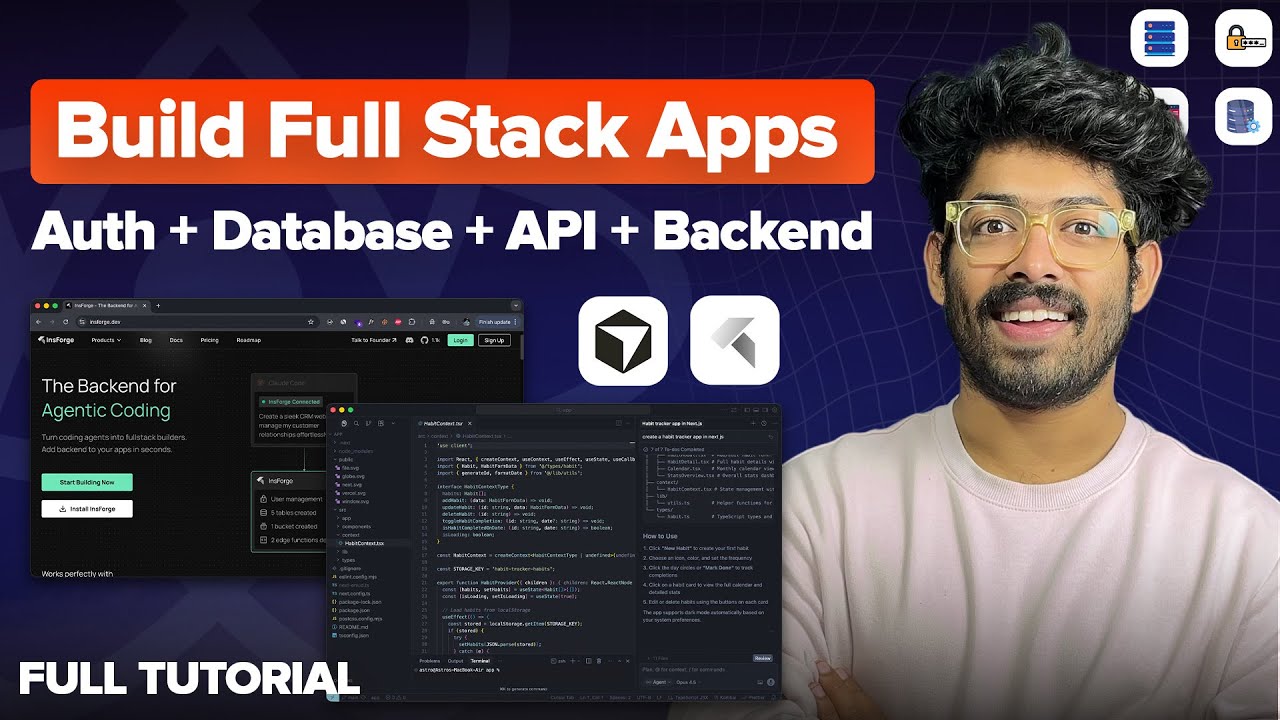
Building Full Stack Apps Using AI Can't Get Any Easier! (InsForge + Cursor)
Keywords
Summary
153 words
Critical Evaluation
Value of the Information & Strength of the Argument
The video provides a concrete, step-by-step demonstration of a real use case, adding practical value for developers interested in low-code/agentic development. The argumentation is straightforward: InsForge’s MCP integration with Cursor automates backend tasks, reducing complexity. However, the presenter’s enthusiasm is promotional, and he does not discuss limitations, security considerations, scalability, or cost. The argumentation relies on a single demo and may not generalize to complex production scenarios. The value lies in illustrating a new workflow, but it lacks critical assessment.
Scientific Rigor, Source Quality, Title Accuracy
The video is a tutorial with a clear scope, and the title matches the content. The sources cited are the tools themselves (InsForge, Cursor) and the creator’s social links; no scientific references are provided. The rigour is limited as it is a promotional demonstration without independent verification. The title is accurate but slightly hyperbolic, yet the content supports the claim of ease. No external sources are cited, only product links.
165 words
Title / Content Match
The title accurately reflects the content, which shows building full-stack apps with AI tools. The excitement is justified by the demo, but slightly overstates generality.
Quality & Reliability
6/10
The content is a practical demonstration with clear steps, but it is promotional and lacks deep scientific or technical validation. The claims about ease and speed are based on a single demo, not rigorous benchmarking.
Key Moments
Markers derived by PSI from the transcript: the creator did not define chapters.
- Introduction to InsForge as an agent-native backend platform
- Demonstration of InsForge dashboard and project creation
- Adding InsForge MCP to Cursor
- Writing the prompt for the full-stack app
- Reviewing generated database tables and authentication setup
- Testing the app: generating a trip itinerary manually
- Redesigning the landing page with a follow-up prompt
- Deploying the app to Vercel with a single click
Cited Sources
- InsForge website — Main platform for backend management
- Cursor website — AI code editor used to build the frontend
- aiholiq Newsletter — Creator's newsletter for AI content
- Astro K Joseph website — Creator's personal site
Concurring Sources
- Backend as a service — Conceptual support for InsForge's approach
External References
Contribution & Novelties
The video introduces a new workflow combining InsForge and Cursor to automate full-stack development, showcasing a paradigm shift where AI agents manage backend infrastructure. This approach reduces entry barriers for non-experts but raises questions about control and debugging. The demonstration is compelling for prototyping, but lacks discussion on long-term maintenance.
Pour aller plus loin :
- Backend as a service — Relevant background on BaaS models.
- Serverless computing — Underlying technology for deployment.
- Model Context Protocol (MCP) — Not provided with URL due to uncertainty about official reference.
87 words
Radar Profile
The radar profile shows moderate scores across all axes, indicating a balanced but not highly in-depth tutorial. The quantity of information is reasonable, but the technical depth and reliability are average, consistent with a promotional demonstration.