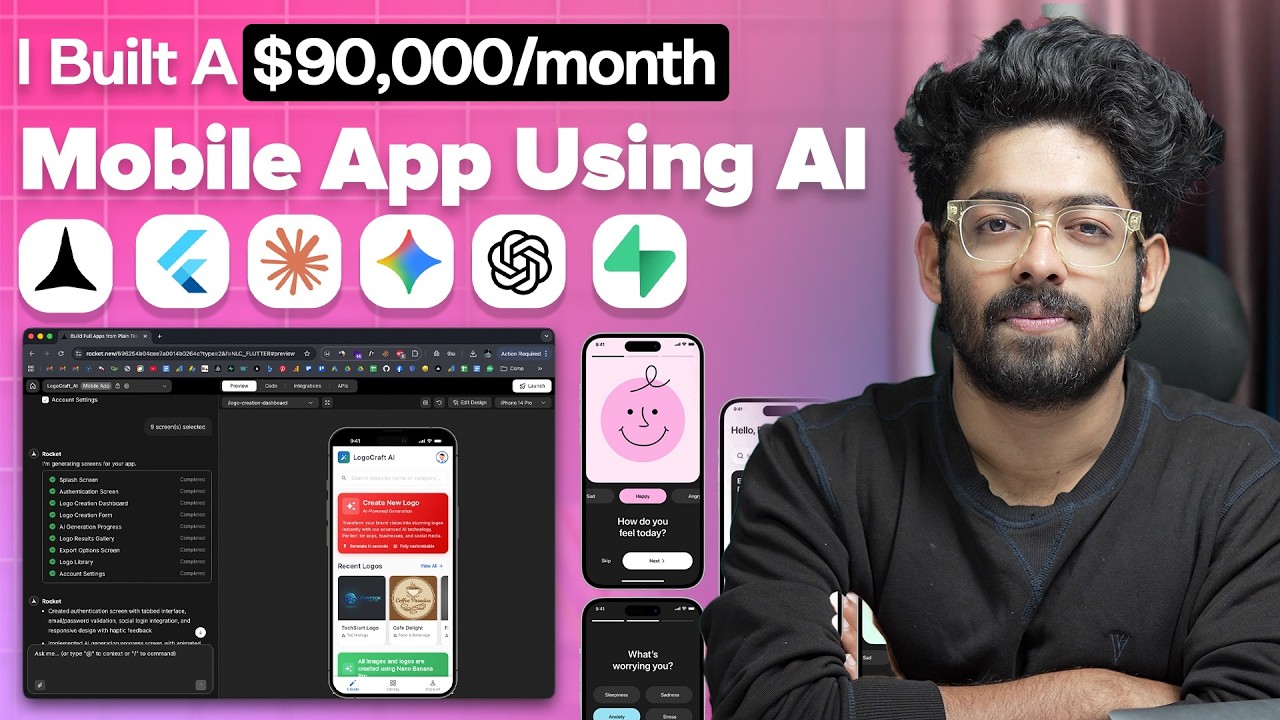
Watch Me Clone A $90,000 MRR Mobile App Using AI
Keywords
Summary
160 words
Critical Evaluation
Value of the Information & Strength of the Argument
The value of the video lies in its clear demonstration of how AI can accelerate mobile app development, making it accessible to non-coders. The step-by-step narrative is engaging and easy to follow, showing a complete flow from idea to working app. However, the argumentation is largely promotional: it portrays the process as effortless, without addressing potential pitfalls such as API costs, scalability issues, or the need for manual code refinement. The claim of cloning a $90k MRR app is used as a hook but is not substantiated with evidence (e.g., revenue charts, app store data). The video also lacks comparisons with traditional development or other no-code platforms, which would have provided a more balanced assessment.
Scientific Rigor, Source Quality, Title Accuracy
The scientific rigor is minimal; the video is a product demonstration rather than an educational study. Sources cited are limited to the creator’s own links (Rocket.new, newsletter, personal profiles) and a tutorial platform (Scrimba). No external research or independent verification is provided. The title is attention-grabbing but somewhat misleading, as the revenue figure is not proven and the cloning process is shown for a generic logo maker, not necessarily the exact app generating that revenue. The content aligns well with the title in terms of showing the build process, but the financial claim is overblown. No comment analysis is provided, as no comments were supplied.
235 words
Title / Content Match
The title accurately describes the process of cloning an AI logo maker app, though the claimed $90,000 MRR is not independently verified and appears to be a screenshot from a third-party analytics tool.
Quality & Reliability
5/10
The video provides a practical step-by-step demonstration of building a mobile app using AI, but it is heavily promotional for Rocket.new and relies on unverified revenue claims. The technical depth is shallow, and while the process is shown, limitations and alternative approaches are not discussed.
Key Moments
Markers derived by PSI from the transcript: the creator did not define chapters.
- Introduction: Creator introduces the goal of cloning a $90k MRR app using AI.
- Overview of Rocket.new features including Flutter, integrations, and deployment.
- Starting the build: Entering a text prompt for an AI logo generator app.
- Selecting screens for the app (e.g., onboarding, logo creation form, gallery).
- Integrating Supabase for authentication and database; creating a project and linking it.
- Adding Gemini API key and connecting the AI image generation model.
- Testing the app: signing up, generating a logo, and checking storage in Supabase.
- Using targeted edits with '@' and '/' commands to modify UI elements.
- Demonstrating visual edit mode and then building the APK for installation.
Cited Sources
- Rocket.new - AI app builder — The main platform showcased in the video for building mobile and web apps via prompts.
- The 'aiholiq' Newsletter — Creator's newsletter mentioned in the description for further AI insights.
- Astro K Joseph - Personal Website — Creator's website with links to social media and contact information.
- Scrimba - Learning Platform — An online coding platform referenced as a resource for improving coding skills.
- LinkedIn Profile — Creator's professional profile.
Contribution & Novelties
The video’s original contribution is its practical walkthrough of using an AI-driven platform (Rocket.new) to clone an existing revenue-generating mobile app, showing the ease of integrating services like Supabase and Gemini without writing code. It highlights a new workflow for rapid prototyping and MVP development. However, the approach is not novel in the broader context of no-code tools, and the video does not provide in-depth analysis or benchmarks.
Pour aller plus loin :
- Rocket.new — The AI platform used in the video for generating Flutter apps from prompts.
- Flutter — The open-source UI framework used by Rocket.new for cross-platform mobile development.
- Supabase — An open-source Firebase alternative providing authentication and database services, integrated in the demo.
- Google AI SDK for Gemini — The API used for generating logos via the Nano Banana Pro model (referred to as Gemini 3 Pro).
140 words
Radar Profile
The radar profile shows moderate scores across all dimensions, with quantity of information (6) slightly higher than quality (5) and technical level (4). Reliability is also moderate (5). This indicates the video offers a substantial amount of practical info but lacks technical depth and independent verification, typical of promotional tutorials.