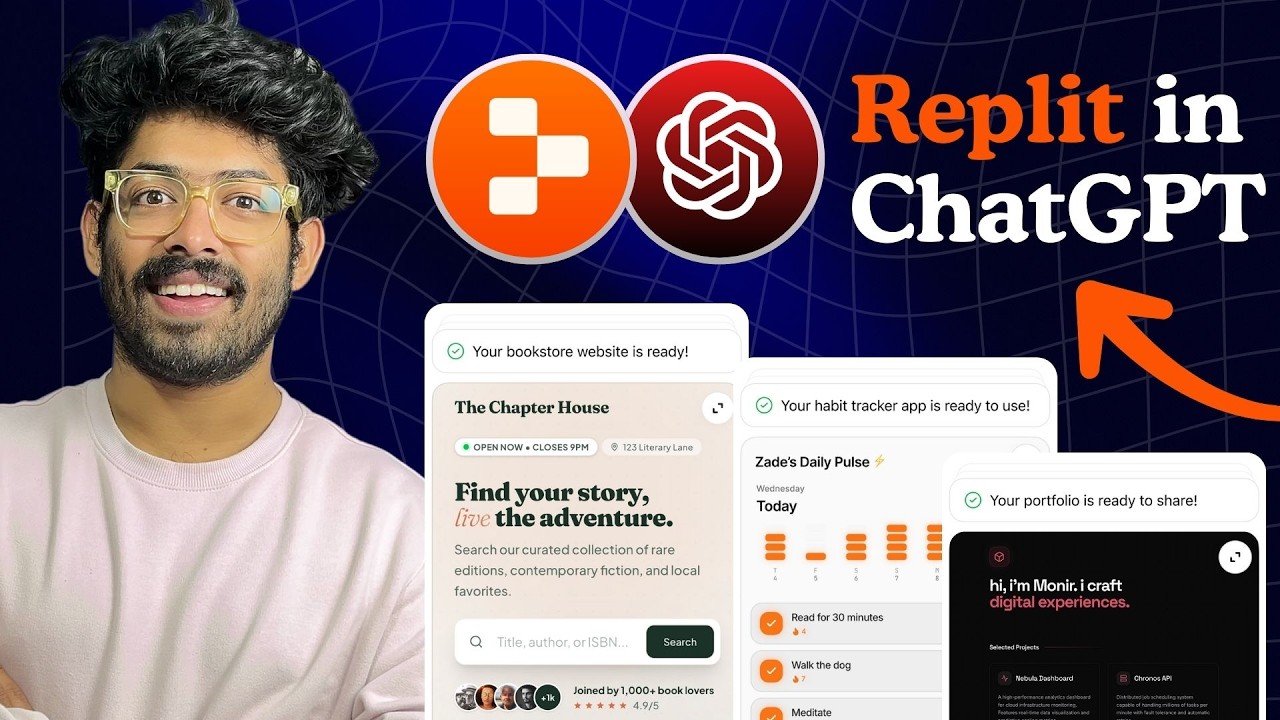
Now Use Replit Inside ChatGPT | Insane Workflow To Build ANYTHING!
Keywords
Summary
141 words
Critical Evaluation
Value of the Information & Strength of the Argument
The video offers practical value by showcasing a concrete, time-saving workflow that combines conversational AI with a development platform. The argument is built around the ease of use and the ability to iterate quickly: from brainstorming to a deployed full-stack app in minutes. The demonstration is convincing, as the host shows real-time creation and error resolution, which strengthens credibility. However, the argumentation is largely anecdotal; there is no comparison with alternative methods or discussion of limitations, and the entire process relies on the capabilities of the underlying services, which are not critically examined.
Scientific Rigor, Source Quality, Title Accuracy
The video maintains a straightforward and honest presentation, with the title accurately reflecting the content. The sources are limited to promotional links in the description (Replit referral, Scrimba, newsletter, social profiles), which serve as monetization rather than academic references. The video does not cite external research or documentation, so its scientific rigor is low, but as a tutorial, it provides clear instructions and visual evidence. The title-content match is strong, with no notable discrepancies. The viewer comments (if none provided) are not assessed, but the absence of a comment section discussion is consistent with a tutorial format.
205 words
Title / Content Match
The title accurately describes the content: the video demonstrates how to use Replit inside ChatGPT to build apps. The 'insane workflow' claim is somewhat hype but the core promise is fulfilled.
Quality & Reliability
7/10
The video is a clear, step-by-step demonstration of integrating Replit with ChatGPT, providing a reliable walkthrough of the workflow. However, it lacks deep technical detail or critical analysis, and relies on promotional links in the description.
Key Moments
Markers derived by PSI from the transcript: the creator did not define chapters.
- Introduction and overview of the Replit x ChatGPT integration
- Step-by-step on how to connect Replit to ChatGPT
- Brainstorming session with ChatGPT to define MVP features
- Invoking Replit to create the app and showing live preview
- Adding authentication and database via follow-up prompt
- Handling and fixing an error during feature submission
- Final working demo and deployment options
- Conclusion and recap of the workflow
Cited Sources
- Replit (referral link) — Promotional link for Replit, mentioned as the platform used in the video.
- Scrimba (affiliate link) — Promotional link for coding courses, included in the description.
- aiholiq Newsletter — Newsletter signup link in the description.
- Astro K Joseph Website — Personal website link in the description.
- LinkedIn Profile — Social media link in the description.
Contribution & Novelties
The video’s main contribution is the practical demonstration of combining ChatGPT’s conversational interface with Replit’s development environment, highlighting a streamlined workflow for non-technical users to build functional apps. While not conceptually novel, it serves as a useful tutorial for early adopters. The integration itself is a notable advancement in AI-assisted software development.
Pour aller plus loin :
- Replit on Wikipedia — Background on the Replit platform and its evolution.
- ChatGPT on Wikipedia — Overview of the AI assistant and its capabilities.
- AI-assisted software development concept — Broader context on AI’s role in software engineering.
- No-code development platforms — Concept without URL, discusses the trend of building applications without traditional coding.
110 words
Radar Profile
The radar profile shows balanced scores across information quantity, quality, technical level, and reliability, with a slight dip in technical depth. This reflects a tutorial that is informative and reliable but not highly advanced, suitable for beginners or intermediate users interested in AI-assisted development.