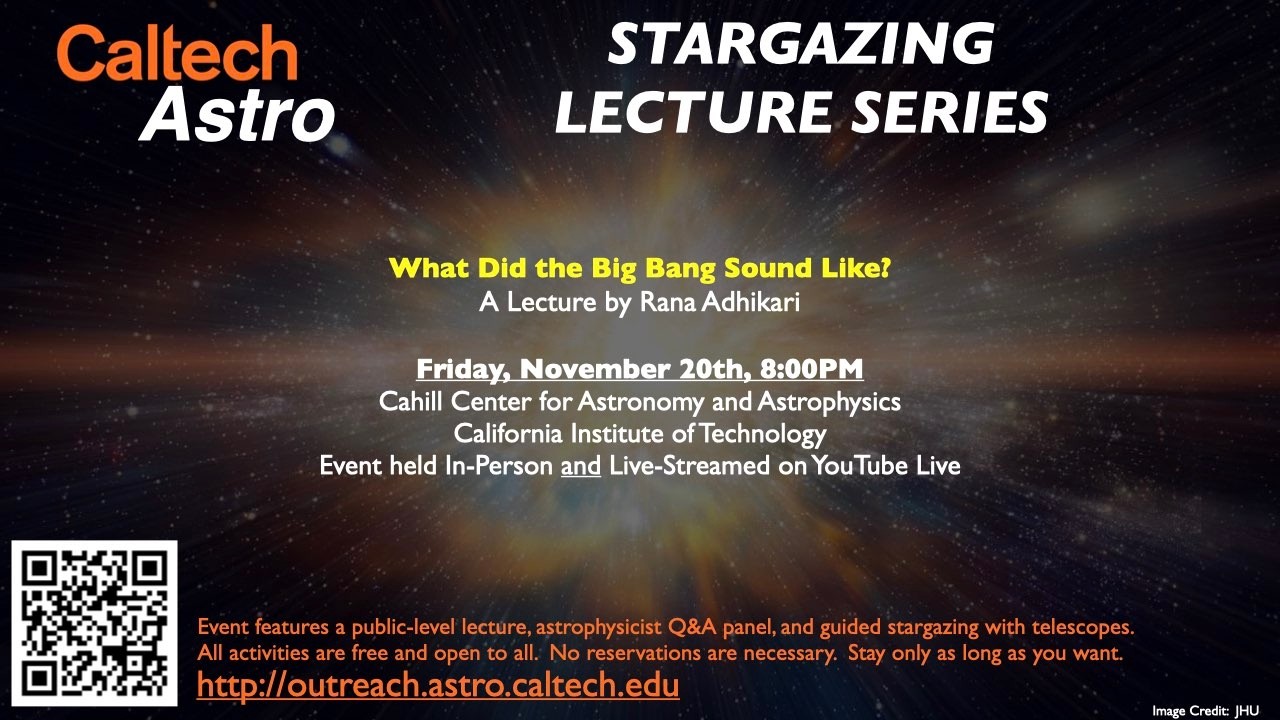
What Did the Big Bang Sound Like?
Keywords
Summary
180 words
Critical Evaluation
Value of the Information & Strength of the Argument
The lecture provides a comprehensive overview of the Big Bang and the potential of gravitational waves to probe the earliest moments of the universe. Adhikari effectively explains complex concepts such as redshift, cosmic microwave background, and the limitations of observing the first 380,000 years with light. He argues that gravitational waves can penetrate the opaque early universe, offering a new observational window. The argumentation is logical and builds on established physics, citing the expansion of the universe and the success of LIGO. While the talk is aimed at a general audience, it does not sacrifice accuracy, and the Q&A session clarifies additional doubts. The discussion of ongoing mysteries like dark matter and dark energy underscores the open questions in cosmology.
Scientific Rigor, Source Quality, Title Accuracy
The video is scientifically rigorous, given the speaker’s expertise and his active role in gravitational wave research. He references historical observations like Hubble and the CMB measurements, and explains the futuristic possibility of detecting primordial gravitational waves. The sources are primarily his own work and established cosmology, and he does not introduce controversial claims. The title accurately reflects the central theme of ’listening’ to the Big Bang, which is a compelling metaphor. Overall, the lecture is trustworthy and well-structured, with appropriate acknowledgement of uncertainties.
219 words
Title / Content Match
The title is apt, as the lecture focuses on how gravitational waves might allow us to 'hear' the Big Bang, though it also covers broader cosmology.
Quality & Reliability
9/10
The lecture is delivered by Dr. Rana Adhikari, a leading experimental physicist in gravitational wave research, and the content accurately reflects current cosmological knowledge and LIGO findings.
Key Moments
Markers derived by PSI from the transcript: the creator did not define chapters.
Cited Sources
- Rana Adhikari - Caltech Physics — Profile page of the speaker providing credentials and research background.
Concurring Sources
- LIGO Caltech — Supports the discussion of gravitational wave detection and the LIGO collaboration's achievements.
Contribution & Novelties
This lecture synthesizes well-established cosmology with the cutting-edge idea of using gravitational waves to explore the first moments after the Big Bang. While it presents no new original research, it effectively communicates the scientific rationale for building next-generation detectors and highlights the deep unknowns that remain in our understanding of the universe. The Q&A session provides valuable insights into how experts respond to public questions about multiverse, dark energy, and primordial black holes.
Pour aller plus loin :
- LIGO Caltech — The official LIGO site, where one can find details about gravitational wave detection and data.
- Cosmic Microwave Background — A reliable overview of the CMB, the afterglow of the Big Bang, and its significance.
- Big Bang — A comprehensive introduction to the Big Bang theory and its evidence.
129 words
Radar Profile
The radar profile demonstrates high quality and reliability, with moderate technical depth and information volume, reflecting a comprehensive yet accessible lecture for a general audience.