Lecture 16 3 class problem 2021 09 23 at 02 35 GMT 7
Keywords
Summary
260 words
Critical Evaluation
Value of the Information & Strength of the Argument
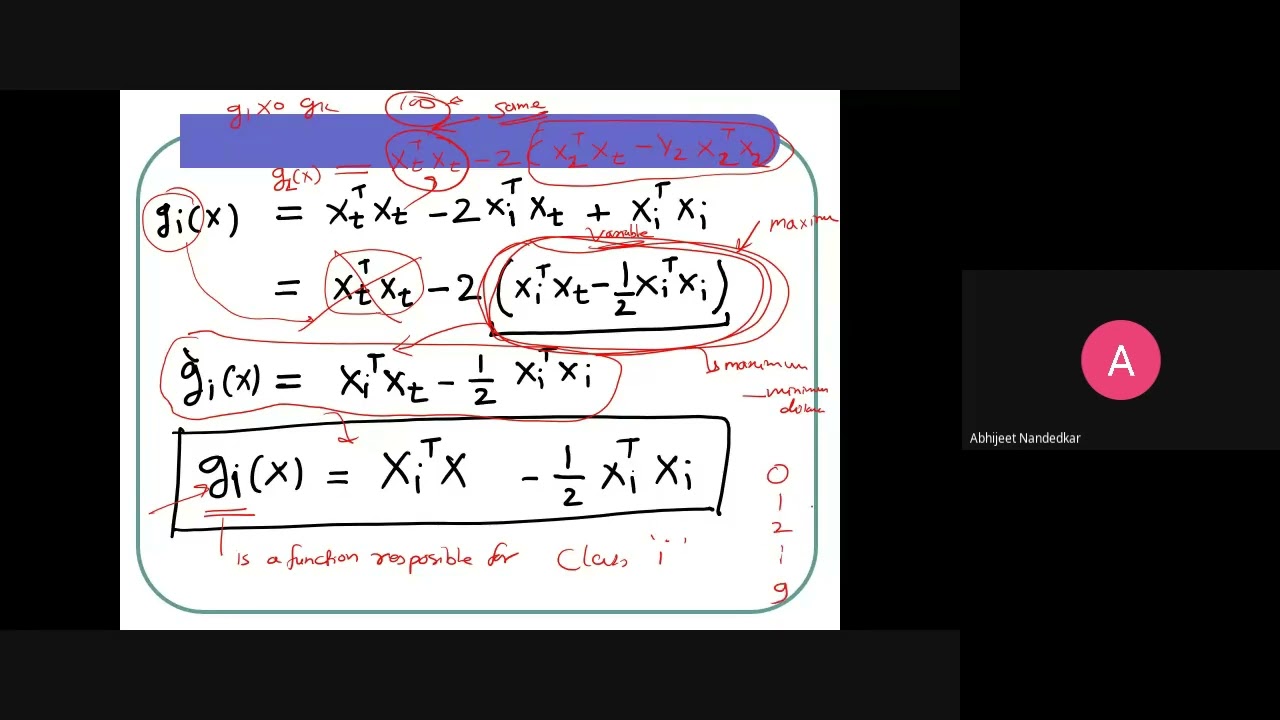
The pedagogical value lies in the completeness of the chain of reasoning: the instructor does not merely state the discriminant function but derives it step by step from the geometric definition of distance, justifies each algebraic simplification (squaring to remove the root, dropping the class-independent term x^T x), and then closes the loop by mapping the resulting expression onto a concrete neuron with explicit weights and bias. The transition from ‘minimum distance’ to ‘maximum discriminant response’ is the conceptual pivot of the lecture and is argued rather than asserted, which makes the material genuinely instructive. The worked example is fully specified and reproducible: prototypes, test point, three linear equations, three numerical outputs and a final label are all given, so a listener can verify every step. The geometric interpretation via perpendicular bisectors between prototype pairs is a strong addition, because it explains visually why the resulting decision regions are convex polyhedral cells and why ties occur exactly on the bisector plane. The argumentation is weaker on the limits of the method: the instructor acknowledges at the very end that the classes treated are linearly separable and that this is ‘a typical case, may not be practically useful’, but does not develop what happens when the assumption fails, how prototypes should be chosen when classes are not well represented by their means, or how the approach compares with alternatives. The closing advice — start with a small circuit and only escalate if it fails — is sound engineering judgement, though it is offered as a maxim rather than demonstrated with a counterexample. Overall the reasoning is correct, transparent and well sequenced, with the main gap being the absence of any quantitative evaluation of the classifier’s behaviour.
Scientific Rigor, Source Quality, Title Accuracy
No external sources, references or citations are given at any point; the lecture is entirely self-contained and derives everything from first principles, which is acceptable for a course lecture but means there is no bibliographic anchoring to the classical literature on linear discriminant functions or minimum-distance classifiers. The mathematical rigour is high: the algebra is correct throughout, the notation is used consistently, and the numerical example checks out. The main rigour limitation is the absence of stated assumptions up front — linear separability is mentioned only at the end, and no error analysis, no discussion of prototype estimation from sample means beyond a brief remark, and no treatment of degenerate cases such as identical prototypes or ties are provided. The title/content fit is adequate: the title is a raw recording label that correctly names the topic (three-class problem) but omits the method, so a viewer cannot infer from the title alone that the lecture concerns minimum-distance classifiers and their neural implementation.
461 words
Quality & Reliability
7/10
The lecture is mathematically self-consistent: the derivation from minimum-distance classification to the linear discriminant function g_i(x) = x_i^T x − ½ x_i^T x_i is correct, the weight/bias assignment (w_i = prototype, bias = −½‖x_i‖²) is standard, and the worked three-class example (prototypes (10,2), (2,−5), (−5,5), test point (5,5) → class 1) is arithmetically verifiable and correct. No external sources are cited, but none are needed for a self-contained derivation. Reliability is limited mainly by the absence of any discussion of the linear-separability assumption's limits, of error rates, or of comparison with alternative classifiers.
Key Moments
Markers derived by PSI from the transcript: the creator did not define chapters.
- Recap of the two-class dichotomizer and the question of extending it to K classes.
- Definition of the K-prototype minimum-distance rule and the distance ‖x_t − x_i‖.
- Switch from distance to squared distance to eliminate the square root.
- Expansion of d_i² and elimination of the class-independent term x^T x.
- Introduction of the discriminant function g_i(x) = x_i^T x − ½ x_i^T x_i.
- Mapping of g_i onto a single linear neuron: weights = prototype, bias = −½‖x_i‖².
- Three-class decision surfaces obtained as perpendicular bisectors between prototype pairs.
- Worked example: prototypes (10,2), (2,−5), (−5,5) and derivation of the three g_i equations.
- Circuit assembly: three neurons plus a max-selector returning the winning index.
- Classification of test point (5,5): responses 8, −29.5, −25 → class 1; closing advice on architecture size.
Contribution & Novelties
The lecture’s contribution is pedagogical rather than original: it presents a clean, end-to-end derivation of the multi-class minimum-distance classifier and its direct realisation as a single-layer neural network with a max-selector. Its most useful element is the explicit bridge between three normally separate framings — the geometric view (nearest prototype, perpendicular bisector boundaries), the algebraic view (linear discriminant functions), and the connectionist view (weights equal to prototypes, bias equal to −½‖x_i‖², no training required once prototypes are computed). The observation that ‘once you compute the prototype your training is done’ is a compact and accurate statement of why this classifier is a non-parametric, one-shot method rather than an iterative learning rule, and it contrasts usefully with the gradient-based training that dominates modern practice. The closing methodological point — begin with the smallest architecture that can solve the problem and escalate only if it fails — is a reasonable design heuristic, though it is stated rather than demonstrated.
Pour aller plus loin :
- Linear classifier — General framing of the discriminant-function approach used throughout the lecture.
- Nearest centroid classifier — Directly corresponds to the minimum-distance rule with class means as prototypes.
- Linear discriminant analysis — The classical statistical counterpart, including the assumption of shared covariance that motivates Euclidean distance.
- Perceptron — Contrasts the one-shot prototype assignment shown here with iterative error-driven weight learning.
- Duda, Hart & Stork, Pattern Classification — Standard reference for minimum-distance classifiers and discriminant functions; cited by name only, as no specific edition or URL is confirmed here.
250 words
Radar Profile
The profile is that of a solid, self-contained technical lecture: high on information quality and quantity, moderate on technical level because the mathematics stays at the level of vector norms and linear algebra without probabilistic or statistical treatment, and moderate on overall reliability because everything is internally consistent but nothing is externally referenced or empirically evaluated. The shape reflects a teaching artefact rather than a research contribution.