31 ml kmeans clustering
Keywords
Summary
169 words
Critical Evaluation
Value of the Information & Strength of the Argument
The lecture offers substantial practical value for beginners in machine learning. It clearly explains the intuition behind k-means, the iterative refinement process, and the importance of the initialization step. The worked example with four points is particularly effective in demystifying the algorithm’s mechanics, showing how the partition matrix evolves and how centroids are recalculated. The discussion of the elbow method provides a concrete heuristic for selecting K, which is a common practical challenge. The argumentation is logical and builds from simple concepts to more complex ones, though it occasionally relies on visual intuition rather than formal proofs. The instructor acknowledges the non-deterministic nature of k-means due to random initialization but does not delve into issues like local minima or the need for multiple restarts. Overall, the value lies in its accessibility and practical orientation, making it suitable for learners seeking a foundational understanding.
Scientific Rigor, Source Quality, Title Accuracy
The lecture does not cite any external sources, research papers, or textbooks, which limits its scholarly rigor. The content aligns with standard textbook descriptions of k-means, but no references are provided to support claims or direct viewers to further reading. The title ‘31 ml kmeans clustering’ accurately reflects the content, indicating it is part of a series (lecture 31) on machine learning. The ad-equation between title and content is high. No comments were provided, so no analysis of audience trends is included.
240 words
Title / Content Match
The title '31 ml kmeans clustering' accurately reflects the content, which is a lecture on k-means clustering. The number '31' likely indicates a lecture number.
Quality & Reliability
6/10
The lecture presents the standard k-means algorithm accurately: random initialization of K centroids, assignment by minimum Euclidean distance, centroid recomputation, and iteration until convergence. The elbow method for choosing K is described correctly. However, no sources, references, or datasets are cited, and the presentation is informal with occasional transcription errors (e.g., 'rainbow method' instead of 'elbow method', 'utian' for 'Euclidean'). The content is technically sound but lacks scholarly rigor.
Key Moments
Markers derived by PSI from the transcript: the creator did not define chapters.
- Introduction to unsupervised learning and the problem of clustering unlabeled data.
- Explanation of K as the number of clusters and the range of possible values (2 to number of samples).
- Step-by-step description of the k-means algorithm: random initialization, assignment, centroid update, iteration.
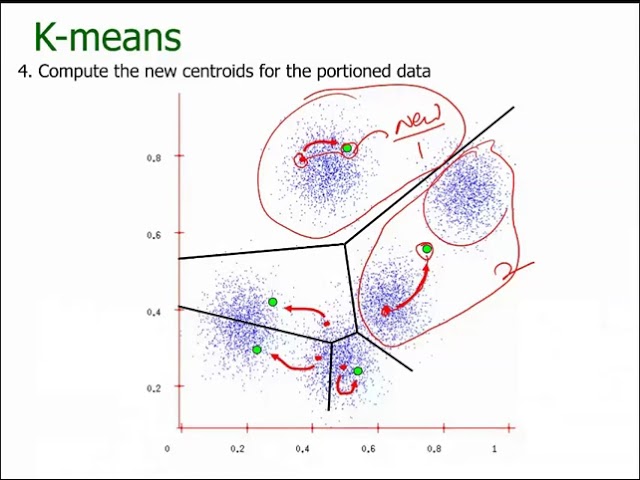
- Visual demonstration of how centroids shift and boundaries change during iterations.
- Worked example with four points, introducing the partition matrix and distance calculations.
- Detailed calculation of centroids and reassignment for the four-point example.
- Convergence check: algorithm stops when no samples change clusters.
- Discussion of Euclidean distance and its formula for n-dimensional data.
- Introduction to the elbow method for choosing K, with sum of squared errors (distortion).
- Demonstration of k-means using scikit-learn and final remarks.
Contribution & Novelties
This lecture does not present novel research or original findings; it is an educational tutorial on a well-established algorithm. Its value lies in the clear, step-by-step explanation and the practical worked example, which can help learners grasp the mechanics of k-means clustering. The instructor’s emphasis on the elbow method and the efficiency of storing only centroids are standard but well-presented.
Pour aller plus loin :
- K-means clustering — Wikipedia article providing a comprehensive overview, including history, variants, and limitations.
- Elbow method (clustering) — Wikipedia article explaining the heuristic for determining the number of clusters.
- Scikit-learn documentation on KMeans — Official documentation with implementation details and examples (URL: https://scikit-learn.org/stable/modules/generated/sklearn.cluster.KMeans.html) .
109 words
Radar Profile
The radar profile shows high scores in information quantity and reliability, moderate in information quality, and lower in technical level. This reflects a tutorial that is informative and accurate but not highly advanced or research-oriented.