24 KNN MKNN classifier
Keywords
Summary
203 words
Critical Evaluation
Value of the Information & Strength of the Argument
The video delivers solid pedagogical value for learners seeking an intuitive and mathematically grounded introduction to k-NN and its weighted variant. The argumentation progresses logically: from the probabilistic foundation (posterior estimation via neighbor counts) to the geometric interpretation (Voronoi cells and decision boundaries), then to the metric requirements and generalized distance norms, and finally to computational considerations and a hands-on numerical example. The explanation of the modified k-NN weighting scheme is particularly clear, with a step-by-step table showing how distances are converted into class weights and how the decision is made by summing weights per class. The theoretical bound on the nearest-neighbor error rate (between Bayes error and twice Bayes error) is stated correctly, though the proof is not developed. The discussion of distance metric sensitivity is valuable, emphasizing that k-NN results depend heavily on the chosen norm and that Euclidean distance is not universally optimal. The complexity analysis is accurate and the three proposed reduction strategies are standard. However, the argumentation occasionally lacks rigor: the transition from k-NN to modified k-NN could better motivate why weighting improves robustness to noise, and the claim that larger k yields ’theoretically a stable result’ is asserted without nuance about the bias-variance trade-off. The worked examples are correct but limited to small, low-dimensional datasets, so scalability issues are only mentioned, not demonstrated.
Scientific Rigor, Source Quality, Title Accuracy
The video does not cite any external sources, references, or academic papers. The instructor mentions ’today’s book’ and ‘Duda’s book’ (likely Pattern Classification by Duda, Hart, and Stork) but provides no precise citation, URL, or edition. This absence of sourcing weakens the scientific rigor, as key results (e.g., the error bound for nearest neighbor) are stated without attribution. The terminology is mostly correct but includes several mispronunciations or garbled terms: ‘base error’ for Bayes error, ‘overnight acceleration’ for Voronoi tessellation, ‘sitting log distance’ for city-block distance, ’nuclear DNA’ for Euclidean norm, and ‘boronite tessellation’ for Voronoi tessellation. These errors could confuse viewers unfamiliar with the correct terms. The mathematical content itself is accurate: the four metric properties are correctly listed, the Minkowski distance formula is correctly presented, and the modified k-NN weight formula is correctly applied in the examples. The title ‘24 KNN MKNN classifier’ is adequately matched to the content, as the video covers both k-NN and modified k-NN in depth. No comments were provided for analysis.
402 words
Title / Content Match
The title '24 KNN MKNN classifier' accurately reflects the content: the video covers k-NN and modified k-NN (MKNN) classifiers in detail. The title is terse but not misleading.
Quality & Reliability
6/10
The content is a standard, accurate presentation of classical k-NN theory (posterior estimation, Voronoi tessellation, metric axioms, Minkowski norms, computational complexity, modified k-NN with distance weighting). The material aligns with well-established pattern recognition literature. However, no sources are cited, no empirical validation is provided, and the delivery is informal lecture-style with occasional imprecision (e.g., 'base error' instead of Bayes error, 'overnight acceleration' for Voronoi tessellation, 'sitting log distance' for city-block distance). The absence of references and the lack of quantitative benchmarks limit the reliability score.
Key Moments
Markers derived by PSI from the transcript: the creator did not define chapters.
- Introduction and recap of posterior probability estimation via k-NN.
- Explanation of the nearest neighbor rule (k=1) and its error rate bound relative to Bayes error.
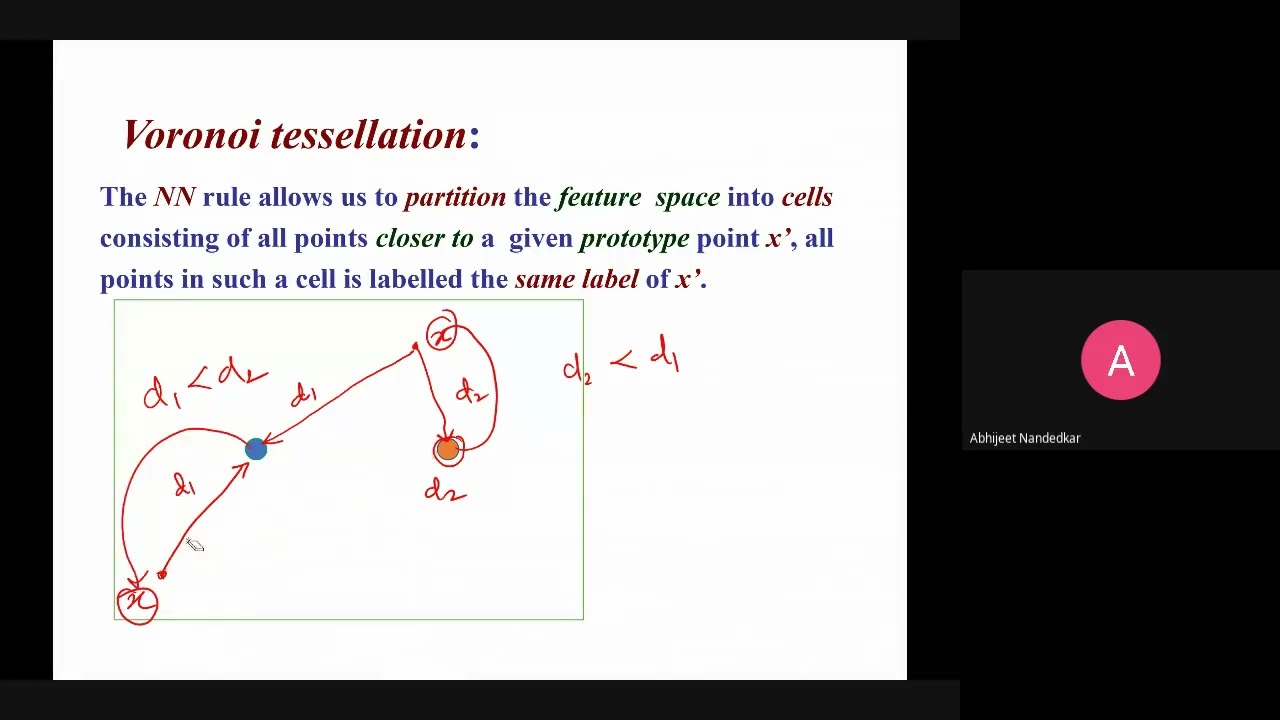
- Illustration of Voronoi tessellation and decision boundary creation in 2D and 3D.
- Introduction to distance metrics: four required properties (non-negativity, reflexivity, symmetry, triangle inequality).
- Generalized Minkowski distance L_k and special cases L1, L2, L∞.
- Computational complexity O(DN) and three strategies to reduce it: partial distance, search trees, prototype elimination.
- Worked example: classifying point (3,2) with k=1 and k=3.
- Introduction to modified k-NN and the distance-based weighting formula.
- Modified k-NN example with k=5 and k=7, computing class weights and final decision.
- Conclusion: k-NN directly estimates posterior probabilities; implementations available in Python.
Contribution & Novelties
The video does not present original research or novel findings; it is a pedagogical lecture on established k-NN and modified k-NN algorithms. Its main contribution is the clear, step-by-step explanation of the modified k-NN weighting scheme, including a fully worked numerical example that demonstrates how to compute weights and aggregate them per class. The visual illustration of Voronoi tessellation and its evolution as prototypes are added is also a valuable didactic element. However, the content is standard textbook material and does not introduce new theoretical results or empirical comparisons.
Pour aller plus loin :
- k-nearest neighbors algorithm — Wikipedia article covering the algorithm, its properties, and variants.
- Voronoi diagram — Wikipedia article explaining Voronoi tessellation, directly relevant to the decision boundary discussion.
- Minkowski distance — Wikipedia article on the generalized distance metric and its special cases.
- Pattern Classification by Duda, Hart, and Stork — The instructor references ’today’s book’ and ‘Duda’s book’; this is the likely source for the theoretical material.
161 words
Radar Profile
The radar profile shows a moderate-to-high quantity of information and technical level, reflecting the breadth of topics covered (theory, metrics, complexity, examples). Quality and reliability are slightly lower due to the absence of citations and occasional terminology errors. Overall, the profile indicates a solid but not rigorous academic lecture.