Lecture 13 Discriminant Functions 2021 09 16 at 02 47 GMT 7
Keywords
Summary
297 words
Critical Evaluation
Value of the Information & Strength of the Argument
The informational value of this lecture lies in its careful reconstruction of a classical geometric argument: how a linear decision boundary in the input space can be represented by two discriminant functions whose comparison is equivalent to a sign test. The instructor does not merely state the result; he builds it step by step, starting from the observation that the coefficient vector of a line is perpendicular to that line, then lifting the normal vectors into a third dimension, normalising them, and applying the normal point form of a plane. This progression is pedagogically effective because it connects three normally separate ideas: the algebraic equation of a line, the geometric notion of a normal vector, and the analytic equation of a plane. The argument is also honest about underdetermination: the instructor explicitly notes that infinitely many separating lines exist and that the choice of one particular line is a design decision, not a mathematical necessity. The main limitation is that the argument remains purely constructive. No criterion is given for choosing among the infinite possible decision surfaces, no mention is made of margins, regularisation, or generalisation, and the question of whether the derived functions actually classify the training samples correctly is deferred to the next session. The lecture therefore has high explanatory value for a learner encountering discriminant functions for the first time, but it does not by itself establish why this construction is preferable to alternatives, nor does it connect to the broader statistical learning framework in which discriminant functions are usually embedded.
Scientific Rigor, Source Quality, Title Accuracy
The mathematical content is rigorous within its scope. The two-point form is applied correctly to the points (1, 0) and (0, -2), yielding the line -2x1 + x2 + 2 = 0. The normal vectors (-2, 1) and (2, -1) are correctly identified as perpendicular to this line. The lifting operation, adding (0, 0, 2) to each normal vector, is clearly described as a deliberate construction rather than a derived result. The normalisation is correct: the vector (2, -1, 2) has norm 3, giving (2/3, -1/3, 2/3), and (-2, 1, 2) gives (-2/3, 1/3, 2/3). The normal point form of a plane is stated correctly as r^T (x - x_p) = 0, with r the normalised normal vector and x_p a point on the plane. The choice of the point (1, 0, 1) is explicitly flagged as intentional, which is good practice. The only source cited is Zurada’s textbook, mentioned verbally without edition or page number; no papers, datasets, or external references are provided. The title is adequate but generic: it announces discriminant functions, and the lecture does deliver a derivation of discriminant functions, though the title gives no indication of the specific geometric construction that occupies most of the session. There are no viewer comments available for analysis.
478 words
Title / Content Match
The title matches the content: the lecture introduces discriminant functions for a single-layer perceptron and derives the corresponding decision surfaces. It is a faithful but generic title.
Quality & Reliability
7/10
The lecture is a coherent, mathematically explicit walkthrough of discriminant functions and the geometric construction of linear decision surfaces. The derivations (two-point form, normal vectors, lifting into 3D, normal point form of a plane) are correct and internally consistent. However, no empirical validation is performed in this session, no datasets or benchmarks are cited, and the only external reference is a textbook (Zurada) mentioned verbally without page or edition. The content is reliable as pedagogy but not as a source of new findings.
Key Moments
Markers derived by PSI from the transcript: the creator did not define chapters.
- Introduction: transition from a single neuron to a single-layer perceptron network with K neurons.
- Presentation of the discriminant function diagram: input feature vector x, functions g1(x) to gK(x), and winner-takes-all class selection.
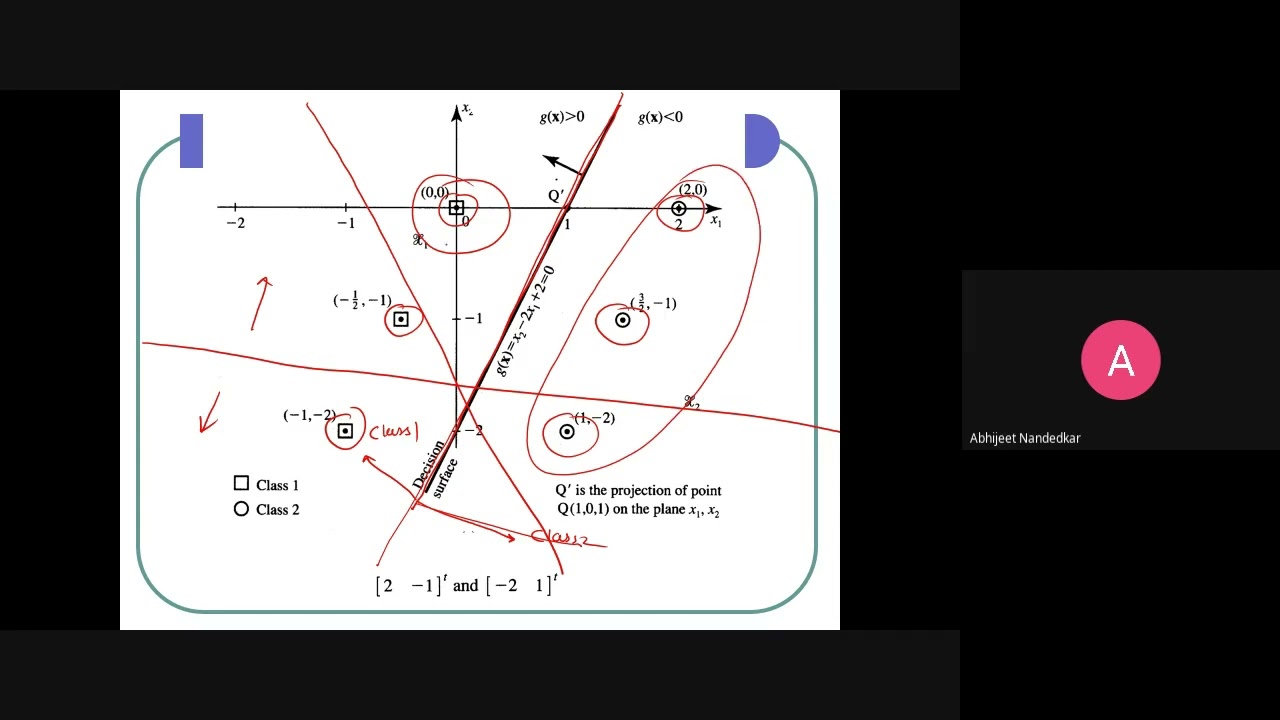
- Two-class problem with six training samples, three per class, plotted in the (x1, x2) plane.
- Discussion of candidate decision lines, showing that some separate the classes poorly and that infinitely many valid lines exist.
- Choice of the separating line -2x1 + x2 + 2 = 0 and identification of its coefficient vector (-2, 1) as perpendicular to the line.
- Introduction of the two opposite normal vectors (-2, 1) and (2, -1), both perpendicular to the decision line.
- Geometric construction: lifting the normal vectors into a third dimension by adding (0, 0, 2).
- Resulting lifted vectors (2, -1, 2) and (-2, 1, 2), and the idea of passing planes perpendicular to them.
- Normalisation of the lifted vectors: division by their norm 3, giving (2/3, -1/3, 2/3) and (-2/3, 1/3, 2/3).
- Application of the normal point form of a plane with the point (1, 0, 1) to derive g1(x) and g2(x).
Cited Sources
- Zurada, Introduction to Artificial Neural Systems — Textbook recommended by the instructor at the end of the lecture for further reading on discriminant functions and neural networks.
Concurring Sources
- Linear classifier — Confirms that a linear classifier separates classes by a hyperplane defined by a linear combination of features, consistent with the lecture's construction.
- Hyperplane — Supports the geometric claim that a line in 2D is the intersection of two planes in 3D, which is the core of the lecture's derivation.
Contribution & Novelties
This lecture does not present new research; its contribution is pedagogical. It offers a clear, self-contained geometric derivation of how two discriminant functions can be constructed from a single linear decision boundary by lifting normal vectors into a third dimension and intersecting two planes. This construction is classical but is rarely presented with such explicit step-by-step geometry in introductory neural network courses, where discriminant functions are often introduced algebraically without the plane-lifting intuition. The lecture’s originality lies in making the equivalence between a decision line in 2D and the intersection of two planes in 3D visually and algebraically explicit.
Pour aller plus loin :
- Linear classifier — Overview of linear decision boundaries and their role in classification.
- Perceptron — Historical and mathematical background on the single-layer perceptron, directly relevant to the lecture’s context.
- Hyperplane — Formal treatment of the geometric object whose intersection defines the decision boundary discussed here.
- Discriminant function analysis — Statistical framework in which discriminant functions are formally defined and estimated.
164 words
Radar Profile
The profile is that of a solid pedagogical lecture: high quality and technical level, moderate information density, and good but not exceptional reliability because no empirical validation or external sources are provided. The balance between quantity and quality reflects a focused, single-topic session rather than a broad survey.