02 ML Diffrent tools and application of ML
Keywords
Summary
220 words
Critical Evaluation
Value of the Information & Strength of the Argument
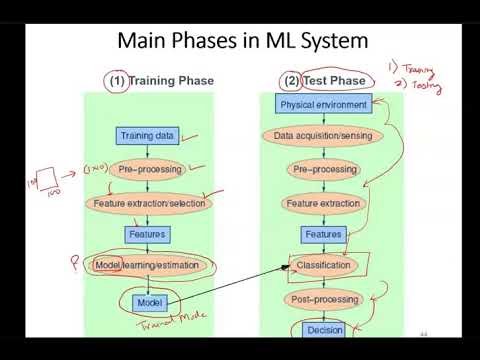
The informational value of this lecture lies in its clear, structured introduction to the conceptual foundations of machine learning. It successfully conveys the standard workflow—feature extraction, model selection, training, and testing—and situates the Bayesian approach within a broader landscape of methods. The explanation of Bayes’ theorem is pedagogically sound: the derivation from joint probability is correct, and the mapping of terms (posterior, likelihood, prior, evidence) to the classification problem is well illustrated with a concrete, if simplified, example. The argumentation is largely expository rather than persuasive; the instructor asserts the importance of model selection and the historical dominance of certain approaches without deeply justifying these claims. The historical narrative of neural networks is presented in a somewhat anecdotal and imprecise manner, with dates and attributions that are occasionally muddled. The discussion of soft computing and the list of neural network architectures are cursory, serving more as signposting for future lectures than as substantive analysis. Overall, the value is didactic: it provides a coherent mental map for beginners, but it does not offer novel insights, critical evaluation of methods, or detailed technical depth.
Scientific Rigor, Source Quality, Title Accuracy
The lecture does not cite any sources, references, or further reading. The mathematical content is standard and correctly presented, but the historical claims are imprecise and sometimes erroneous (e.g., placing Bayes’ work in the 16th century, inconsistent dates for the perceptron and neural network milestones, and a numerical slip in the prior probability). The absence of citations means the audience cannot verify the historical or technical assertions. The title ‘Different tools and application of ML’ is adequately reflected in the content, which does indeed survey several tools and mentions applications such as character recognition, though the treatment of applications is brief. No comments were provided, so no analysis of audience trends is included.
310 words
Title / Content Match
The title 'Different tools and application of ML' matches the content, which surveys classical Bayesian approaches, artificial neural networks, fuzzy logic, rough sets, and genetic algorithms, and discusses applications such as character recognition. The title is somewhat generic but not misleading.
Quality & Reliability
6/10
The lecture is delivered by an academic instructor and covers standard, well-established material (Bayesian decision theory, the history of neural networks, fuzzy logic, rough sets, genetic algorithms). The mathematical derivation of Bayes' theorem is correct and the worked example is coherent. However, the presentation is informal, contains several factual slips (e.g., dates given as '1947 or 48' then corrected to 1943, 'B theorem came in 16th century' when Bayes' work is 18th century, 'probability of omega 2 is 7 by 50' instead of 7/15), and no primary sources or references are cited. The content is reliable as an introductory overview but lacks the precision and sourcing expected of a rigorous scientific presentation.
Key Moments
Markers derived by PSI from the transcript: the creator did not define chapters.
- Introduction to feature extraction as compact representation of raw data.
- Model selection depends on the problem type: classification, clustering, or regression.
- Overview of training and testing phases; definition of training and test data.
- Survey of five machine learning approaches: Bayesian, neural networks, fuzzy logic, rough sets, genetic algorithms.
- Introduction to the classical Bayesian approach and its basis in statistical properties of data.
- Derivation of Bayes' theorem from joint probability; definitions of posterior, likelihood, prior, evidence.
- Worked example with one-dimensional feature (height) and two classes (eraser, duster).
- Calculation of likelihood, prior, and evidence for a specific measurement; decision rule.
- Extension to multiple classes; example of character recognition with 70-75 classes.
- History of artificial neural networks: McCulloch-Pitts, Hebb, Minsky, golden periods, deep learning.
- Biological neuron and basic artificial neuron model; threshold and output.
- List of neural network architectures: perceptron, autoencoders, GANs, CNNs, RNNs, LSTMs, GRUs.
- Closing remarks on quizzes and course logistics.
Contribution & Novelties
This lecture does not present original research or novel findings; it is an educational overview of established machine learning concepts. Its main contribution is pedagogical: it organizes the landscape of classical machine learning approaches and provides a clear, example-driven introduction to Bayesian decision theory. The historical narrative of neural networks, while imprecise, offers a useful timeline for beginners. The lecture also highlights the concept of soft computing as a combination of approaches, which may be less familiar to some audiences.
Pour aller plus loin :
- Bayes’ theorem — Wikipedia article providing the mathematical foundation and historical context.
- Artificial neural network — Wikipedia article covering the history, models, and architectures mentioned in the lecture.
- Soft computing — Wikipedia article explaining the combination of fuzzy logic, neural networks, genetic algorithms, and rough sets.
- McCulloch–Pitts neuron — Wikipedia section on the first mathematical model of a neuron.
- Pattern recognition — Wikipedia article on the broader field that includes classification and feature extraction.
159 words
Radar Profile
The radar profile shows moderate information quantity and quality, reflecting a broad but shallow survey of machine learning topics. The technical level is low, as the lecture is aimed at beginners and avoids mathematical rigor beyond basic probability. Overall reliability is moderate, with correct standard material but imprecise historical claims and no citations.