Lecture 30 Size of Network , Functional Link Networks 2021 11 22 at 01 32 GMT 8
Keywords
Summary
224 words
Critical Evaluation
Value of the Information & Strength of the Argument
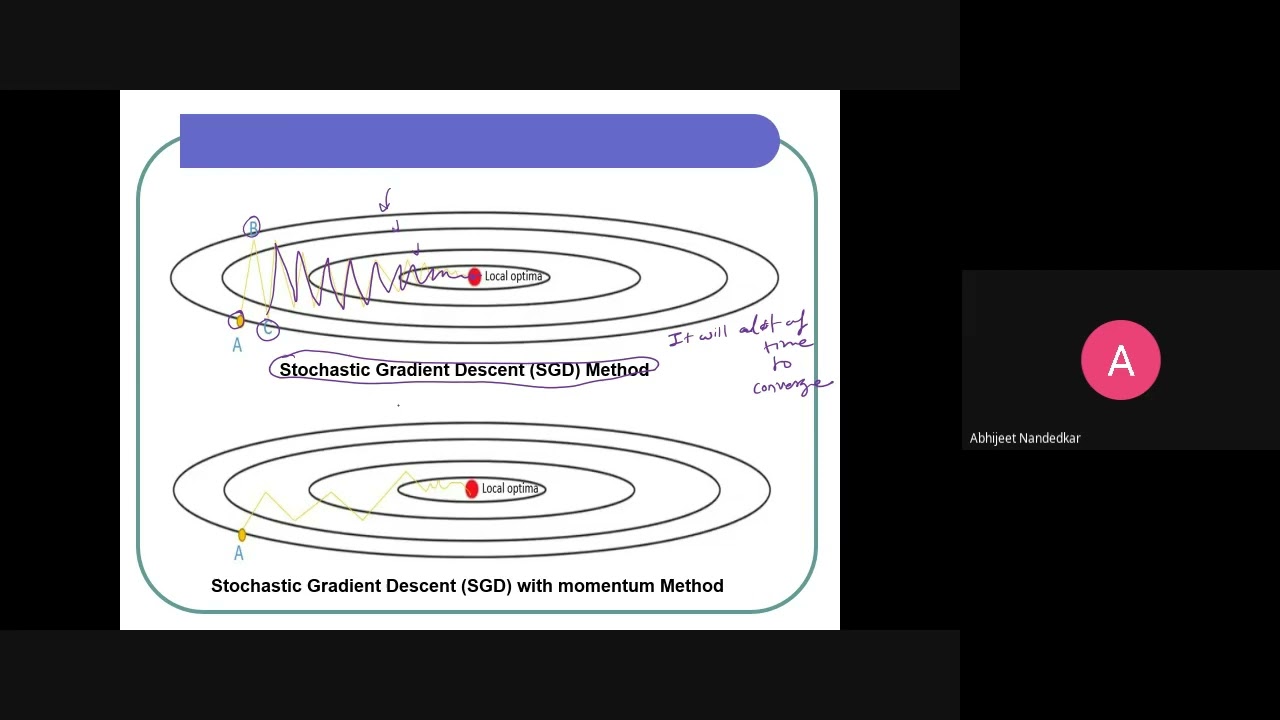
The informational value lies in the clear, incremental exposition of practical design choices in neural networks. The momentum explanation is built from a geometric intuition: the previous update vector is scaled by a small factor and added to the current gradient, producing a resultant direction that cuts across the zigzag path of plain gradient descent. This is a standard and correct account, and the use of elliptical contours to motivate the method is effective. The network-sizing section offers concrete heuristics — inputs equal features, outputs equal classes or target functions, hidden layers tied to non-linearity — while explicitly labelling them as rules of thumb rather than fixed laws, which is an honest framing. The discussion of VGG and GoogLeNet correctly identifies the architectural pattern of a large convolutional feature extractor followed by a small fully connected head, and the historical arc from LeNet to ResNet conveys the scale shift enabled by GPUs. The functional-link network segment is the most original part: the XOR example is worked through step by step, showing how the product term x1·x2 lifts the problem into three dimensions where a plane separates the classes. The argument is sound, but the instructor also acknowledges the central weakness — there is no general method for choosing the right derived features — which prevents the approach from scaling. Overall, the reasoning is didactic and internally consistent, though it relies on assertion rather than demonstration for several claims, such as the ’two to three hidden layers’ rule and the universal approximation property, which is stated without proof or reference.
Scientific Rigor, Source Quality, Title Accuracy
No sources, papers, or external references are cited in the transcript, and the video description is empty, so there is no bibliography to assess. The historical attributions are imprecise: VGG is attributed to ‘Andrew Jackson’ rather than Andrew Zisserman and Karen Simonyan, LeCun is rendered as ‘Lee Kun’, and the chronology of Inception and ResNet versions is muddled. These errors do not invalidate the technical content but reduce confidence in the factual precision of the historical overview. The title matches the content well: network size and functional-link networks are both covered in depth, with momentum and CNN history as supporting material. The lecture is a tutorial rather than a research presentation, so the absence of citations is expected, but a more rigorous treatment would name the original papers. No comments were provided, so no audience analysis is included.
412 words
Title / Content Match
The title accurately announces the two main topics covered: network sizing and functional-link networks. The lecture also spends substantial time on momentum and CNN history, which is consistent with a course lecture but slightly broader than the title suggests.
Quality & Reliability
6/10
The lecture is a coherent, technically accurate walkthrough of well-established neural-network concepts (momentum, network sizing heuristics, CNN history, functional-link networks, universal approximation). It is pedagogically sound and internally consistent, but it is a classroom recording with no citations, no references to specific papers by title, and no data or experiments of its own. Several historical attributions are imprecise (e.g., 'Andrew Jackson' for the VGG authors, 'Lee Kun' for LeCun, a confused chronology of Inception/ResNet). Reliability is therefore moderate: correct in substance, weak in sourcing and precision.
Key Moments
Markers derived by PSI from the transcript: the creator did not define chapters.
- Recap of the momentum method and its geometric intuition on error contours.
- Comparison of plain SGD zigzag path versus SGD with momentum converging faster.
- Network sizing: input nodes equal number of features, output nodes equal number of classes or target functions.
- Hidden layer heuristics: complexity-dependent, rule of thumb of twice the input units.
- VGG-16 and VGG-19 architecture: convolutional feature extraction plus a small fully connected head.
- Automatic feature extraction in CNNs versus handcrafted features.
- History of CNNs: LeNet 1998, AlexNet 2012, VGG 2014, GoogLeNet, Inception, ResNet.
- Introduction to functional link networks: single-layer restriction and higher-order input terms.
- XOR solved with a functional link network using the derived feature x1·x2.
- Regression and universal approximation: feedforward networks as universal approximators.
Contribution & Novelties
This is a course lecture rather than a research contribution, so its novelty lies in pedagogy rather than new findings. It synthesizes momentum, network-sizing heuristics, CNN architectural history, and functional-link networks into a single coherent session, with the XOR example serving as a compact demonstration of how feature expansion enables single-layer solutions to non-linear problems. The instructor’s emphasis on the practical rule of thumb for hidden layers and on the persistence of small fully connected heads in deep architectures is a useful framing for students. The main limitation is the absence of citations and the imprecision of historical attributions.
Pour aller plus loin :
- Momentum (gradient descent) — Background on the momentum method discussed at the start of the lecture.
- Functional link artificial neural network — Overview of the single-layer architecture with expanded inputs.
- Universal approximation theorem — Formal statement of the property mentioned in the regression segment.
- VGG neural network — Reference for the VGG-16 and VGG-19 architectures cited in the lecture.
- Convolutional neural network — General context for the CNN history segment.
174 words
Radar Profile
The profile is balanced toward information quantity and technical level, reflecting a dense but accessible lecture. Reliability is moderate because the content is accurate in substance yet unsourced and historically imprecise. Quality is held back by the absence of references and the reliance on heuristics stated without proof.