Comparing Generalization of Quantum and Classical Generative Models towards Practical QA
Keywords
Summary
124 words
Critical Evaluation
Value of the Information & Strength of the Argument
The talk provides a clear and structured presentation of the research, using an effective race analogy to explain the comparison. The argumentation is solid, based on controlled experiments with multiple quantum and classical models, and the metrics are well-defined. The results are presented with appropriate caveats, and the discussion of data-limited regimes adds practical relevance. The speaker’s explanation of the generalization metrics is thorough, and the inclusion of random baselines strengthens the conclusions.
Scientific Rigor, Source Quality, Title Accuracy
The talk cites the arXiv paper (2303.15626) and acknowledges collaborators, indicating a rigorous academic approach. The title accurately describes the content, which compares generalization of quantum and classical generative models. The methodology is well-documented, and the experiments are reproducible (with seeds and parameters specified). The presentation includes both theoretical definitions and empirical results, maintaining a high standard of scientific rigor.
148 words
Title / Content Match
The title accurately reflects the content, which compares quantum and classical generative models in terms of generalization, a key step toward practical quantum advantage.
Quality & Reliability
8/10
The talk presents original research based on a peer-reviewed (arXiv) paper, with clear methodology, metrics, and experimental results. The presenter is a researcher at Zapata Computing, the Vector Institute, and the University of Waterloo. The work includes collaborations with other researchers, and the content is rigorous and well-structured.
Key Moments
Markers derived by PSI from the transcript: the creator did not define chapters.
- Introduction and overview of the talk
- Definition of practical quantum advantage and the race analogy
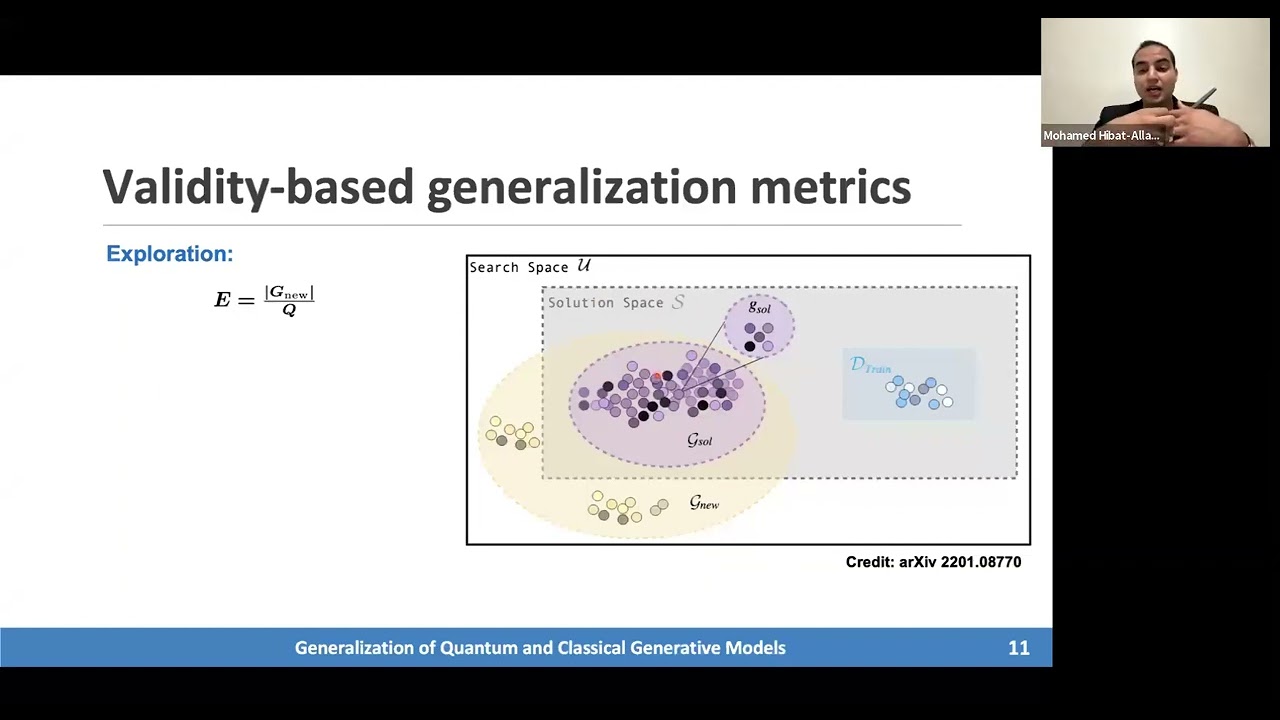
- Explanation of generalization metrics (validity and quality)
- First experiment: QCBM on cardinality dataset with KL divergences
- Results of generalization metrics for QCBM
- Introduction to quality-based generalization and softmax re-weighting
- Experimental results for quality-based approach on parity dataset
- Race framework and comparison with classical generative models
Cited Sources
- A Framework for Demonstrating Practical Quantum Advantage: Racing Quantum against Classical Generative Models — The main paper discussed in the talk, presenting the framework and results.
Contribution & Novelties
The talk contributes a systematic framework for comparing generalization of quantum and classical generative models, introducing specific metrics and a race methodology. It provides evidence that QCBMs can generalize well and even outperform classical models in data-limited regimes, suggesting a potential practical quantum advantage for generative modeling. The quality-based generalization with softmax re-weighting is a novel approach to steer generation toward low-cost solutions.
Pour aller plus loin :
- Quantum machine learning — Overview of quantum machine learning concepts.
- Generative model — Overview of generative models in machine learning.
- Quantum advantage — Discussion on quantum computational advantage.
96 words
Radar Profile
The radar profile shows high scores in information quality and technical depth, with slightly lower but still strong scores in quantity and reliability. The presentation is well-balanced, with a strong emphasis on rigorous research and clear communication.