Structural risk minimization for quantum linear classifiers
Keywords
Summary
193 words
Critical Evaluation
Value of the Information & Strength of the Argument
The value of the information is high, as it provides rigorous theoretical results that link structural risk minimization to quantum machine learning models, offering practical hyperparameters (R and eta) that can be tuned to control the trade-off between training accuracy and generalization. The argumentation is solid: the speaker clearly defines the hypothesis class, presents formal bounds with proofs, and supports the claims with concrete examples, such as the necessity of a certain Frobenius norm to classify a specific data set with a given margin. The reasoning is coherent and builds on classical statistical learning theory, making the implications for quantum models well-founded.
Scientific Rigor, Source Quality, Title Accuracy
The scientific rigor is evident: the speaker cites the original paper published in Quantum (quantum-journal.org) and references foundational works by Havlíček et al. and Schuld and Killoran, though no URLs are provided for the latter. The sources are reputable within the field. The title accurately reflects the content, as the talk exclusively addresses structural risk minimization for quantum linear classifiers. The presentation is well-structured and the proofs are mathematically sound, although the depth may limit accessibility. No external contradictions or alternative viewpoints are discussed, but the approach is grounded in established theory.
209 words
Title / Content Match
The title accurately reflects the content: the talk focuses on structural risk minimization for quantum linear classifiers, presenting theoretical bounds and tunable parameters.
Quality & Reliability
8/10
The presentation is a rigorous theoretical exposition of structural risk minimization applied to quantum linear classifiers, building on established statistical learning theory and providing formal proofs. The methods and results are clearly explained, though the audience is limited and no peer-review commentary is provided.
Key Moments
Markers derived by PSI from the transcript: the creator did not define chapters.
- Introduction to the talk and speaker
- Definition of the quantum machine learning model
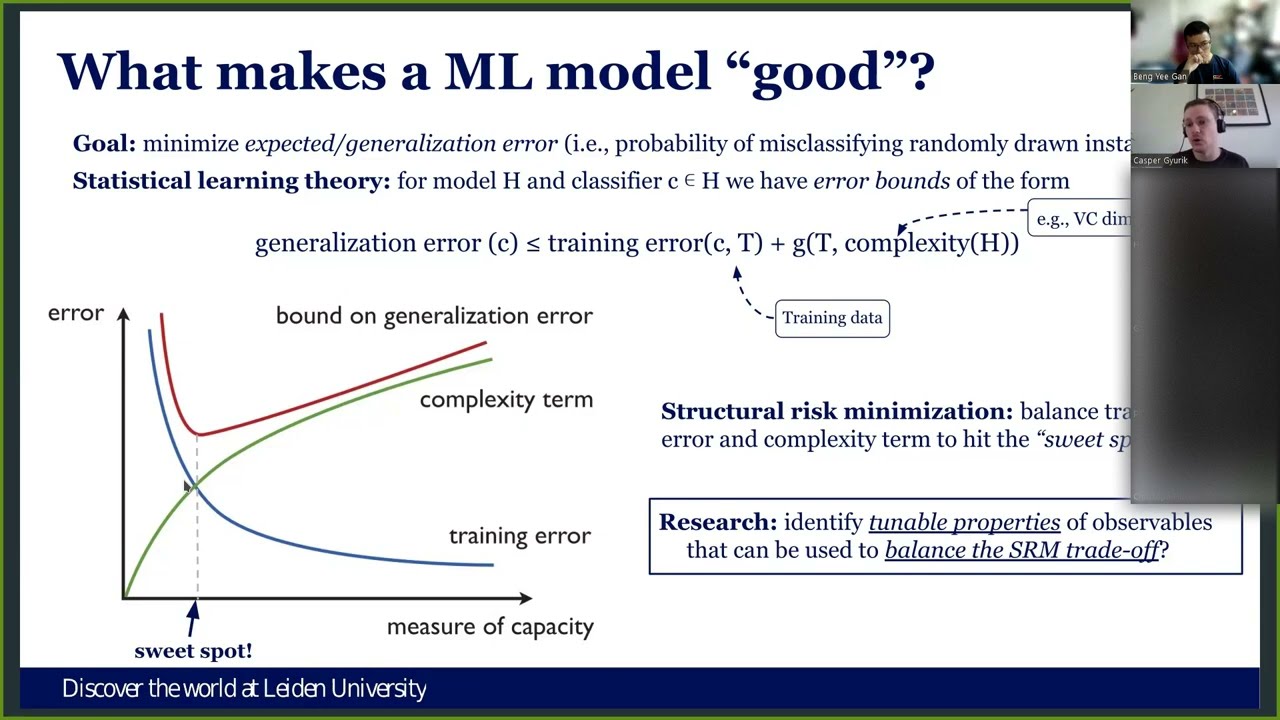
- Explanation of structural risk minimization and the trade-off curve
- Introduction to VC dimension and fat shattering dimension
- Main theoretical results: bounds on VC and fat shattering dimensions in terms of R and eta
- Proof sketches and the interpretation as linear classifiers in Hermitian space
- Training error analysis: rank and Frobenius norm increase expressivity
- Practical regularization strategies for kernel and variational models
- Q&A discussion on choice of complexity measures
Cited Sources
- Structural risk minimization for quantum linear classifiers (Quantum, 2023) — The paper presented in the talk, containing the full theoretical results.
Contribution & Novelties
This work contributes novel theoretical insights by applying structural risk minimization to quantum machine learning, identifying two tunable parameters (R and eta) that govern the complexity and expressivity of quantum linear classifiers. It bridges classical statistical learning theory with quantum computing, providing actionable guidance for model design and regularization.
Pour aller plus loin :
- VC dimension — A fundamental complexity measure in statistical learning theory, used in the talk.
- Fat shattering dimension — Related to margin-based generalization bounds; the talk uses this concept as a complexity measure.
- Structural risk minimization — The overarching framework that balances training error and model complexity, central to the talk.
105 words
Radar Profile
The profile shows high scores across all dimensions, with a particularly strong level of technical depth and information quality, reflecting a highly specialized academic presentation. The quantity of information is substantial, and the reliability is high due to the rigorous proofs and published paper, though the narrow audience limits broader impact.