From explainable NLP to quantum dynamics prediction
Keywords
Summary
157 words
Critical Evaluation
Value of the Information & Strength of the Argument
The talk offers valuable insights into the interplay between quantum physics and machine learning. In the first part, the usage of entanglement entropy as a diagnostic tool for RNN explainability is innovative and provides a concrete design principle: for sentiment analysis, simpler models with well-trained word embeddings can achieve high accuracy without need for long-range correlations. The argumentation is supported by experimental results on benchmark datasets, and the connection to practitioner heuristics (e.g., top sentiment models rely on good embeddings) strengthens the claim. The second part, applying reservoir computing to quantum dynamics, demonstrates a practical advantage of temporal ML models in a physics context, with the potential to bypass costly intermediate time-step simulations. The speaker addresses a question about the relevance of quantum computers, noting that for sentiment analysis quantum advantages are unlikely, but for tasks requiring long-range correlations (e.g., language models) they might be beneficial. Overall, the argumentation is coherent and well-reasoned, though some details are underexplored due to time constraints.
Scientific Rigor, Source Quality, Title Accuracy
The talk cites two key references: one on explainable NLP with matrix product states (Tangpanitanon et al., 2022) and one on quantum next-generation reservoir computing (Sornsaeng et al., 2023), the latter provided as an arXiv link in the description. The presentation aligns closely with these sources, indicating they are used to support the claims. The title accurately mirrors the two-part structure, and the talk delivers on its promise. However, the talk does not critically compare with alternative methods or discuss limitations extensively, which slightly reduces the rigor. The speaker’s academic background and institutional affiliation lend credibility. The absence of detailed methodological exposition in the talk is offset by the availability of the cited papers, making the content verifiable.
295 words
Title / Content Match
The title accurately reflects the content: the talk covers explainable NLP through quantum-inspired methods and quantum dynamics prediction via machine learning.
Quality & Reliability
7/10
The talk presents original research published in peer-reviewed journals, with clear methodology and references. However, it is a high-level overview lacking deep technical details, and some claims are made without exhausting comparisons.
Key Moments
Markers derived by PSI from the transcript: the creator did not define chapters.
- Introduction and talk overview
- Introduction to the lab and research themes
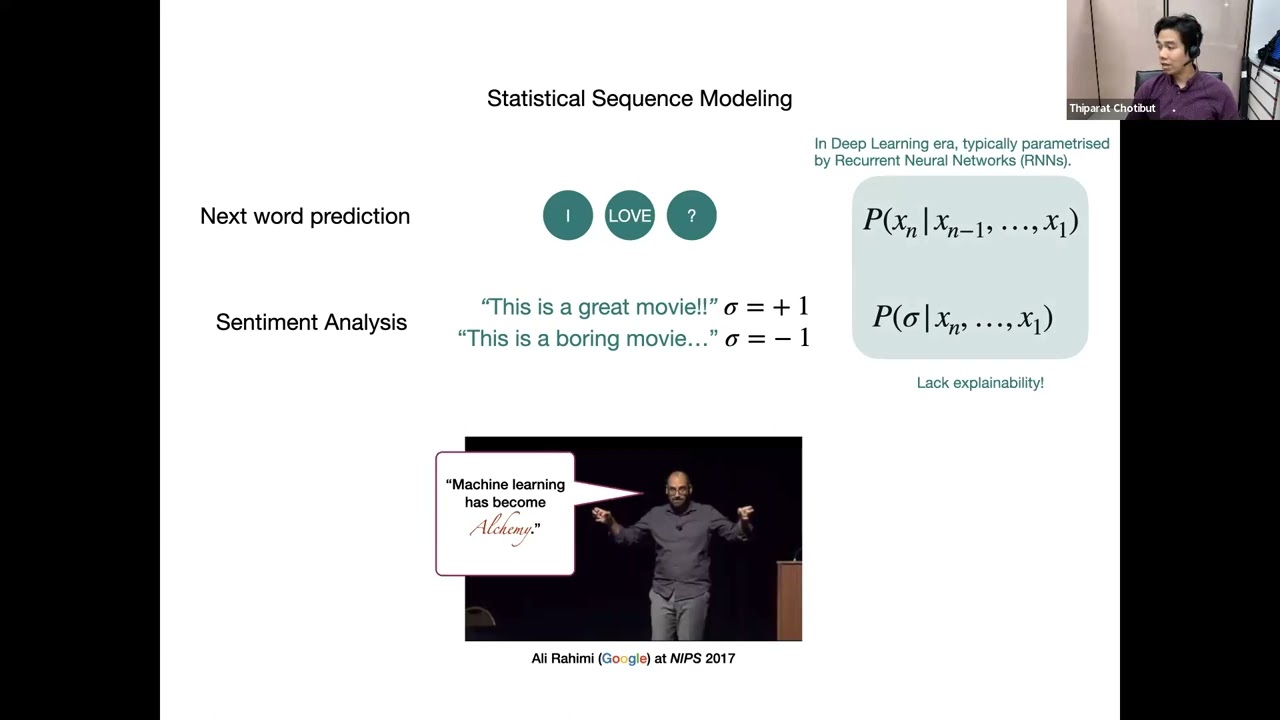
- Part 1: Quantum Meets Language – sentiment analysis and RNN explainability
- Mapping RNN to Matrix Product States and entanglement entropy results
- Q&A session on long-range correlations and quantum computing relevance
- Part 2: Forecasting many-body quantum dynamics with reservoir computing
- Technical details of Next Generation Reservoir Computing and prediction of quantum dynamics
- Results, conclusion, and final discussion
Cited Sources
- Quantum Next Generation Reservoir Computing: An Efficient Quantum Algorithm for Predicting Quantum Dynamics — Reference [2] in the talk, used to support the quantum dynamics prediction part.
Contribution & Novelties
The talk presents a dual contribution: (1) using many-body quantum physics tools (MPS, entanglement entropy) to provide explainability and design principles for RNNs in sentiment analysis, and (2) applying Next Generation Reservoir Computing to predict quantum many-body dynamics efficiently. The original aspects include the identification of long-range correlation saturation and the emphasis on word embedding quality over model complexity for sentiment analysis, as well as the data-driven time-skip prediction for quantum simulations.
Pour aller plus loin :
- Matrix product state — Core concept used in the first part.
- Reservoir computing — Foundation for the second part.
- Quantum simulation — Context for the motivated problem.
104 words
Radar Profile
The profile shows high technical level and quality of information, with moderate quantity and reliability. The talk is dense but accessible to a technical audience, and the content is well-supported by the cited literature. The engagement is strong, though not exhaustive.