Towards Provably Efficient Quantum Algorithms for Large scale Machine learning Models
Keywords
Summary
178 words
Critical Evaluation
Value of the Information & Strength of the Argument
The value of the information is high due to the presentation of two original research contributions backed by mathematical derivations and experimental benchmarks. The argumentation for the QNTK is solid: it provides a rigorous framework for understanding convergence in VQAs, and the proof of the frozen kernel limit is clearly explained. For the HHL-based algorithm, the speaker convincingly argues that fault-tolerant quantum computing can potentially offer provable speedups for gradient descent under conditions of sparsity and dissipation, and the benchmarking on large-scale models strengthens the case. The reasoning is logical and well-structured, though it assumes a high level of familiarity with quantum computing and machine learning concepts.
Scientific Rigor, Source Quality, Title Accuracy
The scientific rigor is evident in the formal proofs and the use of established techniques like unitary t-designs and matrix inversion. The main source cited is the arXiv paper (2303.03428), which is appropriate for a seminar talk. The presentation is consistent with the abstract in the description, and the speaker clearly delineates which parts are from the paper and which are additional context. The title is somewhat narrow compared to the talk’s content, as it emphasizes the HHL algorithm while the QNTK work takes up a significant portion. Nevertheless, the talk delivers on both fronts, and the connection between the two is made explicit.
226 words
Title / Content Match
The title accurately reflects the HHL-based quantum algorithm for large-scale ML, but the talk also extensively covers quantum neural tangent kernel theory, making the scope broader than the title suggests.
Quality & Reliability
8/10
The talk is based on an arXiv preprint by the speaker and collaborators, presenting formal proofs and benchmarks. The speaker is a postdoc at University of Chicago with relevant credentials, and the content is technically rigorous, though the presentation is a seminar talk without peer review at time of delivery.
Key Moments
Markers derived by PSI from the transcript: the creator did not define chapters.
- Welcome and introduction by the host.
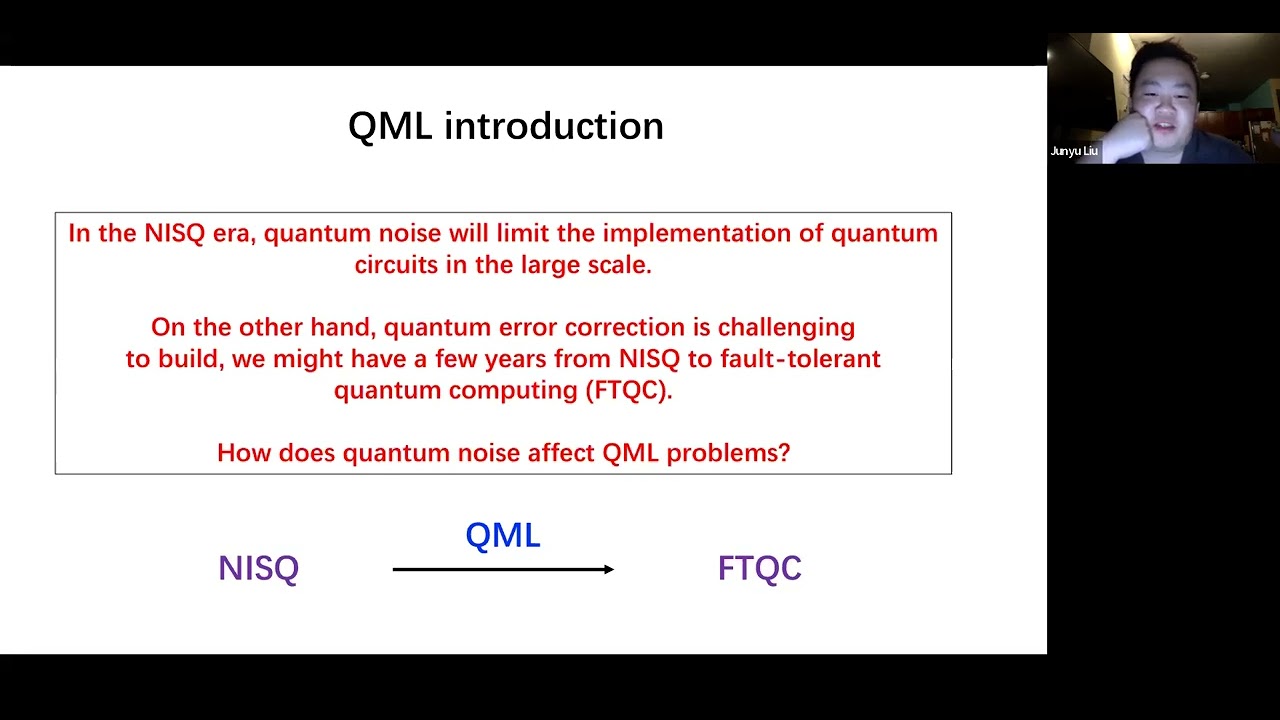
- Overview of quantum machine learning and motivations for the talk, including noise and NISQ era.
- Introduction to variational quantum algorithms and the definition of the loss function and gradient descent.
- Derivation of the Quantum Neural Tangent Kernel (QNTK) and the condition for exponential convergence, including the frozen kernel limit under random unitary ensembles.
- Presentation of the HHL-based algorithm for stochastic gradient descent, with speedup claims and conditions (dissipative, sparse models).
- Benchmark results on large-scale models (7M to 103M parameters) and discussion of practical implications, including sparse parameter download and re-upload.
Cited Sources
- Towards Provably Efficient Quantum Algorithms for Large-scale Machine Learning Models — The primary paper discussed in the talk, presenting the HHL-based quantum algorithm for gradient descent.
Contribution & Novelties
The talk presents two novel contributions: the Quantum Neural Tangent Kernel theory that provides provable convergence conditions for VQAs, and the HHL-based algorithm for stochastic gradient descent that achieves polynomial speedup under specific conditions. The former offers a practical method for ansatz selection and training time prediction, while the latter opens a pathway for quantum advantages in large-scale machine learning, particularly in sparse training regimes. The benchmarks on real-sized models are a notable step forward.
Pour aller plus loin :
- Quantum machine learning — Overview of the field and its challenges.
- HHL algorithm — The matrix inversion subroutine used in the proposed algorithm.
- Neural tangent kernel — The classical analogue that inspired the QNTK concept.
- Quantum error correction — Relevant for fault-tolerant quantum computing prerequisites.
125 words
Radar Profile
The radar profile shows high scores in technical level and information quality, reflecting the advanced and rigorous nature of the content. The lower scores in quantity and reliability are due to the talk's brevity in covering some topics and the reliance on a single preprint source. Overall, it indicates a highly specialized and technically sound presentation.