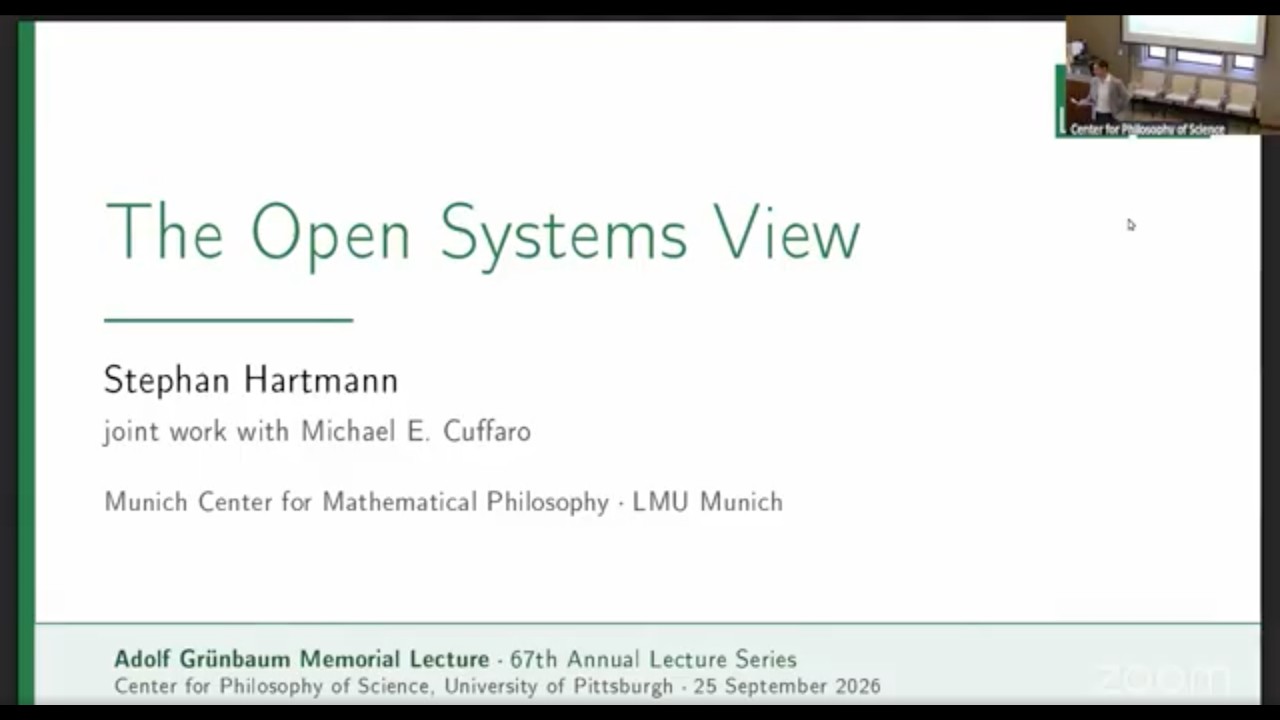
Grünbaum Memorial Lecture – Stephan Hartmann
Keywords
Summary
191 words
Critical Evaluation
Value of the Information & Strength of the Argument
The lecture provides a valuable conceptual clarification of a foundational issue in quantum mechanics. Hartmann systematically defends a philosophical thesis with clear arguments, using technical examples to illustrate abstract points. The argumentation is strong because he anticipates and rebuts plausible objections, and he grounds his claims in both historical context and contemporary practice. The value lies in reframing how we think about the basic unit of physical theory, urging a shift from an uncritical adoption of closed systems to a more open-ended and context-dependent approach. However, the argumentation is admittedly programmatic and does not settle all details.
Scientific Rigor, Source Quality, Title Accuracy
The lecture demonstrates high scholarly rigor, referencing historical figures like Newton, Leibniz, and Laplace, as well as Grünbaum’s own work. While no explicit citations to specific academic papers are given, the content aligns with established literature in philosophy of physics and quantum measurement theory. The title accurately reflects the occasion and the speaker. The lecture does not claim to present new experimental results but rather a novel philosophical interpretation, which is typical for such memorial lectures.
188 words
Title / Content Match
The title correctly identifies this as a Grünbaum Memorial Lecture featuring Stephan Hartmann, which matches the content.
Quality & Reliability
8/10
The lecture is delivered by a leading philosopher of science with a rigorous philosophical argument. It engages with historical positions and technical quantum mechanics, demonstrating careful reasoning and scholarly depth. However, it does not provide peer-reviewed citations and is a single viewpoint.
Key Moments
Markers derived by PSI from the transcript: the creator did not define chapters.
- Host introduces Stephan Hartmann and pays tribute to Adolf Grünbaum's legacy.
- Hartmann poses the central question: Why is the isolated system the basic case of quantum theory?
- Historical overview of Newton, Leibniz, and Laplace's attitudes towards open and closed systems.
- Presentation of the two methodological recipes (closed-first vs open-first) and the atom decay example.
- Discussion of density operators, proper versus improper mixtures, and their implications.
- Concluding arguments linking open-first metaphysics to Grünbaum's philosophical approach.
Contribution & Novelties
The lecture offers a novel philosophical perspective by arguing that open systems should be treated as fundamental in quantum theory, reversing the traditional hierarchy. It provides a clear distinction between closed-first and open-first methodologies, and uses historical and contemporary examples to support this view. The contribution lies in the metaphysical significance attributed to open systems, rather than a purely formal or pragmatic treatment.
Pour aller plus loin :
- Open quantum system — Relevant for understanding the physical background of the lecture.
- Lindblad equation — The general form of the master equation discussed in the lecture.
- Quantum decoherence — Related concept explaining the transition from quantum to classical behavior.
108 words
Radar Profile
The profile shows high scores across all dimensions, with a slight dip in technical level, indicating a well-balanced and accessible lecture on a complex topic. The strong scores in quantity and quality of information reflect the depth and rigor of the philosophical argument.