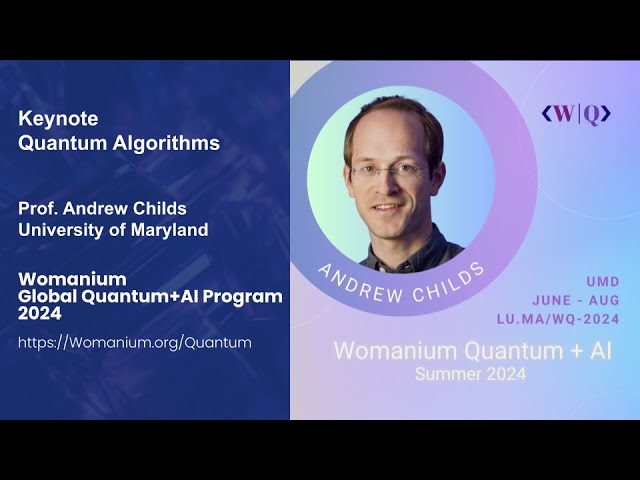
WOMANIUM QUANTUM + AI 2024: DAY 22 ❯ Keynote Quantum Algorithms (Andrew Childs - UMD)
Keywords
Summary
138 words
Critical Evaluation
Value of the Information & Strength of the Argument
The talk offers high informational value by clearly articulating the central challenge of quantum algorithms: identifying problems with sufficient structure to enable significant speedups. Childs uses well-chosen examples (Simon’s problem vs. the collision problem) to illustrate the difference between exponential and polynomial speedups, and he provides a balanced view of the field, including areas of optimism and skepticism. The argumentation is rigorous, with references to known results (e.g., Bennett-Bernstein-Brassard-Vazirani lower bound for Grover’s algorithm) and open problems (e.g., dihedral hidden subgroup problem). The presentation is logically structured, moving from foundational concepts to specific algorithm families, and it avoids overselling quantum computing.
Scientific Rigor, Source Quality, Title Accuracy
The talk is scientifically rigorous, drawing on established results and clearly distinguishing between proven theorems and conjectures. The speaker is a recognized expert, and the content aligns with the current state of the art. Sources are not explicitly cited in the talk, but the description provides links to the WOMANIUM Quantum website and schedule, which may contain further references. The title accurately reflects the content: a keynote on quantum algorithms by Andrew Childs. No comments were provided for analysis.
195 words
Title / Content Match
The title accurately reflects the content: a keynote on quantum algorithms by Andrew Childs, part of the WOMANIUM Quantum + AI 2024 event.
Quality & Reliability
9/10
The speaker is a leading researcher in quantum algorithms, and the content is a rigorous overview of the field, with clear distinctions between proven results and open problems. The presentation is technical and avoids oversimplification, though it is a keynote talk rather than a peer-reviewed paper.
Key Moments
Markers derived by PSI from the transcript: the creator did not define chapters.
- Introduction to quantum algorithms and the role of interference.
- Explanation of Simon's problem and its exponential quantum speedup.
- Contrast with the collision problem, which only allows polynomial speedup.
- Overview of algebraic problems and the hidden subgroup problem.
- Discussion of the dihedral hidden subgroup problem and lattice-based cryptography.
- Introduction to quantum walks and their potential for speedups.
- Quantum algorithms for simulating quantum mechanics.
- Brief remarks on optimization and machine learning.
Cited Sources
- WOMANIUM Quantum Program — Official website for the WOMANIUM Quantum program, providing context for the event.
- WOMANIUM Quantum Schedule — Schedule of the WOMANIUM Quantum + AI 2024 event, including this keynote.
Contribution & Novelties
This keynote provides a comprehensive yet accessible overview of quantum algorithms, emphasizing the importance of problem structure for achieving quantum speedups. It contrasts different types of speedups and highlights open challenges, such as the dihedral hidden subgroup problem. The talk is valuable for both newcomers and experts seeking a high-level perspective.
Pour aller plus loin :
- Quantum algorithm — Wikipedia article providing a general introduction to quantum algorithms.
- Hidden subgroup problem — Wikipedia article explaining the hidden subgroup problem and its significance.
- Quantum walk — Wikipedia article on quantum walks and their applications.
93 words
Radar Profile
The radar shows high scores in information quality and reliability, reflecting the speaker's expertise and the rigorous content. The technical level is high, suitable for an audience with some background in quantum computing. The quantity of information is substantial for a keynote.