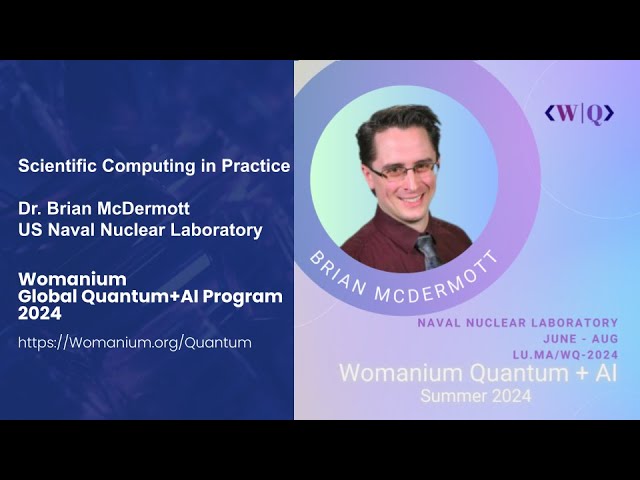
WOMANIUM QUANTUM + AI 2024: DAY 14 ❯ Scientific Computing in Practice (Brian McDermott - NNL)
Keywords
Summary
257 words
Critical Evaluation
Value of the Information & Strength of the Argument
The informational value of this talk lies in its clear articulation of a methodological framework rather than in novel results. McDermott’s distinction between basic science and R&D engineering is useful and concrete: the R&D engineer does not invent new theory but demonstrates that a technology can perform a job better, first at pilot scale and then at production scale. Applied to scientific computing, this becomes a discipline of confirming or refuting claimed benefits of new methods, algorithms, or architectures (AI, quantum) against real use cases, and of matching user needs to state-of-the-art capabilities. The case study on radiative transfer is well chosen to illustrate why some problems resist naive acceleration: the Boltzmann transport equation operates in a seven-dimensional state space, and its computational cost is high enough that brute-force evaluation is impractical. The argument that clouds are a dominant uncertainty in climate modeling is consistent with the broader atmospheric science literature, though the talk does not quantify this. The discussion of discretization is pedagogically effective, using the rabbit triangulation analogy to convey convergence and distinguishing structured from unstructured meshes on the basis of geometric flexibility versus connectivity storage. The three discretization families are presented accurately at a high level: finite difference as stencil-based derivative approximation on structured grids, finite volume as cell-wise conservation accounting, and finite element as weak-form minimization over basis functions. The argumentation is honest about its own limits, repeatedly flagging simplification and deferring precision to domain experts. The main weakness is that the talk remains largely at the level of framing and taxonomy; it does not present quantitative comparisons, benchmark results, or specific algorithmic proposals for how AI or quantum methods would actually accelerate radiative transfer. The promised answer to ‘how do AI and quantum affect this calculation’ is set up but, in the transcribed portion, not yet delivered in concrete terms.
Scientific Rigor, Source Quality, Title Accuracy
The talk is rigorous in tone and epistemically careful: the speaker explicitly states he is an engineer and not an atmospheric scientist, warns that his descriptions prioritize clarity over precision, and acknowledges that domain experts would describe the same material more precisely. This is a mark of intellectual honesty rather than a weakness. However, no primary sources, papers, or datasets are cited during the talk, and the description contains only program-level links (the Womanium Quantum website and schedule) rather than references to the radiative transfer or machine-learning-for-radiation literature that is invoked. The historical claim that radiative transfer implementations originated in astrophysics and nuclear energy in the 1930s and 1940s is broadly consistent with the field’s history but is not sourced. The claim that AI has been applied longer than quantum methods in this area is plausible but unquantified. The title accurately describes the session: it is a practical deep-dive on scientific computing within the Womanium Quantum + AI program, and the content matches that promise without overreach. No advertising segment is present in the transcribed material.
496 words
Title / Content Match
The title accurately reflects the content: a deep-dive session on scientific computing in practice, delivered within the Womanium Quantum + AI 2024 program, with a case study on radiative transfer. No misleading framing.
Quality & Reliability
7/10
The speaker is a Principal R&D Engineer at the Naval Nuclear Laboratory, giving a technically grounded, honest account of scientific computing practice. The content is qualitative and deliberately simplified, with explicit caveats about the speaker not being an atmospheric scientist. No primary literature is cited directly in the talk; only program links appear in the description. The reasoning is sound and the framing (R&D engineering as pilot-scale translation of basic science) is coherent, but the absence of concrete references and quantitative results limits verifiability.
Key Moments
Markers derived by PSI from the transcript: the creator did not define chapters.
- Introduction: third and final appearance, framing the talk as a deep dive into scientific computing R&D engineering.
- Definition of R&D engineering as translating basic science into stable, scalable prototypes, with the benchtop-to-pilot-plant-to-factory analogy.
- The scientific computing workflow: ask a question, model the problem, map to hardware, solve, verify and validate, report findings.
- Problem selection: solar radiation energy transfer and why clouds are a major source of uncertainty in climate modeling.
- Overview of radiative processes: absorption by gases, surface absorption, cloud reflection and scattering, aerosol absorption.
- Introduction of PDEs as the mathematical foundation, with Navier-Stokes, heat equation, and Schrödinger equation as examples.
- The Boltzmann transport equation: seven-dimensional state space and its interpretation as a balance equation of sources, streaming, and collisions.
- Discretization: converting continuous PDEs into finite computable representations, with the rabbit triangulation analogy for convergence.
- Structured versus unstructured meshes, illustrated by an airplane wing grid and by tetrahedral/polyhedral fillings.
- The three discretization families: finite difference, finite volume, and finite element methods.
Cited Sources
- Womanium Quantum Program — Program website referenced in the video description as the home of the Quantum + AI 2024 series.
- Womanium Quantum Schedule — Schedule link from the description, situating this talk as Day 14 of the program.
Concurring Sources
- Radiative transfer — Confirms the physical framing of radiative transfer as a balance of absorption, scattering, and emission processes in the atmosphere.
- Boltzmann equation — Supports the description of the transport equation as a seven-dimensional balance equation valid for rarefied gases, neutrons, and photons.
- Finite volume method — Corroborates the characterization of finite volume methods as enforcing conservation laws cell by cell.
Contribution & Novelties
The talk’s original contribution is not a new scientific result but a methodological framing: it presents R&D engineering as a distinct discipline whose job is to confirm or refute the claimed benefits of emerging technologies (AI, quantum) against concrete use cases, and it applies this lens to radiative transfer as a case study. The pedagogical value lies in the explicit mapping from continuous PDEs to discretized, computable systems, and in the honest acknowledgment that clouds remain a dominant uncertainty in climate modeling and that radiative transfer is among the most expensive governing equations routinely solved. The talk also usefully notes the historical lineage of radiative transfer implementations from astrophysics and nuclear energy, and observes that AI has a longer application history in this domain than quantum methods.
Pour aller plus loin :
- Radiative transfer — Overview of the physical process and its governing equations, directly relevant to the case study.
- Boltzmann equation — Background on the transport equation discussed, including its seven-dimensional state space and balance structure.
- Discretization — General treatment of the continuous-to-discrete mapping central to the talk.
- Finite element method — One of the three discretization families covered.
- Finite volume method — The conservation-based discretization family discussed.
- Finite difference method — The stencil-based discretization family discussed.
- Machine learning for radiative parameterization in climate models — A relevant research direction the talk gestures toward without citing specific papers.
229 words
Radar Profile
The profile is balanced toward practical and informational dimensions: strong on quantity and quality of information, moderate on technical depth because the talk is deliberately qualitative, and solid on reliability given the speaker's institutional position and epistemic caution. The relatively lower technical score reflects the absence of quantitative results or algorithmic specifics rather than any inaccuracy.