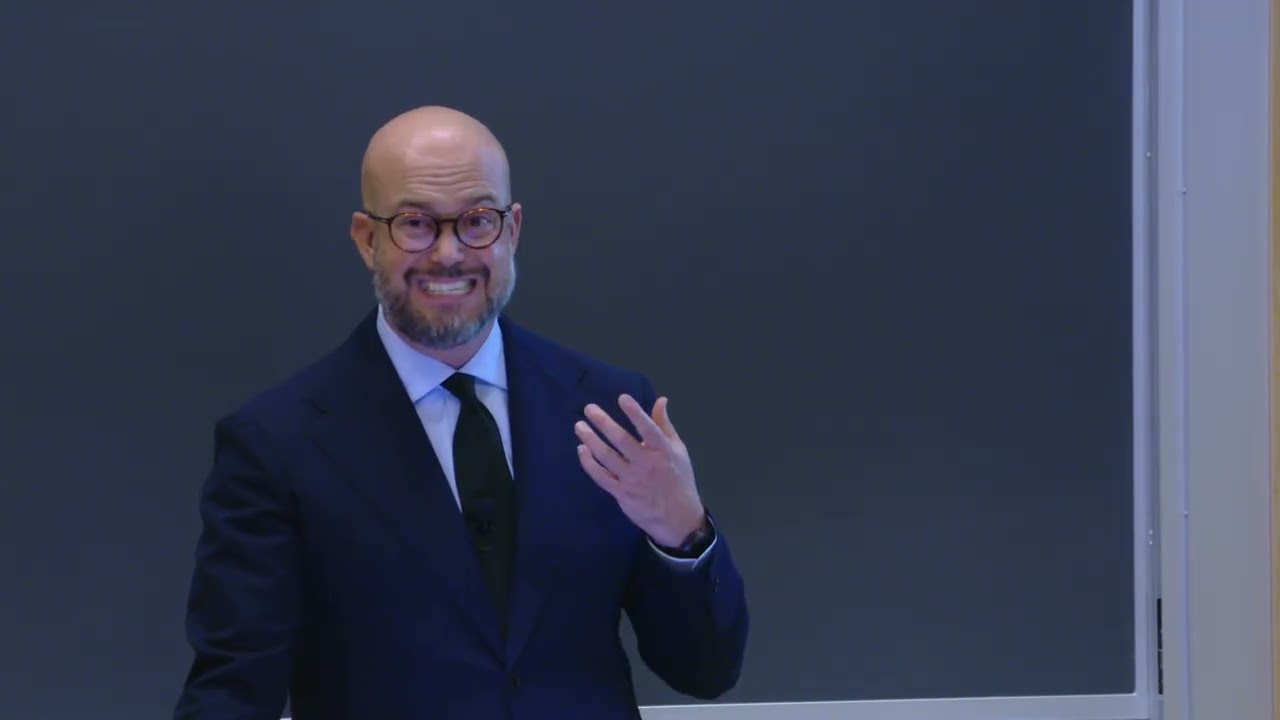
Geoeconomics and the New Economic World Order
Keywords
Summary
194 words
Critical Evaluation
Value of the Information & Strength of the Argument
The talk provides high value by bridging international economics, political science, and policy with a clear conceptual framework. The argumentation is solid: Maggiori systematically builds from micro-level incentives (firm-level dependencies) to macro-level outcomes (fragmentation), and supports claims with concrete examples (ASML, Suez, rare earths) and references to sanctioned literature. He effectively challenges the standard trade theory by integrating power into the analysis, demonstrating that the same mechanism that generates gains from trade also generates vulnerability. The presentation is persuasive because it combines theoretical rigor with practical illustrations, making a compelling case for a renewed research agenda in geoeconomics.
Scientific Rigor, Source Quality, Title Accuracy
The talk demonstrates scientific rigor through its explicit use of established theories (Krugman’s comparative advantage, Hirschman’s pioneering work) and its careful definition of measured power. The speaker candidly discusses the limitations of current models and the need for quantitative tools. The sources cited are authoritative, such as Hirschman’s 1945 book and the Herfindahl-Hirschman index. The title perfectly matches the content, as the lecture indeed addresses how geoeconomic tensions are creating a new economic order. However, the talk is a general-audience lecture, so it simplifies some technical aspects, but it remains faithful to the underlying research. There is no evidence of unsupported claims; rather, the speaker encourages further empirical validation.
222 words
Title / Content Match
The title accurately reflects the content: the lecture explores how geoeconomic pressures reshape the global economic order, with a strong focus on power dynamics in trade and finance.
Quality & Reliability
9/10
The talk is delivered by a leading academic in international finance, with rigorous theoretical foundations and references to classic works (Hirschman, Krugman). The arguments are well-structured, data-oriented, and acknowledge measurement challenges. The high score reflects the speaker's expertise and the coherent logical presentation, though it is a general-audience talk with some simplification.
Key Moments
Markers derived by PSI from the transcript: the creator did not define chapters.
- Introduction: speaker introduces the topic of geoeconomics and sets the agenda.
- Discussion of the trade-off between efficiency and dependency, referencing Krugman's trade model.
- Definition of micro power and formalization using choke points, with examples like ASML.
- Historical case study: the 1956 Suez crisis demonstrates financial leverage.
- Conclusion: need for more quantitative research and implications for the global economy.
Cited Sources
- National Power and the Structure of Foreign Trade — Albert Hirschman's 1945 book, foundational for understanding trade dependency and power, referenced throughout the talk.
- Paul Krugman's theory of comparative advantage — Mentioned as the standard trade model that explains specialization and gains from trade, but fails to account for hold-up problems.
Contribution & Novelties
The talk presents a novel integration of classical trade theory with explicit considerations of coercive power, formalizing the concept of micro power through choke points. It highlights the historical neglect of Hirschman’s insights by economists and calls for a re-engagement with quantitative geoeconomics. The speaker introduces data-driven methods (using AI to measure policy exposure) as a new tool for research.
Pour aller plus loin :
- Geoeconomics — Overview of the field and key debates.
- Herfindahl-Hirschman Index — The index developed from Hirschman’s work, used to measure market concentration.
- Albert O. Hirschman — Background on the economist and his contributions, including the book cited.
103 words
Radar Profile
The radar profile shows high scores in information quantity, quality, and reliability, with a slightly lower technical level reflecting the general-audience format. This indicates a well-balanced talk that is both substantive and accessible.