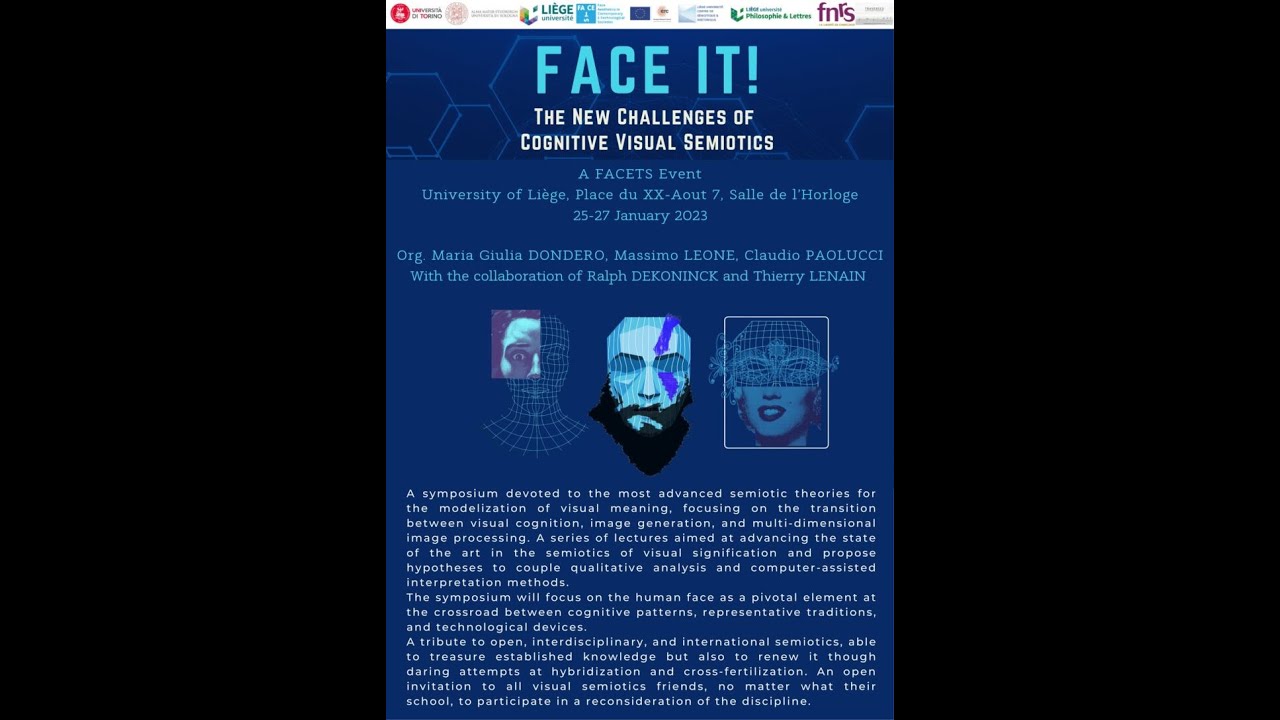
Enzo D’Armenio — Face It! (ULiège)
Keywords
Summary
145 words
Critical Evaluation
Value of the Information & Strength of the Argument
The value lies in offering a fresh semiotic vocabulary to analyze interactive media, specifically merging Peircean diagrammatic reasoning with kinetic and visual syntax. The argument is well-structured: he builds from theoretical distinctions (interaction vs. interpretation), introduces his own concept (image movement), then supports it with a rich case study. The use of Aarseth’s cybertext provides a robust foundation, and the critique of existing immersion models is nuanced. The case study of Zelda is persuasive, showing how the game’s design operates as a diagram that players manipulate creatively. The connection between the prototype as a design tool and the final product as an experiential diagram is illuminating.
Scientific Rigor, Source Quality, Title Accuracy
D’Armenio rigorously cites foundational texts (Aarseth, Peirce, Ermi & Mäyrä) and refers to specific examples like Carne y Arena. The presentation avoids overstatement and acknowledges limitations. The title ‘Face It!’ is only loosely connected to the content; the actual talk title in the description is more accurate. The video is part of an academic symposium, adding credibility. The transcript has occasional errors (e.g., ‘spnr’ for Aarseth), but the overall argument remains coherent.
193 words
Title / Content Match
The YouTube title names the presenter and symposium acronym but omits the actual subject (interactive images, diagrams in Zelda). The description clarifies the content, so the mismatch is acceptable.
Quality & Reliability
8/10
The presentation is theoretically grounded, references established work (Aarseth, Ermi & Mäyrä, Peirce), and offers a coherent argument with concrete examples. The reasoning is clear and well-structured, though the transcript has occasional gaps and the niche topic limits broad verification.
Key Moments
Markers derived by PSI from the transcript: the creator did not define chapters.
- Introduction and acknowledgments
- Discussion of interaction vs. interpretation, Aarseth's cybertext
- Proposal of 'image movement' as visual and kinetic syntax
- Critique of immersion theories and introduction of identity performance
- Analysis of Zelda: Breath of the Wild's elemental interaction system
- The prototype as a creative diagram, discussion of 'clever lies'
- Application of diagrammatic reasoning to the final game, speedruns as identity performance
Cited Sources
- Cybertext: Perspectives on Ergodic Literature — Aarseth's concept of non-trivial effort used to differentiate interaction
- Immersion (virtual reality) — Ermi & Mäyrä's classification of immersion types
- Diagram — Peirce's notion of diagram used for the playful diagram in Zelda
- The Legend of Zelda: Breath of the Wild — The main case study of the talk
- Carne y Arena — VR installation example illustrating remediation and physical movement
Concurring Sources
- Cybertext: Perspectives on Ergodic Literature — The non-trivial effort requirement resonates with the 'clever lies' and multiplicative gameplay in Zelda.
Contribution & Novelties
The talk introduces the concept of ‘image movement’ as a synthesis of visual and kinetic syntaxes, offering a new framework for analyzing interactive media. It reframes immersion through identity performance, moving beyond static classifications. The original contribution is the analysis of video games as ‘playful diagrams’ that generate meaning through material manipulation.
Pour aller plus loin :
- Cybertext theory — Aarseth’s core concept underpinning the non-trivial effort.
- Semiotic diagram — Peirce’s definition applied to interactive systems.
- Affordance — Gibson’s concept relevant for the ‘clever lies’ about material interaction.
- Immersion — Ermi & Mäyrä’s model and its critiques.
97 words
Radar Profile
The radar shows high scores in quality and technical depth, with slightly lower quantity due to the focused scope. The fiability is solid, reflecting the academic rigor and clear argumentation.