L’art urbain brésilien. Approches sémiotiques - Norma Discini
Brazilian urban art. Semiotic approaches - Norma Discini
Keywords
Summary
166 words
Critical Evaluation
Value of the Information & Strength of the Argument
The lecture offers substantial value by applying a rigorous semiotic framework to a contemporary and understudied object: Brazilian urban art. Discini builds her argument on a clear theoretical foundation, moving from general principles (ethos/pathos, nodal points) to specific case studies (murals on Faria Lima and Oscar Freire, graffiti at Praça da Sé). The reasoning is systematic: she first defines urban muralism as a semiotic practice, then describes interpretative scenes, and finally illustrates how environmental and social contexts shape meaning. The argumentation is coherent and well-structured, though it relies heavily on the audience’s familiarity with Greimasian terminology. The analysis of the ‘Couple on Bicycles’ mural demonstrates how plastic categories (diagonal lines, trompe-l’œil, contrast) produce movement effects and interpretative dispositions. The discussion of Praça da Sé effectively shows how irony emerges from the contrast between the written message (‘Only those who love preserve themselves, their neighbor, and the environment’) and the surrounding practices (litter, homelessness, gestures of derision). The argument is persuasive within its paradigm, but it remains an expert interpretation rather than an empirically tested hypothesis.
Scientific Rigor, Source Quality, Title Accuracy
The lecture demonstrates high scientific rigor through its explicit engagement with established semiotic theories: Greimas, Fontanille, Bordron, Landowski, Zilberberg, and others are cited and applied consistently. Discini acknowledges the research program ‘Graf City’ at the University of Bordeaux and credits colleagues such as Anne Beyaert-Geslin and Maria Giulia Dondero. The sources are primarily theoretical and are used to support the analysis rather than to claim empirical proof. The title ‘Brazilian Urban Art. Semiotic Approaches’ accurately reflects the content, which is a semiotic analysis of Brazilian urban art. No misleading claims or sensationalism are present. The transcript is partially garbled, which may affect the precise attribution of some references, but the overall scholarly apparatus is sound.
305 words
Title / Content Match
The title accurately reflects the content: the lecture focuses on Brazilian urban art (muralism and graffiti in São Paulo) analyzed through semiotic approaches. The subtitle and the speaker's introduction align perfectly with the presentation.
Quality & Reliability
8/10
The lecture is delivered by a recognized specialist in discursive semiotics and is grounded in established theoretical frameworks (Greimas, Fontanille, Bordron, Landowski, etc.). The analysis is coherent, methodologically explicit, and based on direct observation of urban inscriptions in São Paulo. However, it remains a single expert interpretation without peer-reviewed validation or quantitative data, and the transcript is partially garbled, which limits full verification of every claim.
Key Moments
Markers derived by PSI from the transcript: the creator did not define chapters.
- Introduction of Norma Discini by the host, highlighting her academic background and research on graffiti in São Paulo and Paris.
- Discini thanks the University of Liège and introduces the research program 'Graf City' at the University of Bordeaux.
- Presentation of the lecture's themes: ethos and pathos of the practice, nodal points of the city, and accommodation between practices.
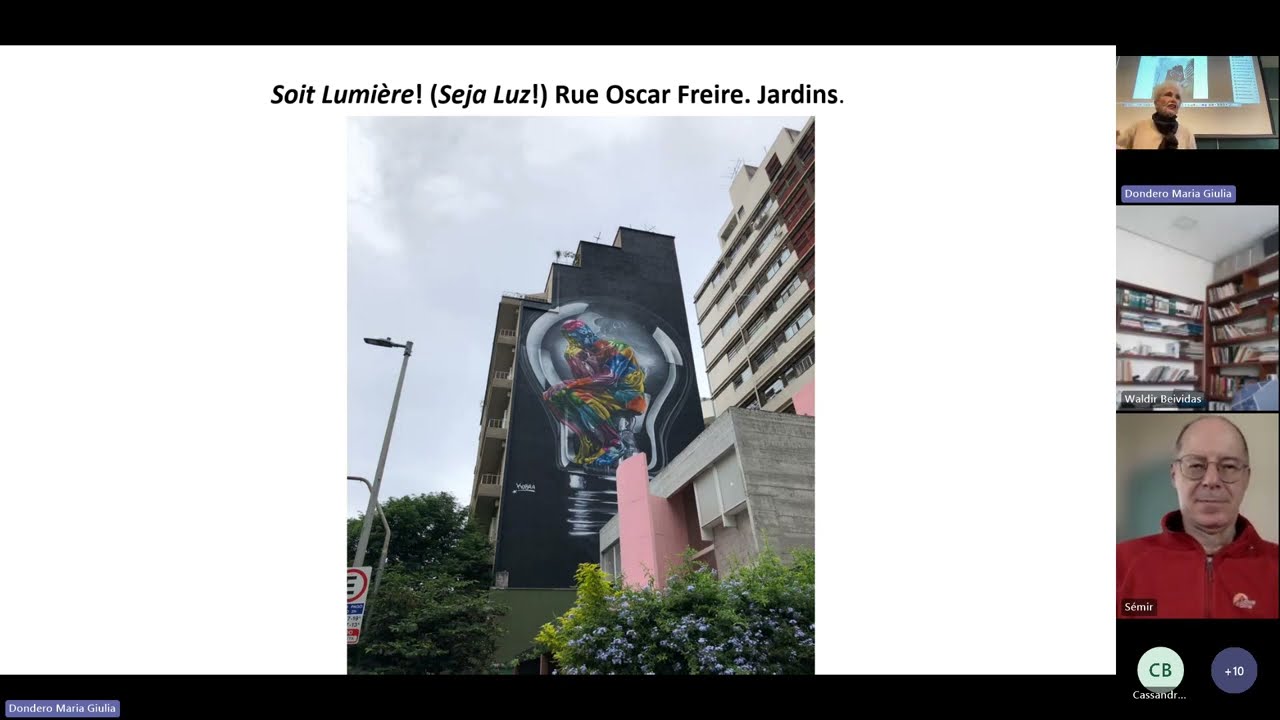
- Analysis of urban muralism as a semiotic practice, with examples of murals on Avenida Faria Lima and Rua Oscar Freire.
- Discussion of interpretative scenes and the pathos of urban muralism, drawing on Fontanille and Greimas.
- Detailed analysis of the 'Couple on Bicycles' mural, focusing on plastic elements such as diagonal lines and trompe-l'œil.
- Examination of the 'Só Luz' mural and its environmental context, including the role of the tree that partially obscures the view.
- Introduction of the concept of nodal points of the city, with the example of Praça da Sé.
- Analysis of graffiti at Praça da Sé, including the ironic contrast between the written message and the surrounding practices.
- Conclusion on the accommodation between conflicting forms of life and the role of urban inscriptions in revealing social tensions.
Contribution & Novelties
This lecture offers an original contribution by applying Greimasian semiotics to Brazilian urban art, a relatively unexplored corpus. Discini develops a nuanced framework for understanding how urban inscriptions function as semiotic practices that articulate ethos, pathos, and the forms of life of the city. The analysis of specific murals and graffiti sites provides concrete examples of how plastic and figurative elements shape interpretation and reveal social conflicts. The concept of ’nodal points’ as strategic urban locations where different practices and forms of life converge is particularly insightful. The lecture also highlights the importance of the immediate environment in the production of meaning, showing how elements like trees, buildings, and passersby become part of the semiotic scene.
Pour aller plus loin :
- Greimasian semiotics — Overview of the theoretical framework used by Discini.
- Semiotics of space — General introduction to the semiotic analysis of spatial practices.
- Urban semiotics — Field that studies meaning-making in urban environments.
- Graffiti — Historical and cultural context of graffiti as a practice.
166 words
Radar Profile
The radar profile shows a strong emphasis on technical depth and information quality, with high scores in both quantity and quality of information. The reliability is solid, reflecting the academic nature of the lecture. The overall profile is that of a specialized, theoretically rigorous presentation aimed at an expert audience.