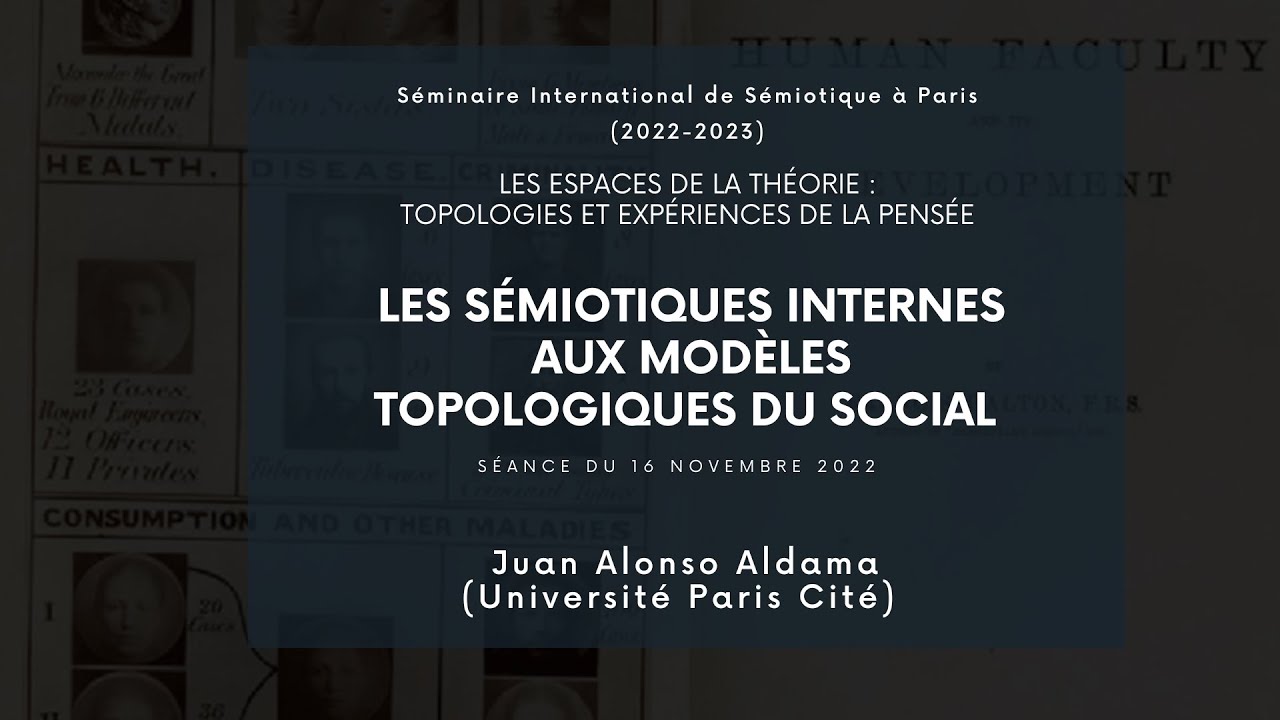
Juan Alonso Aldama (Univ. Paris Cité) — Séminaire International de Sémiotique à Paris (16/11/2022)
Juan Alonso Aldama (Univ. Paris Cité) — International Seminar of Semiotics in Paris (16/11/2022)
Keywords
Summary
169 words
Critical Evaluation
Value of the Information & Strength of the Argument
The presentation offers a valuable comparative analysis of three major thinkers, highlighting how their topological or formal models entail specific semiotic operations. The argumentation is coherent and follows a clear progression: from Lotman’s spatial metaphor of borders to Goffman’s frame-based interactionism and Simmel’s abstract forms. Aldama’s strength lies in synthesizing these theories and showing their internal logic, even if the discussion remains at a high level of abstraction and does not engage with empirical or critical counterexamples. The interpretation of Goffman’s frames as rhetorical is particularly insightful, linking sociological micro-analysis to semiotic rhetorical theory. The argument is well-supported by references to the works of Lotman, Goffman, and Simmel, though the presentation could have benefited from explicit citations of specific editions or pages.
Scientific Rigor, Source Quality, Title Accuracy
The scientific rigor is high: Aldama demonstrates thorough knowledge of the primary sources and connects them to contemporary semiotic discussions (e.g., Fontanille, Bordron). However, the presentation does not explicitly list sources in the video description, which limits verifiability. The title adequately reflects the content, as the talk indeed addresses internal semiotics within topological social models. The structure is well-organized, with clear transitions between the three models. Although the audience is academic, the presentation remains accessible in its logical flow, though it presupposes familiarity with semiotic terminology. No comments were provided, so public reception cannot be assessed.
233 words
Title / Content Match
The video title accurately reflects the seminar and speaker, while the presentation content matches the announced topic on internal semiotics of topological social models.
Quality & Reliability
8/10
The presentation is academically rigorous, based on recognized theoretical frameworks (Lotman, Goffman, Simmel), and well-structured. However, it does not provide explicit citations or references in the description, and the analysis relies on the speaker's scholarly interpretation.
Key Moments
Markers derived by PSI from the transcript: the creator did not define chapters.
- Introduction and announcement of the talk's plan, focusing on three topological models of the social.
- Discussion of Lotman's semiosphere: the concept of borders as translation and filtering mechanisms, and the role of frontiers in cultural identity.
- Analysis of Goffman's frame theory: primary and transformed frames, modalisation vs. fabrication, and the rhetorical dimension of frame shifts.
- Presentation of Simmel's formal sociology: social forms as stable configurations, and money as the purest form of abstract value.
- Comparison of the three models: Lotman's translational mechanism, Goffman's rhetorical mechanism, and Simmel's morphological mechanism, concluding with a synthetic table.
Cited Sources
- Universe of the Mind: A Semiotic Theory of Culture — Yuri Lotman's work on semiosphere and borders, cited throughout the model of the semiosphere.
- Frame Analysis: An Essay on the Organization of Experience — Erving Goffman's book on frames, primary and transformed frames, discussed as a rhetorical model.
- The Philosophy of Money — Georg Simmel's work on money as a social form, referenced for its morphological analysis.
Contribution & Novelties
The contribution lies in systematically comparing three distinct topological/social models and demonstrating how each generates its own semiotic mechanism—translation (Lotman), rhetoric (Goffman), and morphology (Simmel)—across different levels of the generative trajectory of meaning. This synthesis is original in that it bridges cultural semiotics, interactionist sociology, and formal sociology.
Pour aller plus loin :
- Yuri Lotman - Wikipedia — Direct background on Lotman’s semiosphere and cultural semiotics.
- Erving Goffman - Wikipedia — Overview of Goffman’s frame analysis and interactionist sociology.
- Georg Simmel - Wikipedia — Context on Simmel’s formal sociology and philosophy of money.
93 words
Radar Profile
The profile shows high scores in quantity, quality, and technical level, with a slightly lower but still strong reliability score. This indicates a dense, technically demanding presentation with robust scholarly grounding, though the lack of explicit citations and a narrow focus on theoretical synthesis slightly reduces its absolute reliability.