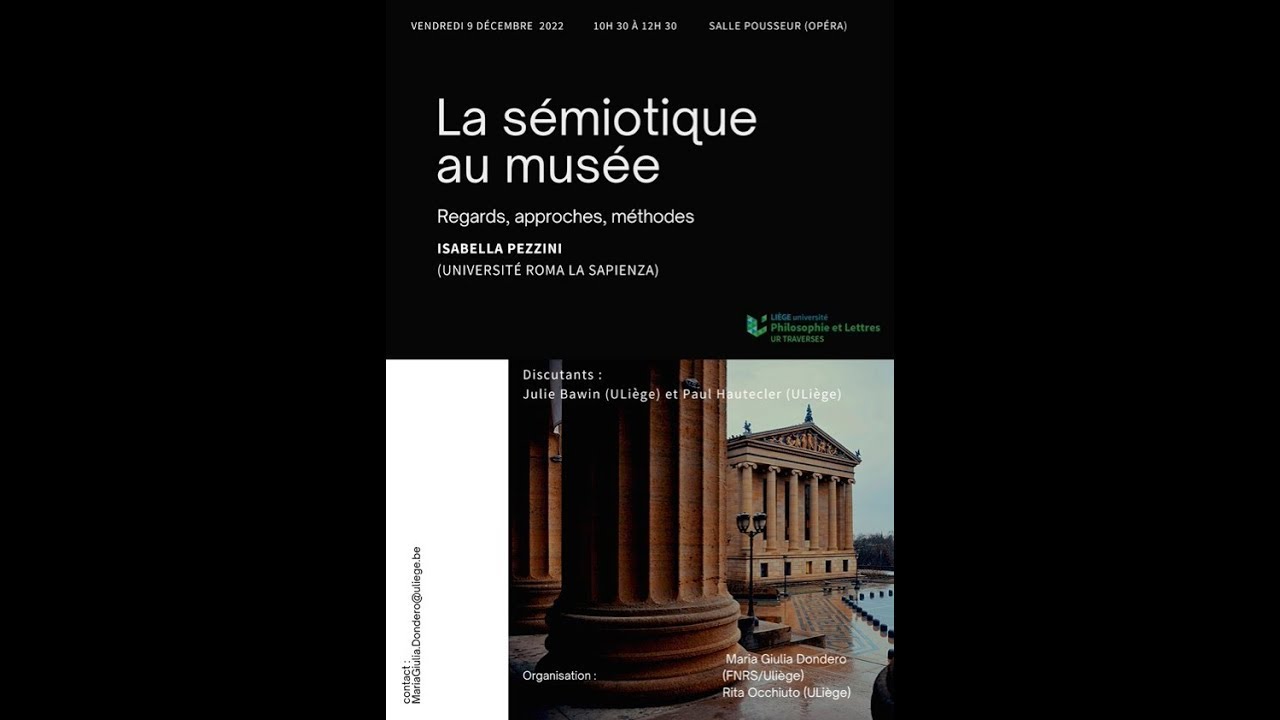
Conférence d'Isabella Pezzini (Université La Sapienza, Rome) à l'ULiège, 9/12/2022
Conference by Isabella Pezzini (Sapienza University, Rome) at ULiège, 9/12/2022
Keywords
Summary
161 words
Critical Evaluation
Value of the Information & Strength of the Argument
The lecture is highly valuable for scholars in semiotics, museum studies, and cultural analysis. Pezzini offers a rigorous argumentation that builds on established theoretical frameworks while introducing original insights. Her typology of museums is a significant contribution, providing a structured way to analyze spatial and narrative configurations. She effectively demonstrates the applicability of semiotic methods to real-world examples, making the argumentation both theoretical and empirical. The discussion of visitor behavior and ethnosemiotics adds practical dimensions, though the argumentation remains primarily theoretical and may require familiarity with semiotic terminology to fully appreciate.
Scientific Rigor, Source Quality, Title Accuracy
Pezzini demonstrates meticulous scientific rigor through extensive references to key figures in semiotics (Greimas, Lotman, Fontanille) and philosophy (Foucault). She also cites her own book, ‘Sémiotique des nouveaux musées’, as a foundation. The sources are used accurately and serve to substantiate her arguments. The title ‘Conférence d’Isabella Pezzini’ is appropriately descriptive, accurately reflecting the content and format. The lecture stays on topic, consistently addressing semiotic analysis of museums. The overall scientific quality is high, with clear methodological explanations and critical engagement with existing literature.
190 words
Title / Content Match
The title accurately describes the content as a conference presentation by Isabella Pezzini at ULiège, consistent with the academic nature of the lecture.
Quality & Reliability
9/10
The lecture is delivered by a renowned semiotics professor, featuring precise references and a well-structured argumentation. The content is grounded in established semiotic theory and original research.
Key Moments
Markers derived by PSI from the transcript: the creator did not define chapters.
- Isabella Pezzini begins her lecture, thanking the organizers and introducing her book on the semiotics of new museums.
- Pezzini reviews existing semiotic studies on museums, referencing Greimas, Lotman, and Foucault's concept of heterotopia.
- She presents her typology of museums, contrasting traditional galleries and modern open-plan spaces, with examples from museums worldwide.
- Pezzini analyzes the Centrale Montemartini in Rome, illustrating how industrial heritage is re-appropriated as a museum space.
- She discusses ethnosemiotic studies, including research on visitor behavior at an exhibition, introducing a typology of visitor movements.
- Pezzini concludes with reflections on the evolution of museums, current challenges, and future research directions in semiotics.
Cited Sources
- Sémiotique des nouveaux musées — Pezzini's own book, cited as the foundation of her analysis of museum spaces.
- De l'imperfection — Mentioned as a key reference for Greimas's semiotic theory on the constitution of meaning.
- Des espaces autres — Foucault's concept of heterotopia, used to describe museums as privileged spaces in modernity.
Contribution & Novelties
Pezzini’s contribution lies in adapting the semiotic framework of Greimas and Lotman to analyze museums as complex texts. She introduces a novel typology that distinguishes traditional and modern museum architectures based on spatial configurations and visitor pathways. Her emphasis on ethnosemiotics—combining spatial analysis with empirical observation—offers a methodological innovation for museum studies. Additionally, she highlights the contemporary trend of converting industrial sites into museums, as exemplified by the Centrale Montemartini, and discusses the implications for visitor experience.
Pour aller plus loin :
- Semiotics — Foundational discipline for understanding meaning-making in museums.
- Heterotopia (space) — Foucault’s concept relevant to museum spaces as ‘other places’.
- Museum studies — Academic field that integrates semiotic, historical, and sociological perspectives.
- Greimas — Semiotician whose narrative and structural theories underpin the lecture’s approach.
127 words
Radar Profile
The profile shows very high scores across all dimensions, with slightly lower score for technical level (8/10) compared to others, indicating the content is dense and requires some background in semiotics but remains accessible. The global reliability and information quality are particularly strong.