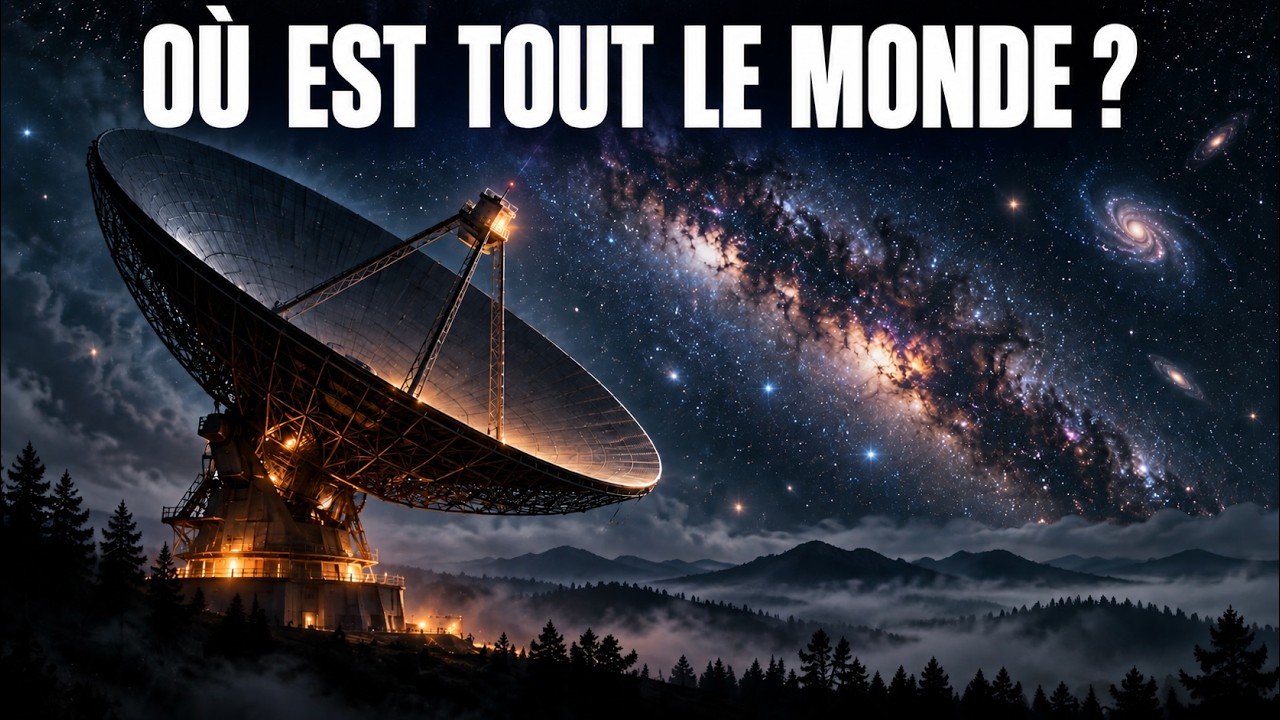
Le Grand Silence : pourquoi l’Univers semble si terriblement vide
The Great Silence: Why the Universe Seems So Terribly Empty
Keywords
Summary
222 words
Critical Evaluation
Value of the Information & Strength of the Argument
The video provides a compelling and cohesive synthesis of major scientific hypotheses, effectively explaining complex concepts like the Drake equation, the Great Filter, and the Rare Earth hypothesis in accessible terms. The argumentation is structured logically, moving from statistical probabilities to specific biological hurdles and astronomical conditions, supporting each point with historical references and known research. However, the value is limited by a lack of in-depth critique or alternative viewpoints; the narrative leans heavily on a singular interpretation, presenting the Rare Earth hypothesis as more established than it might be. Despite this, the video excels in framing the paradox and offering a comprehensive overview, which serves as an excellent primer for those unfamiliar with the field.
Scientific Rigor, Source Quality, Title Accuracy
The scientific rigor is moderate: the video correctly attributes hypotheses to their originators (e.g., Drake equation to Frank Drake, Fermi paradox to Enrico Fermi, Great Filter to Robin Hanson, Rare Earth to Ward & Brownlee) and uses plausible astronomical data (e.g., number of galaxies, Kepler results). However, it does not provide direct citations to peer-reviewed papers or detailed evidence, relying instead on generally accepted facts and dramatic narrative. The title accurately reflects the content, which is focused on the existential mystery of the universe’s apparent emptiness, and the content aligns well with the title’s promise. The video maintains a storytelling tone rather than a strict documentary analysis, which, while engaging, slightly dilutes its scientific rigor.
246 words
Title / Content Match
The title accurately reflects the content, which centers on the Fermi paradox and the apparent emptiness of the universe.
Quality & Reliability
7/10
The video presents a well-structured overview of established scientific concepts (Fermi paradox, Drake equation, Great Filter, Rare Earth hypothesis) with accurate citations of researchers and theories. However, it lacks rigorous source references and relies heavily on narrative speculation, reducing its scientific depth.
Chapters
- L'immensité terrifiante de l'univers et le Grand Silence
- L'équation de Drake et le paradoxe de Fermi
- Le Grand Filtre et l'hypothèse de la Terre Rare
- La Terre : une forteresse astronomique improbable
- L'autodestruction, l'IA et les menaces existentielles
- Nos instruments sont-ils simplement sourds ?
- La Forêt Sombre, le Zoo cosmique et la transcension
- La traque des biosignatures : un nouvel espoir
Cited Sources
- Drake equation — Mentioned as a framework to estimate the number of communicative civilizations.
- Fermi paradox — Core concept introduced via Enrico Fermi's question 'Where is everybody?'.
- Great Filter — Robin Hanson's concept of an evolutionary barrier preventing advanced civilizations.
- Rare Earth hypothesis — Peter Ward and Donald Brownlee's idea that complex life requires a unique set of circumstances.
- Endosymbiotic theory — Discussed as a critical, improbable step in the evolution of complex cells.
Concurring Sources
- Fermi paradox - Scientific literature — Supports the video's explanation of the paradox and its various resolutions.
- Drake equation - Senior discussions — Reinforces the video's description of parameters and how they have been constrained by observations.
Dissenting Sources
- Rare Earth hypothesis counterarguments — Some scientists argue that the step leading to complex life might be less improbable than the hypothesis suggests, presenting a less bleak view of cosmic abundance.
Contribution & Novelties
This video synthesizes well-known concepts into a cohesive narrative, making the Fermi paradox accessible to lay audiences. It adds value by connecting disparate ideas—from planetary geology to evolutionary biology—to illustrate why intelligent life might be extremely rare. Its contribution lies in its educational and engaging presentation, rather than presenting new scientific data.
Pour aller plus loin :
- Fermi paradox - Wikipedia — Comprehensive overview of proposed solutions and counterarguments.
- Drake equation - Wikipedia — Detailed breakdown of parameters and their estimated values.
- Rare Earth hypothesis - Wikipedia — Explains the geological and biological arguments for Earth’s uniqueness.
- Great Filter - Wikipedia — Discusses the implications and possible locations of the filter.
- Search for extraterrestrial intelligence (SETI) — Current efforts to detect signals from other civilizations, relevant to the video’s conclusion.
130 words
Radar Profile
The radar profile shows strong scores in quantity of information and global reliability, indicating a dense and generally trustworthy presentation. The lower score in technical level reflects its outreach focus rather than deep mathematical or observational detail, balancing accessibility with comprehensiveness.