QEC and Quantum Information Theory: Lecture 14 Stabilizer Codes (1)
Keywords
Summary
209 words
Critical Evaluation
Value of the Information & Strength of the Argument
The lecture provides substantial value by systematically developing the stabilizer formalism from first principles, using concrete examples to bridge abstract definitions and practical code constructions. The argumentation is rigorous: each step is justified, and the transition from code space to stabilizer group and back is demonstrated explicitly. The three-qubit bit-flip code serves as a simple, fully worked example that clarifies the mechanics of stabilizer generators and the recovery of the code space via common +1 eigenspaces. The extension to the nine-qubit Shor code illustrates how the formalism scales and how concatenated code structures manifest in the stabilizer language. The speaker carefully distinguishes between the full stabilizer group and its generators, and explains why the number of independent generators determines the code space dimension. The reasoning is self-contained and avoids hand-waving, making the material accessible to students with the prerequisite background. The only limitation is the lack of formal proofs for some general statements, which are deferred to later lectures, but this is appropriate for the pedagogical context.
Scientific Rigor, Source Quality, Title Accuracy
The lecture is highly rigorous, adhering to standard definitions and theorems in quantum error correction. The mathematical derivations are correct and well-structured, with no apparent errors or oversimplifications. Sources are not explicitly cited in the transcript, but the content aligns with canonical textbooks such as Nielsen & Chuang and Gottesman’s thesis. The title accurately reflects the content: it is the first part of a lecture on stabilizer codes, and the material covers the foundational aspects as expected. No misleading claims or exaggerated promises are made. The absence of a formal bibliography is typical for a lecture recording, and the reliance on established results ensures high reliability.
288 words
Title / Content Match
The title accurately reflects the content: the lecture is the first part of a two-part series on stabilizer codes within a quantum error correction course.
Quality & Reliability
9/10
The lecture is delivered by an academic expert (Prabha Mandayam, IIT Madras) and presents standard, well-established material in quantum error correction. The derivations are rigorous, self-contained, and consistent with the canonical stabilizer formalism. No unsupported claims or speculative content are present.
Key Moments
Markers derived by PSI from the transcript: the creator did not define chapters.
- Introduction to the stabilizer framework and its association with quantum error-correcting codes.
- Definition of the Pauli group on n qubits and its role in the stabilizer formalism.
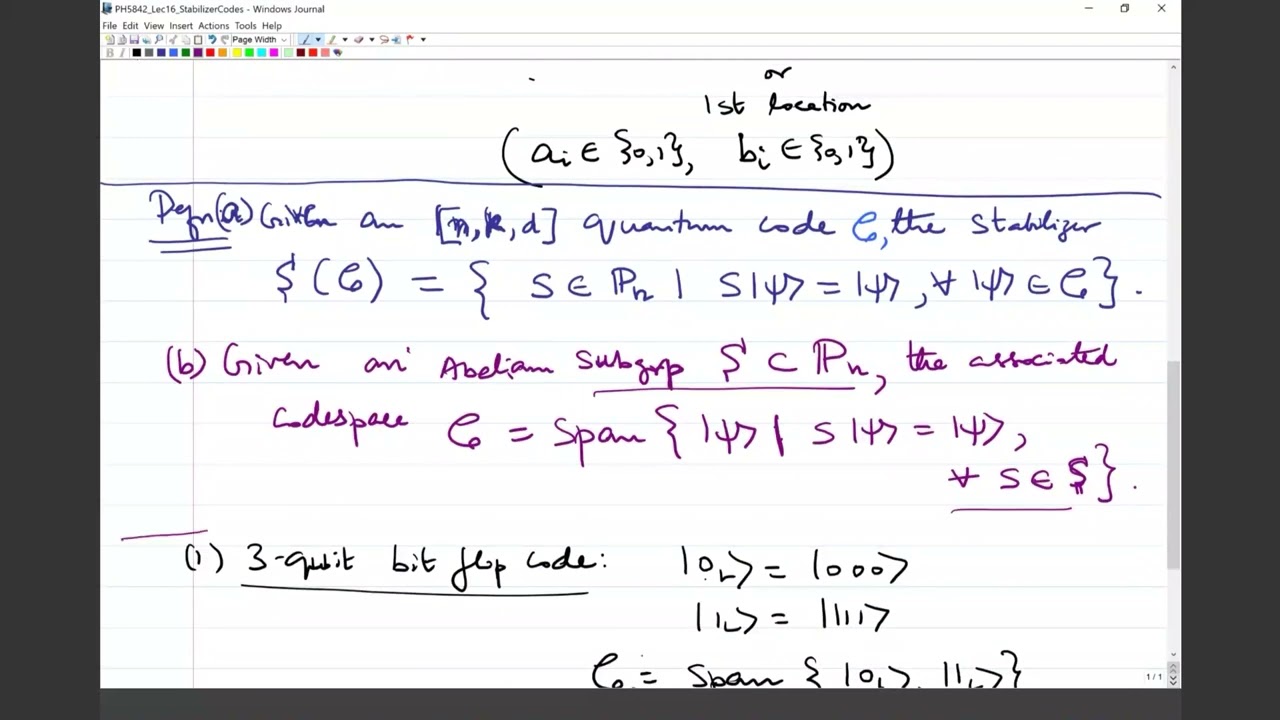
- Recap of the three-qubit bit-flip code and its code words.
- Derivation of the stabilizer group for the three-qubit bit-flip code: generators Z1Z2 and Z2Z3.
- Construction of the code space as the common +1 eigenspace of the stabilizer generators.
- Illustration of how each independent generator halves the dimension of the code space.
- Introduction to the nine-qubit Shor code and its stabilizer generators.
- Identification of the eight independent stabilizer generators for the Shor code.
- Discussion of the general relation: an [[n,k,d]] code has n−k independent stabilizer generators.
- Properties of the stabilizer group: abelian, contains identity, excludes minus identity.
Contribution & Novelties
This lecture does not present new research but offers a clear, pedagogical synthesis of the stabilizer formalism, bridging abstract definitions with concrete examples. It reinforces the connection between code spaces and stabilizer groups, and demonstrates the construction of stabilizer codes for both the three-qubit bit-flip code and the nine-qubit Shor code. The step-by-step derivation of the code space as a common +1 eigenspace is particularly instructive for learners.
Pour aller plus loin :
- Stabilizer code — Wikipedia article providing an overview of stabilizer codes and their properties.
- Quantum error correction — General introduction to quantum error correction, including the Shor code.
- Daniel Gottesman’s thesis — Foundational work on stabilizer codes and the Heisenberg representation.
- Michael Nielsen and Isaac Chuang, Quantum Computation and Quantum Information — Standard textbook covering stabilizer codes in detail.
132 words
Radar Profile
The radar profile shows high scores in information quantity, quality, technical level, and overall reliability, reflecting the lecture's rigorous and comprehensive treatment of stabilizer codes. The balance across dimensions indicates a well-structured educational content with strong theoretical foundations.