Quantum Computation and Quantum Information: Lecture 31 (Universality and Complexity)
Keywords
Summary
119 words
Critical Evaluation
Value of the Information & Strength of the Argument
The lecture provides solid mathematical foundations for the universality of quantum gates, clearly motivating the need for approximation and introducing a rigorous error measure. The argumentation is coherent, progressing from exact to approximate universality, and the instructor does not shy away from explaining the operational significance of the error function. The presentation of quantum algorithms is brief but sets the stage for subsequent topics. The lecture’s value lies in its pedagogical clarity and the emphasis on understanding the underlying principles.
Scientific Rigor, Source Quality, Title Accuracy
The instructor relies on the standard reference work by Nielsen and Chuang and explicitly mentions the Solovay-Kitaev theorem. The lecture is faithful to the topic announced in the title, covering universality and providing a glimpse into complexity aspects. The reasoning is rigorous, though some proof details are delegated to the textbook. The title–content alignment is perfect, with no misleading elements.
155 words
Title / Content Match
The title exactly matches the content, covering universality and touching on complexity.
Quality & Reliability
8/10
The lecture is well-structured and based on the standard textbook by Nielsen and Chuang. The instructor provides rigorous definitions and clear explanations, with appropriate references for further study. Minor omissions of proofs are compensated by references.
Key Moments
Markers derived by PSI from the transcript: the creator did not define chapters.
- Administrative announcements and assignment details (assignment 3, IBM Q access).
- Recap of universal gate sets: Hadamard, phase, T, CNOT, and Toffoli.
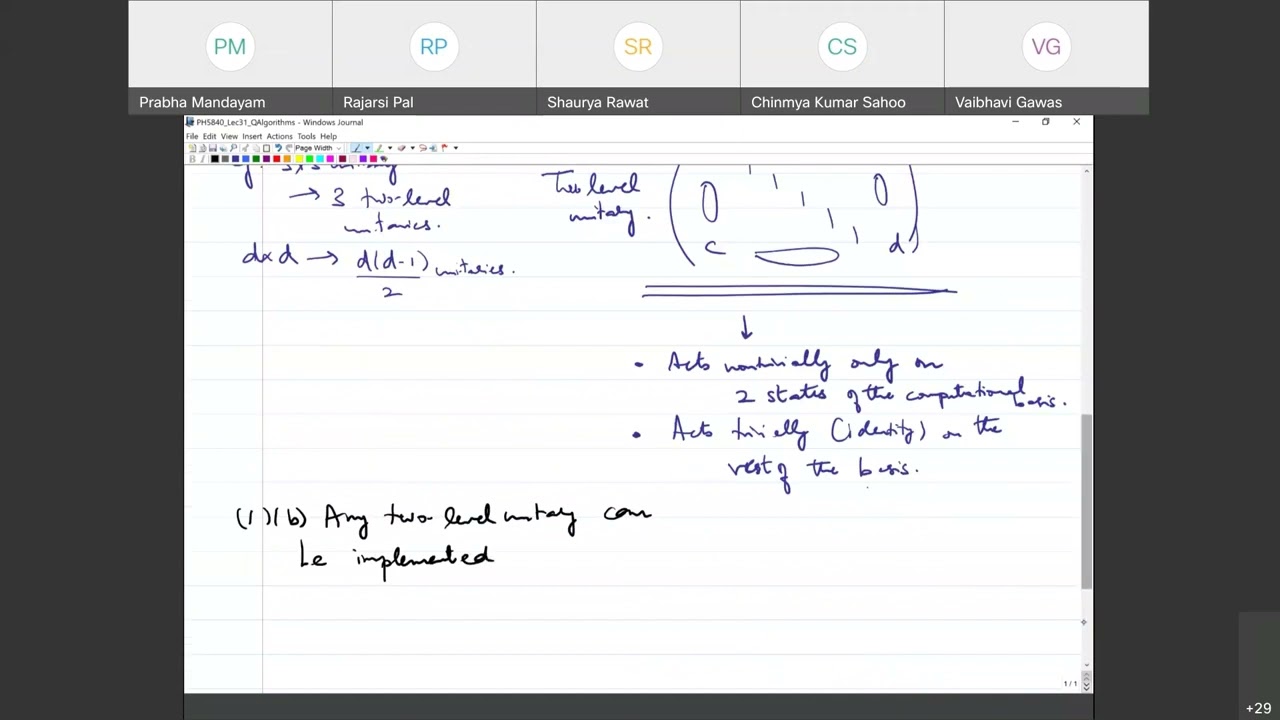
- Decomposition of arbitrary unitary into two-level unitaries.
- Example of a three-qubit unitary acting non-trivially on |000> and |111> and its circuit implementation.
- Approximate universality and definition of the error function E(U,V).
- Operational bound on measurement probabilities using the error function.
- Mention of the Solovay-Kitaev theorem and recommended reading (Nielsen & Chuang).
- Introduction to two broad classes of quantum algorithms: oracle-based and quantum Fourier transform based.
Cited Sources
- Quantum Computation and Quantum Information — The instructor repeatedly refers to this textbook (Nielsen & Chuang) for proofs and further reading.
Contribution & Novelties
The lecture does not present original research but offers a self-contained exposition of deep results in quantum computation, making them accessible to students. It bridges the gap between abstract universality proofs and practical error measures. The introduction of the error metric is particularly useful for understanding approximation quality.
Pour aller plus loin :
- Solovay–Kitaev theorem — Provides the efficient approximation of quantum gates.
- Quantum Fourier transform — Core component of many quantum algorithms, mentioned in the lecture.
- Quantum algorithm — Overview of the two classes of algorithms discussed.
88 words
Radar Profile
The radar profile shows a lecture with very high technical depth (9/10) and substantial information content (8/10), but slightly lower on quality (7/10) and reliability (8/10), indicating a thoroughly technical session suitable for advanced students.