QEC and Quantum Information Theory: Lecture 6 The Choi-Kraus-Sudarshan representation
Keywords
Summary
164 words
Critical Evaluation
Value of the Information & Strength of the Argument
The value of this lecture lies in its careful exposition of a core topic in quantum information theory. The argumentation is solid: the instructor logically builds from the physical motivation of the amplitude damping channel to its mathematical description, then uses it to illustrate general principles like non-unitality and fixed points. The non-uniqueness of Kraus representations is demonstrated concretely with worked examples, and the general theorem is stated and proved in a clear manner. The lecturer emphasizes the conceptual implications for error correction, tying the mathematics to practical concerns. The treatment is thorough and pedagogically effective, though it requires a solid background in quantum mechanics to follow fully.
Scientific Rigor, Source Quality, Title Accuracy
The lecture is rigorous, relying on standard textbook material, explicitly referencing Nielsen and Chuang’s ‘Quantum Computation and Quantum Information’ (Chapter 8). The presentation adheres to conventional formalisms and includes mathematical derivations. The title ‘QEC and Quantum Information Theory: Lecture 6 The Choi-Kraus-Sudarshan representation’ is well-matched to the content; the lecture indeed concentrates on the Choi-Kraus-Sudarshan representation, which is another name for the operator-sum representation. No additional external sources are cited in the video or description, but the course context is provided. The soundness of the content is high, consistent with established literature.
215 words
Title / Content Match
The title accurately reflects the lecture's focus on the Choi-Kraus-Sudarshan representation, which is central to the presented material.
Quality & Reliability
8/10
The lecture provides a rigorous mathematical treatment of quantum channels, with clear derivation of the amplitude damping channel and the non-uniqueness of Kraus representations, based on standard textbook material.
Key Moments
Markers derived by PSI from the transcript: the creator did not define chapters.
- Introduction to single-qubit channels and recap of previous lectures.
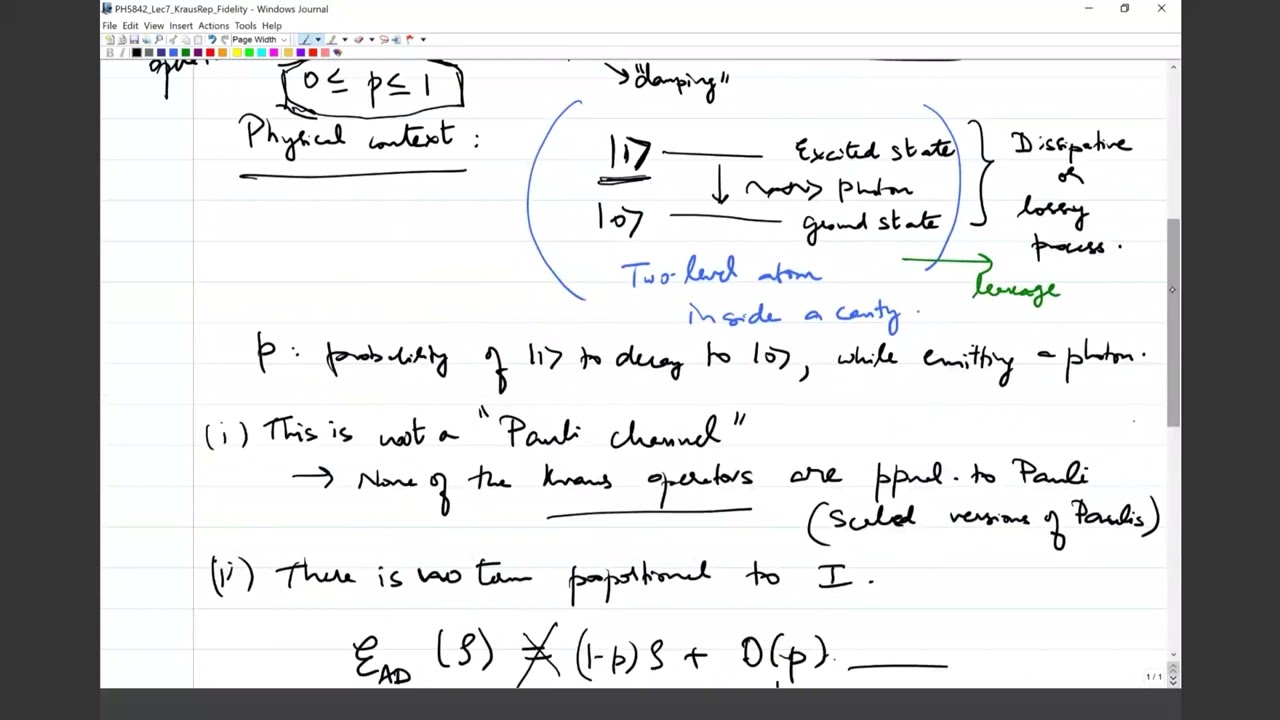
- Definition of amplitude damping channel: Kraus operators E0 and E1 and physical interpretation with a two-level atom.
- Discussion of non-unital nature of amplitude damping, fixed point at |0>, and absence of identity in Kraus representation.
- Bloch sphere dynamics, flow to the fixed point, and introduction of T1 coherence time.
- Demonstration of non-uniqueness of Kraus representation via equivalent representations of phase flip channel.
- Statement of the general theorem: any two Kraus representations of the same channel are related by a unitary matrix.
Cited Sources
- Quantum Computation and Quantum Information — Reference text for the course, Chapter 8 discusses quantum channels and Kraus representation.
Concurring Sources
- Quantum Computation and Quantum Information (Nielsen & Chuang) — Standard reference that agrees with the lecture's treatment of quantum channels and Kraus representations.
Contribution & Novelties
The lecture’s contribution lies in its clear pedagogical presentation of how quantum channels, especially non-unital ones, are represented and analyzed. It bridges physical intuition with mathematical formalism, showing how the same channel can be expressed with different Kraus operators and why this freedom matters for error correction. The instructor also connects to advanced concepts like dynamical semigroups and T1/T2 times.
Pour aller plus loin :
- Completely positive map — This concept underpins the definition of quantum channels and the Choi-Kraus-Sudarshan representation.
- Quantum channel (Kraus operators) — Provides the general framework for the operator-sum representation discussed in the lecture.
- Amplitude damping channel — Gives more detail on the specific channel examined in the lecture, including its physical models and applications.
119 words
Radar Profile
The radar profile is strongly balanced with high scores on technical level and information quantity, indicating a dense and advanced lecture. Qualitative quality and global reliability are slightly lower but still high, reflecting the reliance on established textbook material. This suggests a highly informative but demanding resource.