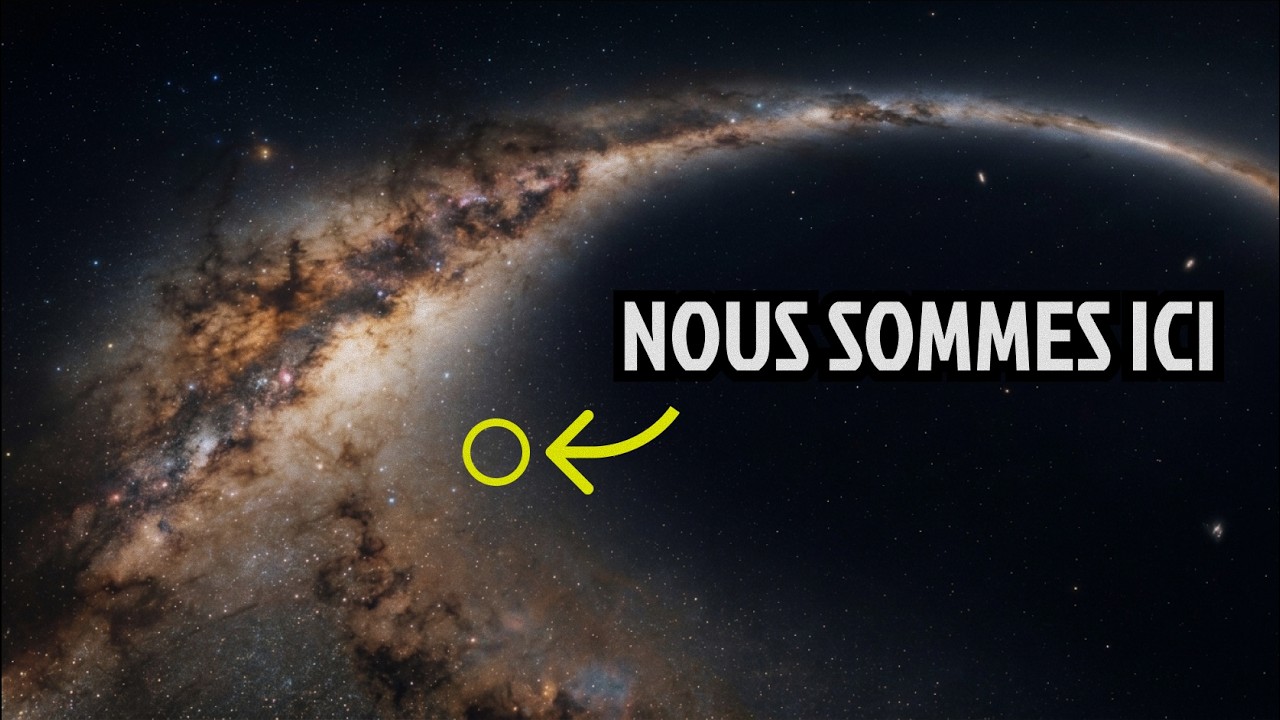
La Véritable Taille du Bras d’Orion… Et À Quel Point Nous Sommes Petits
The True Size of Orion's Arm... And How Small We Are
Keywords
Summary
173 words
Critical Evaluation
Value of the Information & Strength of the Argument
The video’s value lies in its careful use of concrete numbers and analogies to convey immense distances, such as comparing the travel time of Voyager 1 across the Orion Arm to the entire history of animal life on Earth. It argues that the Orion Arm, though not a major arm, is a substantial structure with active star formation, and presents the evidence for this from recent astrometric data. The reasoning is logical and builds progressively from defining the arm’s location to exploring its contents, then to the larger context of galactic evolution. The argumentation is solid, distinguishing between established facts (e.g., GAIA measurements) and speculative hypotheses (e.g., correlations with cometary impacts), and it avoids overstatement, making the science reliable.
Scientific Rigor, Source Quality, Title Accuracy
The scientific rigor is high: the video references the GAIA mission, Spitzer and JWST telescopes, and a specific Nature paper published in 2022, indicating reliance on peer-reviewed research. It uses appropriate terminology and clearly separates observational data from interpretation. The title is faithful to the content, although the phrase ’et à quel point nous sommes petits’ (and how small we are) is a rhetorical framing that the video supports through immersive scale comparisons. The only minor weakness is the lack of explicit citations or links in the description, which would strengthen traceability, but the content itself is consistent with current astronomical knowledge.
236 words
Title / Content Match
The title accurately reflects the content, which extensively details the Orion Arm's scale, structure, and implications for our place in the galaxy.
Quality & Reliability
8/10
The video synthesizes well-established astronomical knowledge, referencing recent high-impact studies (2022 Nature paper on the Local Bubble) and major missions (GAIA, Spitzer, JWST). The scientific content is accurate and up-to-date, with clear distinctions between established facts and hypotheses.
Key Moments
Markers derived by PSI from the transcript: the creator did not define chapters.
- Introduction: no external photograph of the Milky Way exists; we live in the Orion Arm, a smaller structure between the Perseus and Sagittarius arms.
- Scale of the Orion Arm: definition of light-year and travel times; crossing it at Voyager 1 speed would take 4.5 million years.
- Stellar population: from red dwarfs to massive supergiants like Eta Carinae, which may explode as a hypernova in the near future.
- The Local Bubble: a cavity formed by ancient supernovae, with the 2022 Nature study showing that nearby star-forming regions lie on its surface.
- Mapping the Milky Way from inside: radio telescopes (21-cm hydrogen) and the GAIA mission's astrometric revolution.
Cited Sources
- GAIA mission – European Space Agency — Cited as the astrometric mission that revised the Orion Arm's length and structure.
- Spitzer Space Telescope Legacy — Mentioned for infrared surveys of the Milky Way that mapped spiral arms.
- James Webb Space Telescope (Webb Telescope) — Used to observe star-forming regions like the Orion Nebula in detail.
- Voyager mission – NASA JPL — Voyager 1 is described as the fastest human-made object leaving the Solar System, used to illustrate travel times across the Orion Arm.
Concurring Sources
- GAIA mission – European Space Agency — Supports the revised structure and extent of the Orion Arm.
- Spitzer Space Telescope Legacy — Confirms the presence of four main spiral arms and the Orino Arm as a spur.
Contribution & Novelties
The video provides a unique narrative that connects the precise, updated measurements of the Orion Arm’s size to deep historical and physical context, emphasizing that we live in a dynamic, evolving structure rather than a static region. It also highlights the surprising discovery that the Sun sits inside a bubble of hot gas created by ancient supernovae, and that this bubble has triggered nearby star formation. This perspective enriches public understanding of galactic architecture.
Pour aller plus loin :
- Orion Arm (Wikipedia) — Overview of the structure, including its revised length and location.
- Local Bubble (Wikipedia) — Details on the cavity’s discovery, properties, and origin from supernovae.
- Density wave theory (Wikipedia) — Explains the nature of spiral arms as waves of density, supporting the video’s ’traffic jam’ analogy.
128 words
Radar Profile
The profile shows high scores in information quantity and scientific reliability, with a medium level of technical depth, indicating a balanced but detailed explanatory video. The low technical level score relative to others suggests it is accessible to a general audience while still being scientifically sound.