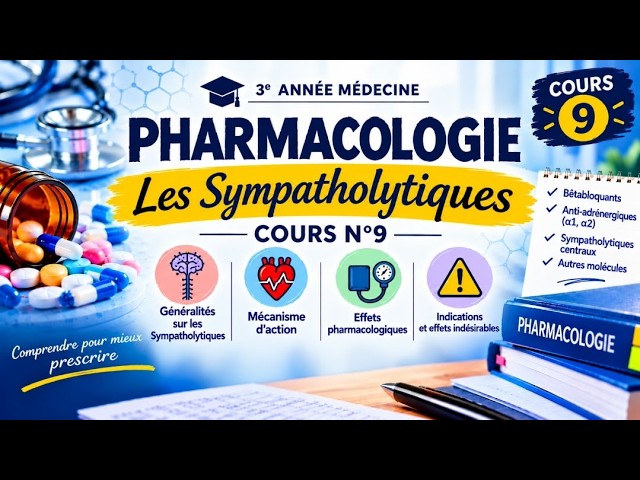
LES SYMPATHO-LYTIQUES
SYMPATHOLYTIC DRUGS
Title history
- LES SYMPATHO-LYTIQUES — observed on 20261120-2340 UTC (YouTube)
Keywords
Summary
130 words
Critical Evaluation
Value of the Information & Strength of the Argument
The information provided is highly valuable for medical education, as it systematically covers the major classes of sympatholytics, their pharmacodynamics, and therapeutic uses. The argumentation is solid, rooted in well-established physiological and pharmacological principles. The instructor effectively links receptor subtypes (alpha-1, alpha-2, beta-1, beta-2) to specific clinical outcomes, which strengthens the explanatory framework. However, the argumentation could have been reinforced by referencing clinical trials or guideline recommendations. The discussion of side effects and drug interactions adds practical depth, but the lack of concrete dosing information reduces its direct applicability.
Scientific Rigor, Source Quality, Title Accuracy
The scientific rigor is moderate: the content aligns with standard pharmacological knowledge, but no external sources or references are provided in the description. The presentation is logically structured, starting with basic receptor physiology and progressing to drug classes and clinical scenarios. The title exactly reflects the content, which is entirely devoted to sympatholytic drugs. The absence of citations makes independent verification difficult, yet the overall accuracy appears reliable based on the coherent and systematic explanation of mechanisms and indications. No comments were provided for analysis.
189 words
Title / Content Match
The title perfectly matches the content, which is exclusively about sympatholytic drugs and their clinical applications.
Quality & Reliability
8/10
The lecture provides a detailed and accurate overview of sympatholytics, consistent with standard medical education. However, it lacks explicit citations and uses a conversational style that may be less rigorous than formal textbooks.
Key Moments
Markers derived by PSI from the transcript: the creator did not define chapters.
- Recap of the sympathetic nervous system and adrenergic receptors.
- Introduction to sympatholytics and classification into alpha-blockers and beta-blockers.
- Alpha-blockers: mechanism, examples (phentolamine, prazosin), and clinical uses.
- Beta-blockers: mechanism, examples (propranolol, metoprolol), and cardiovascular indications.
- Side effects and contraindications (asthma, diabetes) of beta-blockers.
- Management of pheochromocytoma and hypertensive crises using alpha-blockers.
- Drug interactions and practical prescribing tips.
Contribution & Novelties
The main contribution of this video is its clear and comprehensive explanation of sympatholytics, bridging molecular mechanisms and clinical practice. It offers a valuable review for medical students, with a pedagogical approach that prioritizes understanding over rote memorization. The session covers a wide range of agents, including both selective and non-selective blockers, and addresses practical concerns such as contraindications and drug interactions.
Pour aller plus loin :
- Beta blocker - Wikipedia — To explore the detailed pharmacology and clinical use of beta-blockers.
- Alpha blocker - Wikipedia — For an overview of alpha-blockers, their subtypes, and therapeutic applications.
- Adrenergic receptor - Wikipedia — To review the physiological roles of alpha and beta receptors.
112 words
Radar Profile
The radar profile indicates a strong supply of information and a high technical level, while the overall reliability is solid but not perfect, reflecting the absence of explicit citations. The balance between quantity and quality suggests a well-structured educational resource, though slight improvements in sourcing could elevate its credibility.